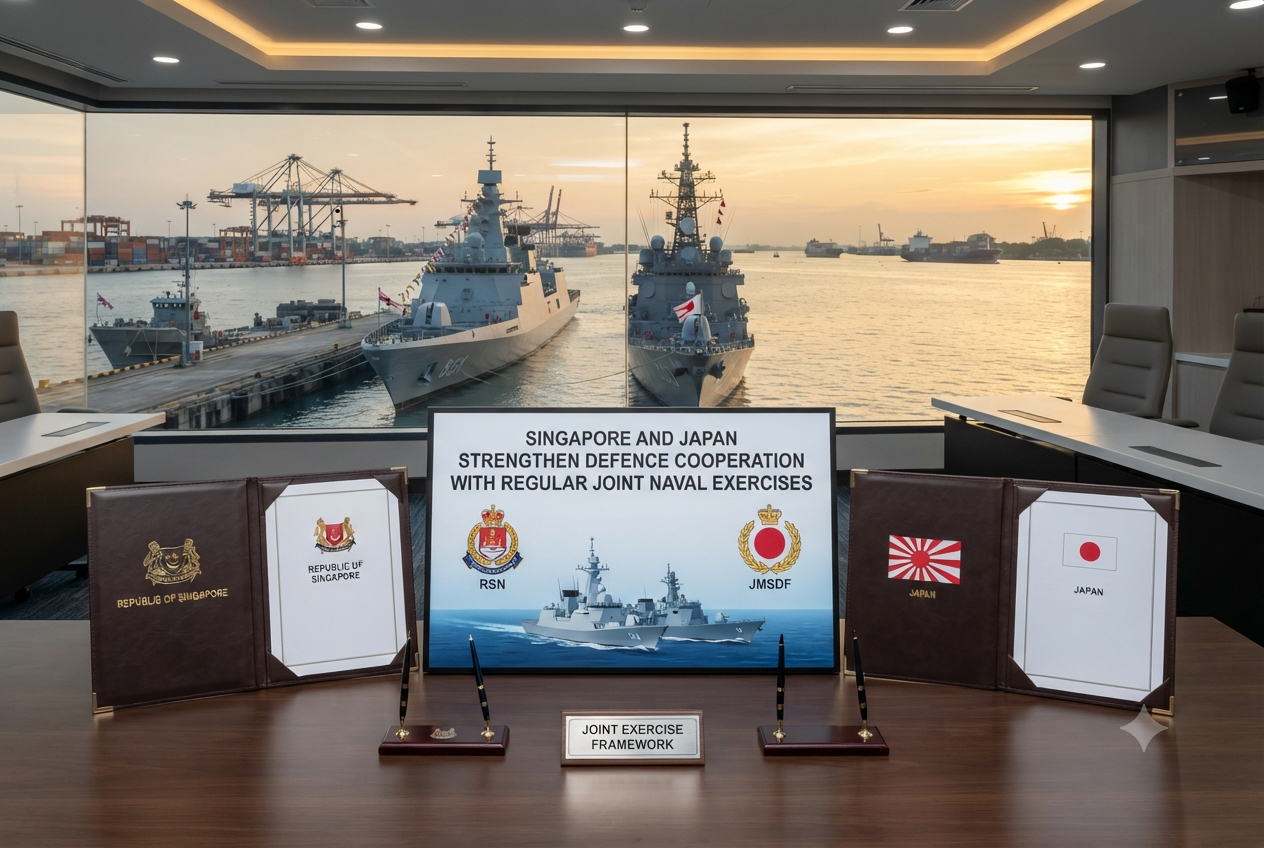
Singapore and Japan have agreed to strengthen their defence partnership by conducting regular joint naval exercises, expanding maritime security cooperation and exploring new areas of military collaboration. The agreement marks an important development in bilateral relations as both countries seek to contribute to regional peace, protect vital sea routes and respond to an increasingly complex security environment.
The decision was confirmed during a meeting between Singapore’s Minister for Defence Chan Chun Sing and Japan’s Minister of Defense Koizumi Shinjiro in Tokyo on 25 November 2026. The discussions focused on strengthening naval cooperation, improving information sharing and expanding practical engagement between the two countries’ armed forces.
The announcement comes during the 60th anniversary of diplomatic relations between Singapore and Japan and follows the establishment of their Strategic Partnership in March 2026.
Regular Naval Exercises to Strengthen Maritime Security
One of the key outcomes of the meeting was the agreement to further develop Exercise SINGAPAN, the first bilateral naval exercise between the Republic of Singapore Navy (RSN) and the Japan Maritime Self-Defense Force (JMSDF).
Both governments have agreed to conduct the exercise regularly, creating more opportunities for naval personnel to train together, exchange operational knowledge and improve coordination.
The first edition of Exercise SINGAPAN took place in August 2026 in the waters off Japan in the Pacific Ocean. It involved Singapore’s Formidable-class frigate RSS Steadfast and Japanese naval vessels JS Hamagiri and JS Teruzuki.
The exercise included conventional naval warfare drills, communication activities, gunnery exercises, ship manoeuvres and personnel exchanges. Naval officers also participated in planning activities and visited each other’s vessels.
Regular exercises are expected to strengthen professional relationships and improve the ability of both navies to cooperate during maritime operations.
Submarine Rescue Cooperation Under Consideration
Beyond conventional naval exercises, Singapore and Japan are also considering the possibility of conducting submarine rescue exercises.
Submarine rescue operations require specialised equipment, trained personnel and close coordination between naval forces. In an emergency involving a submarine, the ability to mobilise assistance quickly and work effectively with international partners can be critical.
Exploring joint rescue exercises could provide both countries with opportunities to exchange technical expertise, understand operational procedures and improve emergency-response coordination.
The discussions also reflect a broader effort to expand defence cooperation beyond traditional naval activities and address practical challenges faced by modern armed forces.
Protecting Important Sea Lanes
Maritime security is a major shared interest for Singapore and Japan. Both countries depend heavily on international shipping routes for energy supplies, industrial materials, manufactured goods and other essential trade.
Singapore occupies a strategic position near the Strait of Malacca and Singapore Strait, two important waterways connecting the Indian Ocean and the South China Sea. Japan, meanwhile, relies on secure maritime routes for its international trade and energy imports.
Disruptions to major shipping corridors can affect transportation costs, supply chains, energy security and international business confidence.
During their meeting, both defence ministers reaffirmed the importance of open sea lanes and agreed to strengthen information sharing and cooperation between their naval services.
Their approach highlights the connection between maritime security and economic stability. Protecting international shipping routes is not only a defence priority but also an important requirement for maintaining regional and global trade.
Broader Defence Partnership Beyond Naval Exercises
The latest agreement forms part of a wider effort to deepen cooperation between Singapore and Japan.
The two countries have already expanded defence exchanges through reciprocal military visits, professional engagements and discussions on defence technology.
Their November meeting also covered cooperation between their armies, including chemical, biological, radiological and nuclear (CBRN) expertise. The ministers welcomed plans for a Japan-ASEAN tabletop exercise in Singapore in December 2026 and further exchanges between the Singapore Army and Japan Ground Self-Defense Force.
Singapore also invited Japanese special operations personnel to visit SAFTI City, its next-generation urban military training facility. Both sides agreed to work towards arranging the visit.
The countries also discussed opportunities to use technology to address shared manpower challenges, including labour-saving and unmanned solutions.
These initiatives indicate that the relationship is developing across several areas of defence activity rather than being limited to naval cooperation.
Singapore-Japan Strategic Partnership Gains Momentum
The strengthening of defence ties comes as Singapore and Japan mark six decades of diplomatic relations.
In March 2026, both countries established a Strategic Partnership designed to deepen cooperation across areas of mutual interest, including security, economic relations, technology and regional engagement.
Defence cooperation has become an important component of this relationship. The two governments have maintained regular high-level discussions and increased exchanges between their military leadership.
The 2023 Agreement concerning the Transfer of Defense Equipment and Technology has also provided a framework for expanding cooperation in defence-related technology.
Both countries have agreed to hold the second Japan-Singapore Defence Industry Day alongside DSEI Japan in April 2027, creating another opportunity to discuss equipment, technology and industrial collaboration.
Singapore is also preparing to assume the ASEAN chairmanship in 2027. Its discussions with Japan include cooperation through ASEAN-led security frameworks, particularly the ASEAN Defence Ministers’ Meeting-Plus (ADMM-Plus).
The Worldonomics Times View
The Worldonomics Times believes that the Singapore-Japan defence agreement reflects the growing importance of practical security cooperation in the Indo-Pacific region.
Regular naval exercises can improve communication, operational understanding and coordination between the two countries. Such cooperation is particularly relevant for nations whose economies depend on uninterrupted maritime trade.
However, stronger defence engagement should also be accompanied by diplomatic dialogue and support for regional institutions. Maritime security requires cooperation among neighbouring countries and major trading partners, not only bilateral military arrangements.
Singapore and Japan have an opportunity to contribute through professional military exchanges, information sharing, emergency-response cooperation and support for ASEAN-led security platforms.
The focus on submarine rescue, defence technology and unmanned systems also demonstrates that modern defence partnerships increasingly depend on technical expertise and innovation.
Ultimately, the value of this partnership will be measured not simply by the frequency of military exercises but by its contribution to maritime safety, regional confidence and peaceful cooperation.
Conclusion
Singapore and Japan’s decision to conduct regular Exercise SINGAPAN marks a significant step in their expanding defence relationship. Their agreement to explore submarine rescue exercises and strengthen information sharing further broadens the scope of cooperation.
As both countries face an evolving regional security environment and depend on secure international shipping routes, closer naval coordination can support their shared interests.
The partnership also reflects a wider commitment to regional stability through bilateral engagement and ASEAN cooperation. With further initiatives planned for 2027, Singapore and Japan are positioning their relationship for deeper defence and strategic collaboration in the years ahead.