As the financial year 2025–26 comes to a close, businesses must prepare for one of the most important GST compliance requirements: filing of the Annual Return in Form GSTR-9 and, wherever applicable, the Reconciliation Statement in Form GSTR-9C.
The normal statutory due date for filing these forms is 31 December 2026. However, annual return filing is not merely a procedural formality. It requires careful verification of turnover, tax liability, Input Tax Credit (ITC) and financial records.
Understanding GSTR-9 and GSTR-9C
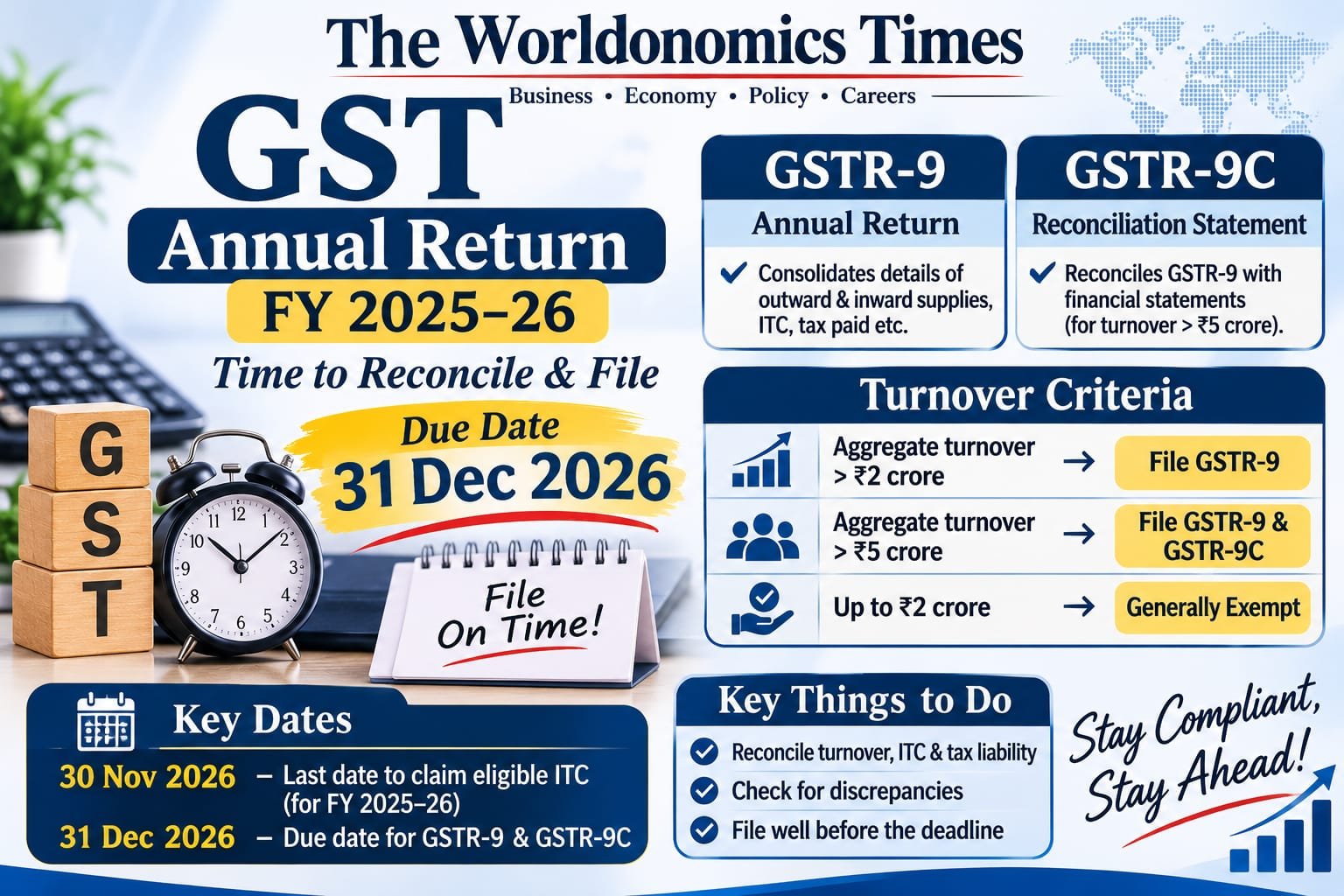
GSTR-9 is an annual return prescribed under Section 44 of the CGST Act, 2017. It consolidates details of outward supplies, inward supplies, ITC claimed, tax paid and other relevant particulars during the financial year.
GSTR-9C is a self-certified reconciliation statement required from registered taxpayers whose aggregate turnover exceeds ₹5 crore during the relevant financial year. It reconciles the figures declared in the annual return with the annual financial statements.
Generally, taxpayers with aggregate turnover exceeding ₹2 crore are required to file GSTR-9, subject to applicable exemptions. Certain categories of taxpayers are excluded from these requirements.
Key Compliance Deadlines
Businesses must pay special attention to two important dates:
- 30 November 2026: General deadline under Section 16(4) for claiming eligible ITC relating to FY 2025–26, or the date of furnishing the annual return, whichever is earlier, subject to statutory provisions.
- 31 December 2026: Normal due date for furnishing GSTR-9 and applicable GSTR-9C.
Therefore, businesses should complete their ITC review before filing the annual return.
Reconciliation: The Most Important Step
Before filing GSTR-9, businesses should carefully reconcile:
- Turnover as per books of accounts with GSTR-1 and GSTR-3B.
- ITC claimed with GSTR-2B and purchase registers.
- Tax liability with actual tax payments.
- Credit notes, debit notes and other adjustments.
- Ineligible ITC and applicable reversals.
These reconciliations help identify reporting errors, missing invoices and unexplained differences before they become potential grounds for departmental scrutiny.
Consequences of Non-Compliance
Failure to furnish the annual return within the prescribed time may attract late fees under Section 47(2) of the CGST Act, subject to applicable limits and provisions.
Incorrect reporting may also lead to tax demands, interest and unnecessary departmental correspondence.
Businesses should therefore avoid last-minute filing and maintain proper supporting documentation.
Role of Finance Professionals
Annual GST compliance requires more than data entry. It demands sound accounting knowledge, an understanding of tax provisions and the ability to analyse financial discrepancies.
Finance professionals, including Cost and Management Accountants, play an important role in ensuring accurate reporting, identifying tax risks and strengthening internal controls.
Conclusion
GST annual return filing should be viewed as an opportunity to review the organisation’s overall tax compliance rather than simply another statutory obligation.
With the 30 November ITC deadline and 31 December annual return deadline approaching, businesses should begin reconciliation well in advance.
Effective GST compliance is not about filing returns at the last moment; it is about ensuring accuracy, transparency and accountability throughout the financial year.