7 Days to November 30: Clearing FY 2025-26 GST Input Tax Credit and Getting Ready for RCM e-Invoicing
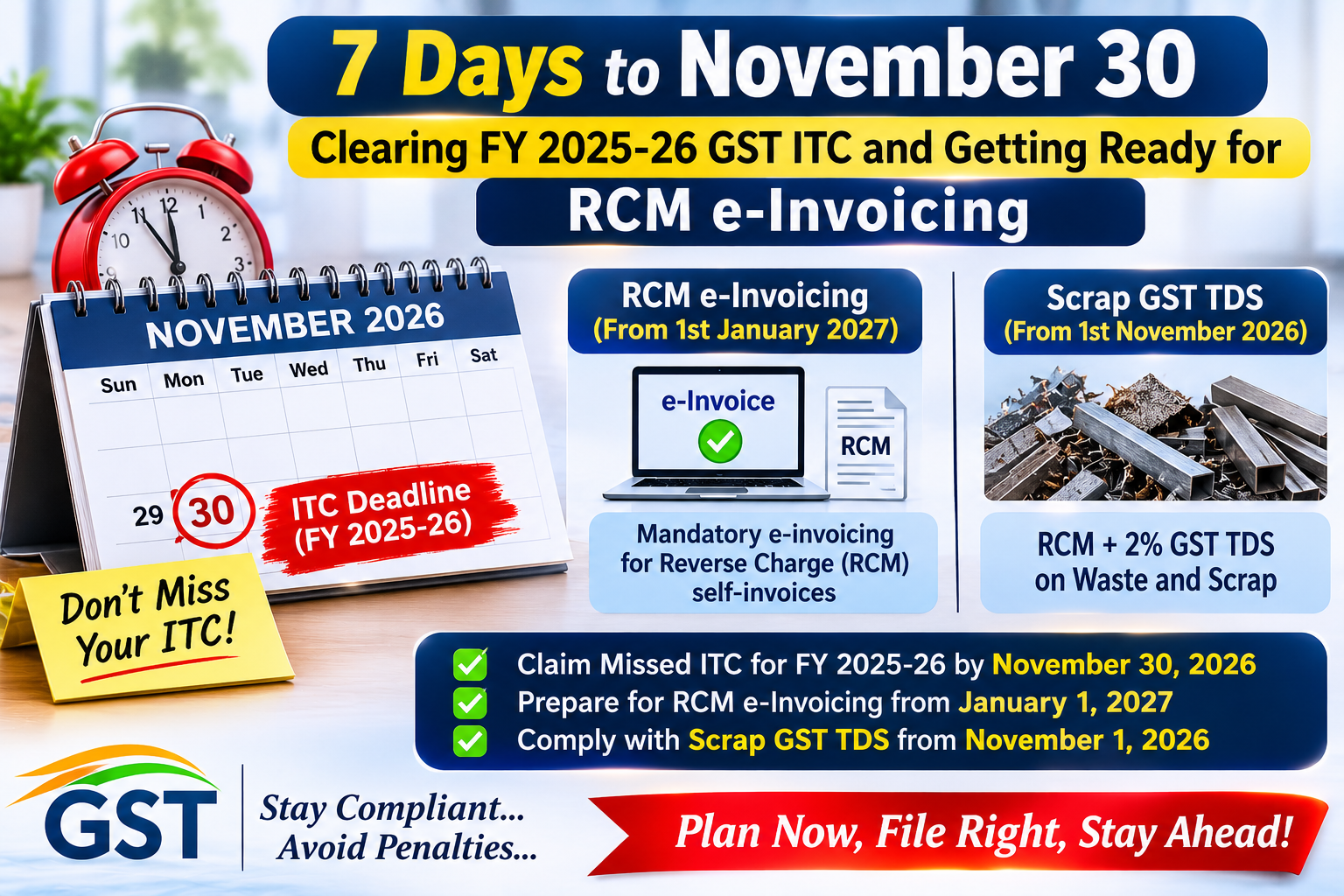
The last week of November is one of the busiest weeks of the year for Indian accountants and business owners. On November 30, 2026, the legal door closes for claiming any missed Input Tax Credit (ITC) for the financial year 2025-26. At the same time, two major GST rule changes from late October and November 2026 are demanding immediate attention: mandatory e-invoicing for Reverse Charge (RCM) self-invoices starting January 1, 2027, and the new RCM plus 2% GST TDS rules on waste and scrap that started on November 1, 2026.
Here is a practical action plan to handle all three without losing money or attracting penalties.
1. The November 30, 2026 Cut-Off for FY 2025-26 ITC
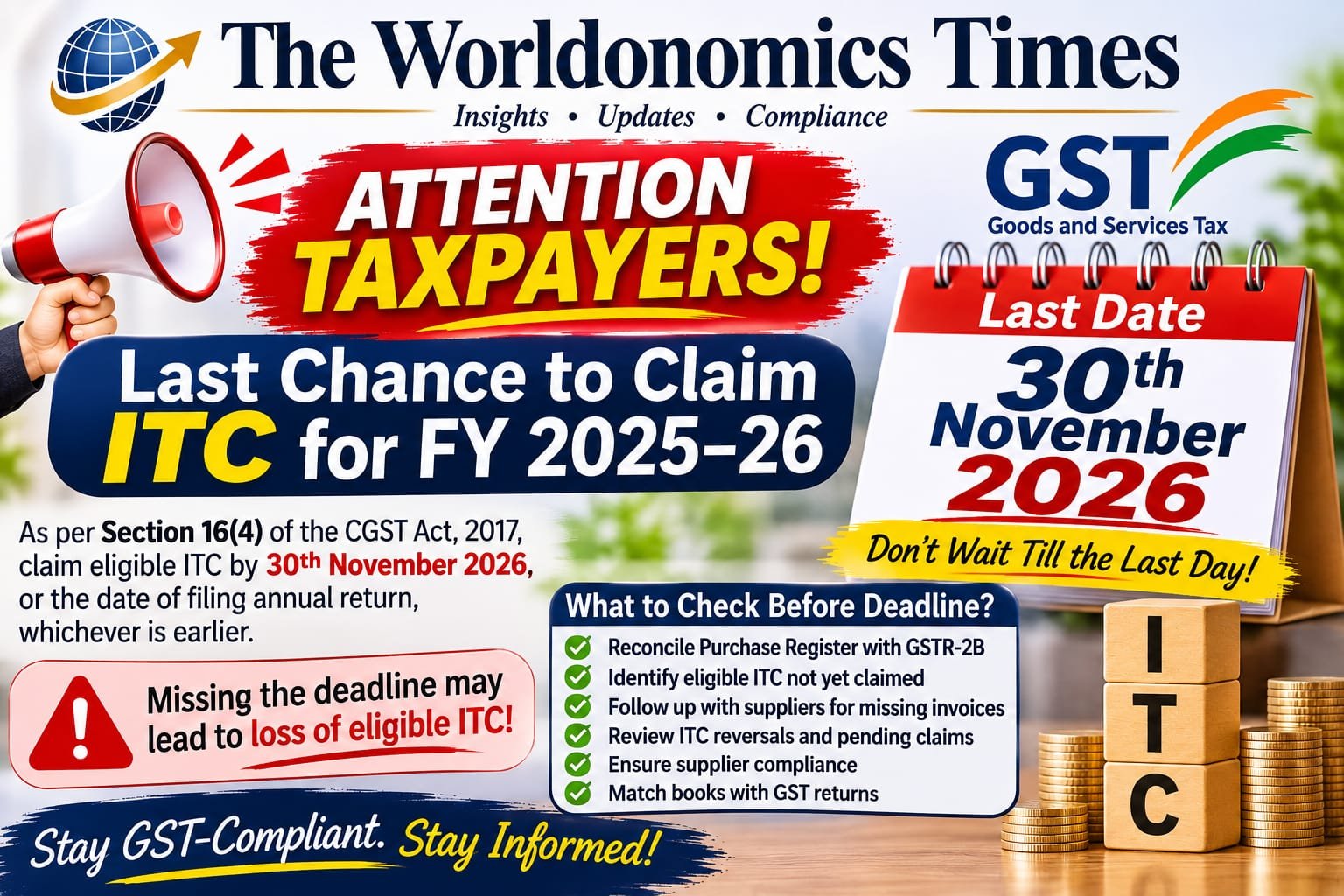
Under Section 16(4) of the CGST Act, 2017, a registered business cannot claim ITC on any invoice or debit note belonging to FY 2025-26 after November 30, 2026 (or the date of filing the annual return, whichever is earlier). In practice, this means all pending FY 2025-26 ITC must be claimed in your October 2026 GSTR-3B (or any return filed on or before November 30).
Take three quick steps this week:
- Run a full-year GSTR-2B vs. Purchase Register check: Look for invoices from April 2025 to March 2026 that appear in your books but were missed in GSTR-3B.
- Follow up with late suppliers: If a vendor forgot to upload an FY 2025-26 invoice in GSTR-1, they can still report or amend it only up to the November 30 statutory limit. Once that date passes, you lose the credit permanently.
- Issue FY 2025-26 credit notes: Under Section 34(2), November 30, 2026 is also the final date to declare credit notes for FY 2025-26 sales so you can adjust your outward tax liability.
2. Mandatory RCM e-Invoicing Starts January 1, 2027
Most businesses know that e-invoicing applies to B2B sales. Now, it is expanding to purchases where the buyer pays GST under Reverse Charge.
Through CBIC Notification No. 04/2026–Central Tax and Notification No. 05/2026–Central Tax (both dated October 26, 2026), the government extended e-invoicing to self-invoices issued under Section 31(3)(f). On November 17, 2026, GSTN issued Advisory No. 688 laying out the exact rollout schedule.
Two new supply types are covered:
- RCMDOM: Domestic goods or services bought from an unregistered supplier where the registered buyer must pay GST under RCM (for example, GTA freight, commercial rent from an unregistered landlord, or notified scrap).
- RCMIMP: Import of services where the registered Indian buyer pays IGST under RCM (such as foreign software subscriptions or overseas consulting).
Key Dates You Must Mark:
- Now (Sandbox Open): Testing is live on all six Invoice Registration Portals (IRPs).
- December 15 to December 31, 2026 (Voluntary Trial): Live production opens. Eligible businesses can voluntarily generate Invoice Reference Numbers (IRNs) for genuine RCMDOM and RCMIMP self-invoices dated December 15 or later.
- January 1, 2027 (Mandatory): Generating an IRN for RCMDOM and RCMIMP self-invoices becomes compulsory.
Do not wait until New Year’s Day. Ask your ERP or billing software vendor (Tally, Zoho, SAP, or Marg) to update your e-invoice schema now and run test entries between December 15 and December 31.
3. New GST Rules on Scrap and Waste (Effective November 1, 2026)
If your factory, hotel, workshop, or IT office sells or buys scrap, check your November 2026 invoices right away. Through three notifications dated October 27, 2026—Notification No. 04/2026–Central Tax (Rate), Notification No. 06/2026–Central Tax, and Notification No. 07/2026–Central Tax—CBIC extended the metal-scrap tax model to four more items from November 1, 2026:
- Used cooking oil (HSN 1518)
- Plastic waste and scrap (HSN 3915)
- Tyre waste and scrap (HSN 4004)
- Electrical and electronic waste and scrap (HSN 8549)
(Metal scrap under Chapters 72 to 81 was already covered.)
How the Rule Works for Buyers:
- If you buy from an unregistered dealer: You must pay GST under Reverse Charge (RCM) (Notification 04/2026-CT(R)) and issue a self-invoice and payment voucher under Sections 31(3)(f) and 31(3)(g). Do not deduct TDS here.
- If you buy from a registered dealer: If the taxable contract value exceeds ₹2,50,000 (excluding GST), you must deduct 2% GST TDS (1% CGST + 1% SGST for intra-state, or 2% IGST for inter-state) under Section 51 (Notification 07/2026-CT). Do not pay RCM here.
- Separate TDS Registration: Your normal GSTIN cannot be used to file TDS returns. Under Rule 12 and GSTN Advisory No. 684 (dated November 1, 2026), buyers must apply for a separate TDS deductor GSTIN using Form GST REG-07 and file Form GSTR-7 by the 10th of the next month. For November 2026 purchases, the very first GSTR-7 is due on December 10, 2026.
Meanwhile, Notification No. 06/2026–Central Tax removed the special registration exemption for suppliers of these five waste categories once they cross the normal Section 22 turnover limit. Mixing up RCM and TDS is the most common mistake happening right now, so update your purchase ledgers before closing November accounts.
Official References and Websites
- Notifications: CBIC Notifications No. 04/2026-CT and 05/2026-CT (dated Oct 26, 2026); Notifications No. 04/2026-CT(R), 06/2026-CT, and 07/2026-CT (dated Oct 27, 2026).
- GSTN Advisories: Advisory No. 684 (dated Nov 1, 2026) and Advisory No. 688 (dated Nov 17, 2026).
- Official Portals: GST Portal — https://www.gst.gov.in | e-Invoice Portal — https://einvoice.gst.gov.in | CBIC Tax Information — https://taxinformation.cbic.gov.in
Author Bio :
CMA Vivek Kumar is a qualified Cost and Management Accountant (ACMA) and B.Com (Accounting Honours) graduate specializing in statutory and tax audits, direct and indirect taxation, and ROC/MCA corporate compliances. Alongside his active corporate finance practice, he mentors CA, CMA, and CS aspirants by designing exam-oriented test series that bridge practical industry expertise with academic preparation.