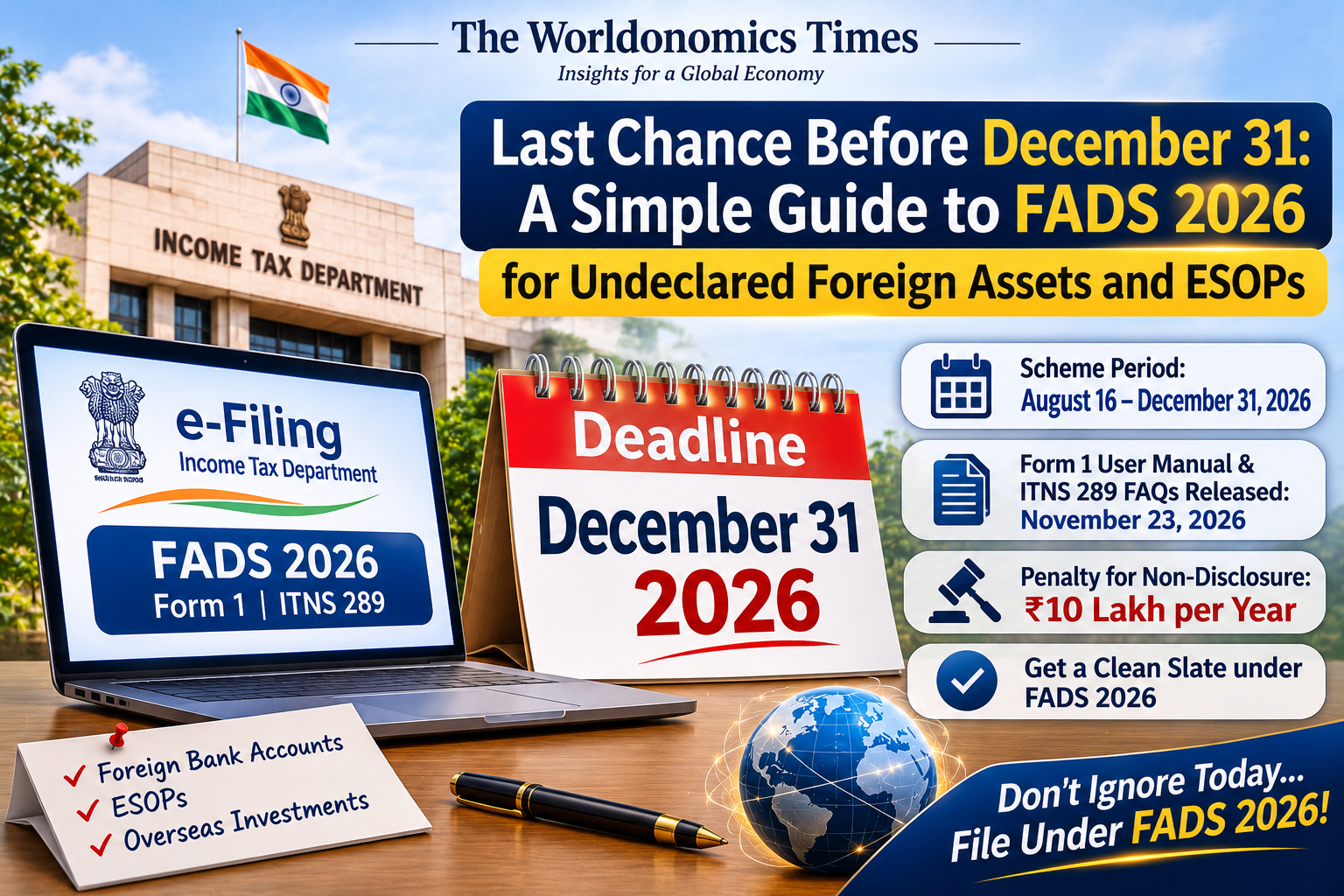
Last Chance Before December 31: A Simple Guide to FADS 2026 for Undeclared Foreign Assets and ESOPs
Many salaried Indians, tech workers, and returning NRIs hold foreign bank accounts, employee stock options (ESOPs), or small overseas investments. Often, they forget to report these in Schedule FA of their Income Tax Return (ITR). Under the Black Money (Undisclosed Foreign Income and Assets) and Imposition of Tax Act, 2015, even an honest mistake can lead to a flat ₹10 lakh penalty per year and possible prosecution.
To give small taxpayers a clean way out, the government introduced the Foreign Assets of Small Taxpayers – Disclosure Scheme, 2026 (FADS 2026), also called FAST-DS 2026, under Chapter IV of the Finance Act, 2026. The window opened on August 16, 2026, and closes on December 31, 2026. On November 23, 2026, the Income Tax Department published the Form 1 User Manual and the ITNS 289 Payment FAQs on the e-filing portal. With just over five weeks left, here is everything you need to know in plain terms.
Who Can Apply Under FADS 2026?
The scheme is meant for taxpayers who are currently Resident in India under Section 6 of the Income-tax Act, 1961. It also covers taxpayers who are currently Non-Resident (NRI) or Resident but Not Ordinarily Resident (RNOR), provided they were Resident in India in the year when the undisclosed foreign income was earned or when the foreign asset was bought.
This rule matters a lot for Indian professionals who worked abroad, came back to India, kept their old foreign bank account or brokerage account open, and forgot to show it in their Indian tax return after becoming residents. It also helps employees of multinational companies who received foreign parent-company shares or RSUs and never reported them in Schedule FA.
The Two Categories: Tax vs. Flat Fee
Under Section 133 of the Finance Act, 2026, the scheme splits taxpayers into two clear groups. Knowing which group you fall into can save you lakhs of rupees.
Category 1: Undisclosed Foreign Income or Unexplained Assets (Up to ₹1 Crore)
This applies if you hold a foreign asset or earned foreign income whose source was never taxed in India, or for which you cannot give a proper explanation. The total value of all such assets and income must not exceed ₹1 crore.
- What you pay: 30% tax on the value of the asset or income, plus an additional amount equal to that tax (another 30%). In total, you pay 60% of the value.
Category 2: Tax-Paid or Non-Resident Foreign Assets (Up to ₹5 Crore)
This applies if you bought a foreign asset using money earned outside India while you were a Non-Resident, or using money on which you already paid Indian tax, and you simply failed to report it in Schedule FA after becoming a resident. The total value must not exceed ₹5 crore.
- What you pay: A flat fee of ₹1,00,000, no matter whether the asset is worth ₹15 lakh or ₹4.5 crore.
Step-by-Step Process: From Form 1 to Form 4
The Income Tax Department has laid out a four-form digital workflow on the e-filing portal. You do not need to visit any tax office.
- File Form 1 (Declaration): Log in to the Income Tax e-Filing portal and file Form 1 between August 16, 2026, and December 31, 2026. List every eligible foreign asset or income in one single declaration.
- Receive Form 2 (Order of Payable Amount): The tax authority reviews your Form 1 and issues Form 2, confirming the exact tax or flat fee you must pay. Form 2 is issued within one month from the end of the month in which you filed Form 1.
- Pay via Challan ITNS 289: Do not pay before receiving Form 2. Once Form 2 arrives, go to e-File → e-Pay Tax → Income-tax Act, 1961 → Foreign Assets of Small Taxpayers Disclosure Scheme, 2026 (ITNS 289). Use Major Head 0021 (Income Tax other than companies) and Minor Head 116 for non-corporate PANs, or Major Head 0020 and Minor Head 115 for corporate PANs. Always select Assessment Year 2026-27 (which is pre-filled), regardless of when you originally bought the asset.
- File Form 3 (Payment Proof): Submit Form 3 online with your ITNS 289 challan details. You have two months from Form 2 to pay without interest. If you miss the two-month mark, you get an extra two months (total four months from the end of the month in which Form 2 was issued), but you must pay 1% interest per month for the delay. If you fail to pay within four months, your declaration becomes void.
- Receive Form 4 (Final Certificate): Within one month from the end of the month in which you file Form 3, the department issues Form 4. This certificate gives you full immunity from further tax, penalty, and prosecution under the Black Money Act, 2015 for the declared items.
Practical Checks Before You File
Before submitting Form 1, gather your foreign bank statements, brokerage holding reports, and ESOP grant or vest letters. Check the fair market value carefully so you do not cross the ₹1 crore or ₹5 crore caps by mistake. Remember that once you pay under FADS 2026, you must still report these assets every year going forward in Schedule FA of your regular ITR.
Official References and Websites
- Statute: Chapter IV (Section 133), Finance Act, 2026; Black Money (Undisclosed Foreign Income and Assets) and Imposition of Tax Act, 2015.
- Official Portal: Income Tax Department e-Filing Portal — https://www.incometax.gov.in
- FADS 2026 FAQs & ITNS 289 Guide (Nov 23, 2026): https://www.incometax.gov.in/iec/foportal/help/all-topics/e-filing-services/foreign-assets-small-taxpayers-disclosure-scheme-2026
- Form 1 User Manual (Nov 23, 2026): Available under Downloads on
incometax.gov.in(Form 1 of FADS 2026 - User Manual).
Author Bio :
CMA Vivek Kumar is a qualified Cost and Management Accountant (ACMA) and B.Com (Accounting Honours) graduate specializing in statutory and tax audits, direct and indirect taxation, and ROC/MCA corporate compliances. Alongside his active corporate finance practice, he mentors CA, CMA, and CS aspirants by designing exam-oriented test series that bridge practical industry expertise with academic preparation.