Understanding India’s ESG Regulatory and Policy Framework
1. What is India’s ESG policy?
India’s ESG framework is a combination of laws, regulations, guidelines and reporting requirements covering environmental responsibility, social impact and corporate governance. It is not contained in one single ESG law.
2. Which authority regulates ESG disclosures for listed companies in India?
The Securities and Exchange Board of India (SEBI) is the principal regulator for ESG-related disclosures by listed entities through the Business Responsibility and Sustainability Reporting (BRSR) framework.
3. What is BRSR?
BRSR stands for Business Responsibility and Sustainability Report. It provides a structured framework for listed companies to disclose their performance against environmental, social and governance parameters.
4. When did BRSR become mandatory?
BRSR became mandatory from FY 2022–23 for the top 1,000 listed entities by market capitalisation. Other listed entities may voluntarily provide BRSR disclosures.
5. What is the connection between BRSR and ESG?
BRSR converts ESG concepts into structured corporate disclosures. It enables investors and other stakeholders to evaluate a company’s environmental, social and governance performance using more standardised information.
6. What are the nine principles of India’s responsible business framework?
BRSR is based on the nine principles of the National Guidelines on Responsible Business Conduct (NGRBC). These cover ethical governance, sustainable products and services, employee well-being, stakeholder responsiveness, human rights, environmental protection, responsible public-policy engagement, inclusive growth and responsible consumer engagement.
7. What are the NGRBC?
The National Guidelines on Responsible Business Conduct were issued by the Ministry of Corporate Affairs in 2019, updating the earlier National Voluntary Guidelines on Social, Environmental and Economic Responsibilities of Business.
8. Is ESG mandatory for every company in India?
No. ESG-related legal and reporting requirements differ according to the type, size and regulatory status of an organisation. The mandatory BRSR requirement specifically applies to the top 1,000 listed entities under SEBI’s framework.
9. What is BRSR Core?
BRSR Core is a more focused subset of BRSR containing key ESG performance indicators. It is designed to improve the reliability and comparability of important ESG information.
10. Why was BRSR Core introduced?
BRSR Core was introduced to focus attention on a limited set of important ESG metrics and strengthen the credibility of reported information through assessment or assurance requirements.
11. What is ESG assurance?
ESG assurance involves an independent evaluation of specified sustainability information to increase confidence in the reliability of reported ESG data.
12. What is the BRSR Core glide path?
SEBI introduced a phased approach for BRSR Core. The framework was initially applicable to the top 150 listed entities and was designed to expand progressively to the top 1,000 listed entities.
13. What is value-chain ESG disclosure?
Value-chain ESG disclosure requires relevant listed companies to consider sustainability information relating to important upstream suppliers and downstream partners.
14. Which companies are covered by value-chain ESG disclosures?
Under the current framework, value-chain disclosures apply to the top 250 listed entities by market capitalisation on a comply-or-explain basis, with limited assurance also following a phased approach.
15. Why is value-chain ESG important?
A company’s environmental and social footprint may extend beyond its own offices and factories. Suppliers, logistics providers, distributors and other business partners can significantly influence its overall ESG performance.
16. What role does the Companies Act, 2013 play in ESG?
The Companies Act, 2013 contains several provisions relevant to ESG, including directors’ duties, CSR, disclosures, environmental and energy-related reporting and requirements relating to employees and governance. The government has described the Act as an important foundation for responsible business conduct in India.
17. Is CSR the same as ESG?
No. CSR and ESG are related but different concepts. CSR generally focuses on a company’s social responsibility activities and statutory obligations, while ESG provides a broader framework covering environmental, social and governance performance and its relevance to business and investors.
18. What is the relationship between CSR and ESG?
CSR activities can contribute to the social component of ESG, but ESG also covers areas such as carbon emissions, energy, climate risk, governance, business ethics, employee practices and supply-chain sustainability.
19. What is India’s National Guidelines on Responsible Business Conduct framework?
The NGRBC provides nine principles for responsible business conduct. It encourages companies to integrate ethical, social, environmental and stakeholder considerations into their operations.
20. What is greenwashing?
Greenwashing occurs when an organisation makes environmental or sustainability claims that are misleading, exaggerated or insufficiently supported by evidence.
21. Why is India focusing on greenwashing?
As sustainable investment and ESG-labelled financial products grow, regulators have become increasingly concerned about misleading sustainability claims. SEBI’s ESG framework specifically seeks to strengthen disclosure quality and mitigate greenwashing risks.
22. Does India regulate ESG investing?
Yes. SEBI has developed a regulatory framework covering ESG disclosures, ESG ratings and ESG investing, including requirements relevant to mutual funds and ESG-labelled investment products.
23. What are ESG rating providers?
ESG rating providers assess companies or securities using environmental, social and governance criteria. Their assessments can be used by investors and other market participants in evaluating sustainability-related risks and performance.
24. What is sustainable finance in India?
Sustainable finance involves directing capital toward activities and projects that contribute to environmental or social objectives while considering associated sustainability risks.
25. What are Sovereign Green Bonds?
Sovereign Green Bonds are government securities issued to mobilise funds for eligible public-sector projects intended to reduce the carbon intensity of the economy.
26. What role does IFSCA play in sustainable finance?
The International Financial Services Centres Authority (IFSCA) has developed frameworks relating to ESG-labelled debt securities, ESG ratings and data products, transition bonds and sustainable finance within India’s International Financial Services Centre.
27. What is transition finance?
Transition finance provides capital to businesses or projects that are moving toward lower-emission and more sustainable operations, particularly where an immediate shift to a zero-emission model may not be feasible.
28. How does ESG affect investors?
ESG information can help investors assess risks and opportunities that may not be fully visible in traditional financial statements, including climate risks, regulatory risks, governance weaknesses and social risks.
29. How does ESG affect CFOs?
CFOs increasingly need to connect ESG information with financial planning, risk management, capital allocation, budgeting, internal controls and corporate reporting.
30. What role can CA and CMA professionals play in ESG?
CA and CMA professionals can contribute to ESG through:
- ESG reporting and disclosures
- Carbon and environmental cost measurement
- Budgeting and investment analysis
- Internal controls
- ESG data verification
- Risk management
- Sustainability-linked financial analysis
- ESG assurance
- Management dashboards
- Integration of ESG with financial performance
31. Is ESG only an environmental concept?
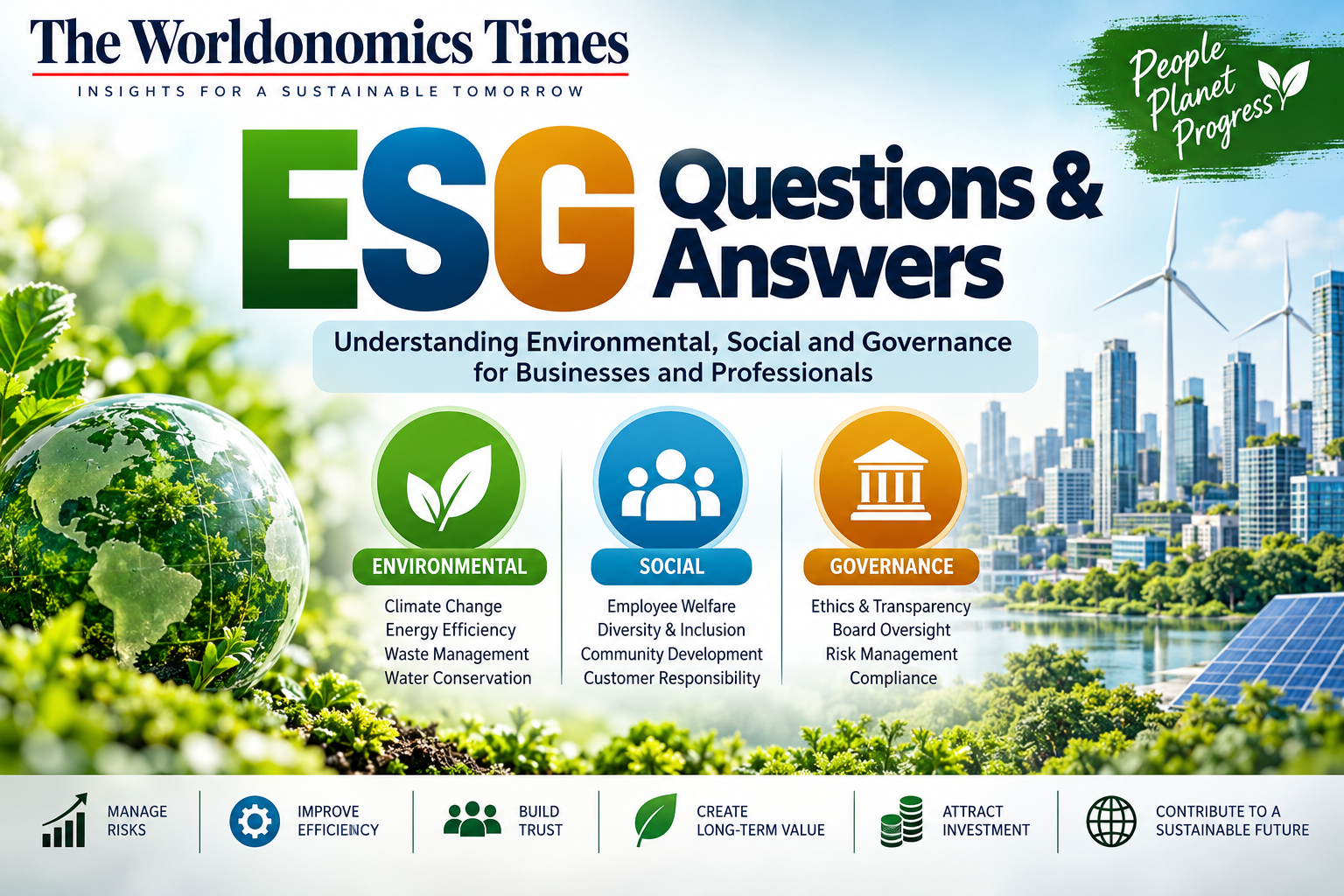
No. ESG has three major dimensions:
E – Environmental: Climate change, emissions, energy, water, waste and biodiversity.
S – Social: Employees, human rights, diversity, safety, communities, customers and supply chains.
G – Governance: Board structure, ethics, transparency, anti-corruption, shareholder rights and risk management.
32. What is the role of the Ministry of Corporate Affairs in India’s ESG framework?
The Ministry of Corporate Affairs plays an important role in responsible business conduct through corporate-law provisions and the NGRBC framework. Its institutions, including the Indian Institute of Corporate Affairs, also contribute to research, training and policy development on responsible business conduct.
33. Is ESG policy evolving in India?
Yes. India’s ESG framework continues to evolve as sustainability reporting, climate risks, responsible investment, supply-chain expectations and global trade requirements become increasingly important.
34. What is the future direction of India’s ESG framework?
The direction is toward better-quality data, greater transparency, stronger assurance, value-chain visibility, responsible investment and integration of sustainability into mainstream corporate decision-making.
35. Why is ESG important for India’s businesses?
ESG is increasingly relevant to access to capital, investor confidence, supply-chain participation, international trade, regulatory compliance, risk management and long-term competitiveness.
Conclusion
India’s ESG framework is developing through a multi-regulatory approach rather than a single ESG statute. The NGRBC provides the responsible-business foundation, the Companies Act incorporates several relevant corporate responsibilities, and SEBI’s BRSR and BRSR Core frameworks provide structured sustainability disclosures for listed entities. Sustainable finance initiatives and emerging requirements around ESG ratings, value chains and greenwashing are further strengthening the ecosystem.
For Indian businesses, ESG is therefore moving beyond a reporting exercise. It is increasingly becoming a strategic, financial, governance and risk-management issue. Finance professionals, particularly CAs and CMAs, have an important role to play in converting ESG information into measurable business performance and informed decision-making.