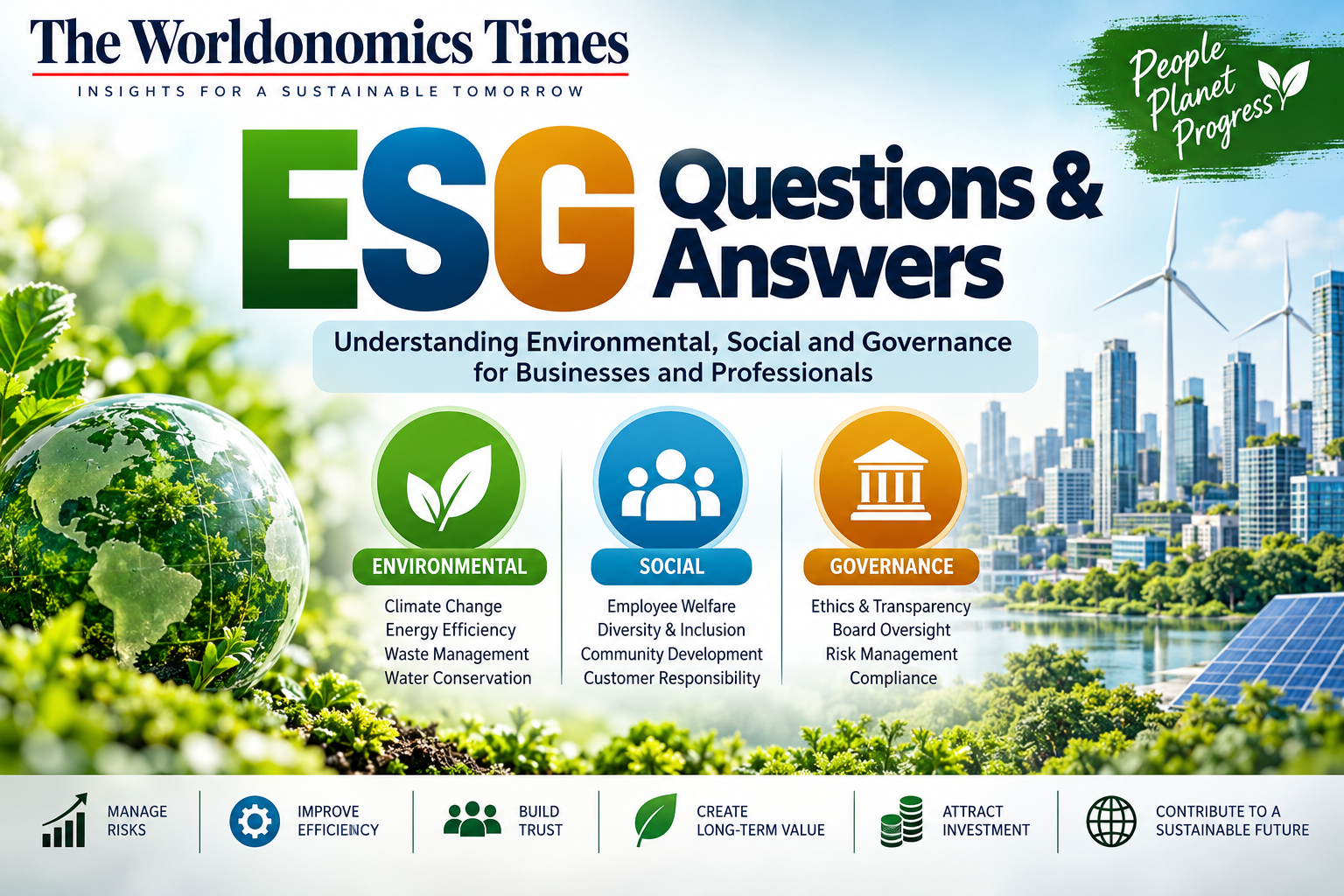
Understanding the ESG Regulatory Framework in the United States
1. What is ESG policy in the USA?
ESG policy in the United States refers to the collection of federal and state laws, regulations, disclosure requirements, investor practices and corporate policies dealing with environmental, social and governance issues.
Unlike India, the USA does not have one comprehensive ESG law applicable to all companies.
2. Which U.S. regulator is most relevant to ESG disclosures?
The U.S. Securities and Exchange Commission (SEC) is a key federal regulator because ESG information can be relevant to securities disclosures, investor decisions and material business risks.
3. Does the USA have a mandatory ESG reporting framework?
There is no single nationwide ESG reporting framework covering every company.
Requirements depend on factors such as whether a company is publicly traded, its industry, where it operates and which state laws apply.
4. What was the SEC’s 2024 climate disclosure rule?
In March 2024, the SEC adopted rules intended to standardize certain climate-related disclosures by public companies and companies making public offerings. The rules included disclosures concerning material climate risks, board and management oversight, climate targets and, for certain large filers, material Scope 1 and Scope 2 emissions.
5. Are the SEC’s 2024 climate disclosure rules currently in force?
The situation has changed substantially.
The SEC stayed the 2024 rules in April 2024 while litigation proceeded. In March 2025, the SEC voted to stop defending the rules. In May 2026, the SEC formally proposed rescinding the climate-disclosure rules. The proposed rescission is therefore a major part of the current U.S. ESG regulatory landscape.
6. Does this mean climate disclosure has disappeared in the USA?
No.
Even with the federal SEC rules being reconsidered, companies can still face climate-disclosure requirements under state laws, contractual requirements, investor expectations and other applicable regulations.
7. What is California’s ESG policy?
California has developed one of the most significant state-level climate disclosure regimes in the United States.
Its framework includes SB 253, relating to corporate greenhouse-gas emissions reporting, and SB 261, relating to climate-related financial risk disclosure.
8. What is California SB 253?
SB 253, the Climate Corporate Data Accountability Act, requires qualifying U.S.-based entities doing business in California and exceeding $1 billion in annual revenue to report greenhouse-gas emissions.
The law covers Scope 1, Scope 2 and Scope 3 emissions on a phased basis.
9. When does California SB 253 reporting begin?
California’s framework provides for Scope 1 and Scope 2 reporting beginning in 2026 and Scope 3 reporting beginning in 2027.
CARB has identified November 10, 2026 as the deadline for the first-year Scope 1 and Scope 2 reporting under its current implementation framework.
10. What is SB 261?
SB 261 is California’s Climate-Related Financial Risk Act.
It applies to qualifying U.S.-based entities with more than $500 million in annual revenue that do business in California and addresses reporting of climate-related financial risks.
11. Is SB 261 currently mandatory?
There is an important qualification.
CARB states that, pursuant to a court order, it is not enforcing SB 261 and reporting is voluntary at present.
12. Why is California important for ESG?
California is economically significant and has adopted climate-related corporate disclosure requirements that can affect large companies doing business in the state, including companies headquartered outside California.
13. Can a company outside California be affected by California ESG rules?
Yes.
Certain California laws are based on revenue thresholds and doing business in California rather than simply being incorporated there.
14. What are Scope 1 emissions?
Scope 1 emissions are direct greenhouse-gas emissions from sources owned or controlled by an organisation, such as fuel combustion in company-operated facilities or vehicles.
15. What are Scope 2 emissions?
Scope 2 emissions generally relate to indirect emissions associated with purchased or acquired electricity, steam, heat or cooling.
16. What are Scope 3 emissions?
Scope 3 emissions cover other indirect emissions occurring throughout a company’s value chain, including certain supplier, transportation, product-use and other upstream or downstream activities.
17. Why is Scope 3 reporting difficult?
Scope 3 can involve thousands of suppliers, customers and business activities. Obtaining consistent and reliable information across a value chain can therefore be challenging.
18. What is the role of the SEC in ESG?
The SEC’s primary focus is investor protection, capital formation and securities-market regulation. ESG-related information becomes relevant where environmental, social or governance matters may constitute material information for investors.
19. Is ESG the same as climate disclosure?
No.
Climate disclosure primarily focuses on climate-related risks, emissions and financial impacts. ESG is broader and includes environmental, social and governance factors.
20. What environmental issues are covered under ESG?
Typical environmental issues include:
- Greenhouse-gas emissions
- Climate risk
- Energy consumption
- Renewable energy
- Water
- Waste
- Pollution
- Biodiversity
- Resource efficiency
21. What social issues are covered under ESG?
Social factors may include:
- Employee health and safety
- Human rights
- Diversity and inclusion
- Labour practices
- Supply-chain standards
- Customer safety
- Community impact
- Human capital management
22. What governance issues are covered under ESG?
Governance commonly includes:
- Board oversight
- Executive compensation
- Business ethics
- Anti-corruption
- Risk management
- Internal controls
- Shareholder rights
- Transparency
- Cybersecurity oversight
23. What is ESG investing in the USA?
ESG investing involves considering environmental, social and governance factors alongside traditional financial analysis when evaluating investments.
24. Is ESG investing mandatory for U.S. investors?
Generally, ESG investing is not mandatory for investors. Investment managers must, however, comply with applicable fiduciary, disclosure and securities requirements.
25. What is ESG greenwashing?
Greenwashing occurs when a company or investment product presents sustainability characteristics in a misleading or unsupported manner.
26. Why is greenwashing a concern in the USA?
Investors increasingly use sustainability-related information when making decisions. Misleading ESG claims can therefore create investor-protection, reputational and legal risks.
27. What is an ESG fund?
An ESG fund is an investment fund that incorporates specified environmental, social or governance considerations into its investment process.
The exact methodology can differ significantly between funds.
28. What should investors examine before investing in an ESG fund?
Investors should examine:
- Investment objective
- ESG methodology
- Portfolio holdings
- Screening criteria
- ESG data sources
- Fees
- Risk factors
- Voting and stewardship policies
- Sustainability claims
29. What is fiduciary duty in the context of ESG?
Fiduciary responsibilities require investment professionals to act consistently with applicable legal duties and the interests of their clients or beneficiaries. ESG factors may be considered when they are relevant to investment risk or return.
30. What is climate risk in U.S. corporate reporting?
Climate risk can include physical risks such as hurricanes, floods, wildfires and extreme temperatures, as well as transition risks arising from technological, regulatory, market or consumer changes.
31. How can climate risk affect U.S. businesses?
Climate risk can affect:
- Insurance costs
- Property values
- Supply chains
- Production
- Energy costs
- Capital expenditure
- Financing
- Customer demand
- Asset valuations
32. What is climate scenario analysis?
Climate scenario analysis evaluates how different potential climate and economic conditions could affect a company’s strategy, operations and financial position.
33. What is a corporate climate transition plan?
A transition plan explains how a company intends to adapt its business model, operations and investments as the economy moves toward lower greenhouse-gas emissions.
34. Are U.S. companies required to achieve net zero?
There is no single federal requirement that all U.S. companies achieve net-zero emissions.
Companies may nevertheless establish voluntary targets or become subject to particular state, sectoral, contractual or investor expectations.
35. What is the role of the board in ESG?
The board can oversee ESG-related risks, strategy, corporate policies and management accountability, particularly where these issues could materially affect the business.
36. Why is materiality important in U.S. ESG regulation?
Materiality is central to U.S. securities regulation.
The SEC’s 2026 proposal to rescind its climate rules specifically emphasizes a materiality-focused approach to disclosure.
37. What is ESG materiality?
ESG materiality asks whether an environmental, social or governance issue could reasonably influence business performance, financial condition, strategy, risk or investment decisions.
38. What is double materiality?
Double materiality considers both:
- How sustainability issues affect the company; and
- How the company’s activities affect people and the environment.
This approach is more prominent in some international reporting frameworks than in traditional U.S. securities disclosure.
39. Does the USA follow the European Union’s ESG framework?
Not exactly.
The EU has developed its own extensive sustainability reporting and sustainable-finance framework. U.S. companies operating internationally may nevertheless encounter EU requirements depending on their activities and structure.
40. What is the importance of ESG for multinational U.S. companies?
Large U.S. companies operating globally may need to manage multiple ESG regimes, including U.S. federal and state requirements and requirements in international markets.
41. How does ESG affect U.S. CFOs?
CFOs increasingly need to consider ESG in:
- Financial planning
- Risk management
- Capital allocation
- Internal controls
- Investor reporting
- Carbon accounting
- Scenario analysis
- Sustainability-linked financing
42. What role can CPAs play in ESG?
CPAs can contribute to ESG through:
- Sustainability reporting
- ESG assurance
- Internal controls
- Data verification
- Financial impact assessment
- Risk management
- Governance
- Climate-related financial analysis
43. What role can management accountants play in ESG?
Management accountants can connect sustainability information with financial performance through:
- Environmental cost accounting
- Carbon costing
- Capital budgeting
- Performance measurement
- ESG KPIs
- Scenario analysis
- Cost reduction
- Strategic planning
44. How can ESG create business value in the USA?
ESG initiatives can support:
- Energy savings
- Resource efficiency
- Risk reduction
- Innovation
- Brand reputation
- Customer relationships
- Supply-chain resilience
- Access to capital
45. Is ESG only relevant to large corporations?
No.
Although many formal disclosure requirements target larger companies, ESG issues can affect businesses of every size through customers, lenders, investors, employees, suppliers and large-company procurement requirements.
46. How can ESG affect U.S. small businesses?
Small businesses may face ESG requirements indirectly when they supply larger corporations. They may be asked to provide emissions, labour, safety, diversity, sourcing or governance information.
47. What is supply-chain ESG?
Supply-chain ESG evaluates environmental, social and governance performance throughout the company’s supplier network.
48. Why is supply-chain ESG becoming important?
A company’s ESG risks may originate outside its own operations. Supplier labour practices, emissions, resource use, human rights and business ethics can affect the company’s overall risk profile.
49. What is responsible sourcing?
Responsible sourcing means purchasing goods and services while considering environmental impacts, labour conditions, human rights, ethical conduct and supply-chain risks.
50. What is the future of ESG policy in the USA?
The U.S. ESG environment is likely to remain fragmented and dynamic, with federal securities policy, state-level climate laws, investor expectations and international requirements developing at different speeds.
As of 2026, the SEC is moving toward rescission of its 2024 climate-disclosure rules, while California continues implementing its corporate climate reporting framework.
Conclusion
The U.S. ESG framework is fundamentally different from a single, centralized ESG regime. Instead, it is a combination of federal securities regulation, state climate legislation, investor expectations, corporate governance requirements and sector-specific rules.
The most important current development is the contrast between the federal and state approaches. The SEC has proposed rescinding its 2024 climate-disclosure rules, while California is advancing implementation of its climate disclosure legislation.
For finance professionals, the key lesson is that ESG in the USA should not be viewed simply as a sustainability reporting exercise. It increasingly intersects with financial materiality, risk management, corporate governance, capital allocation, investor communication and supply-chain management.