Introduction: India’s Expanding Global Trade Ambitions
In an increasingly interconnected global economy, international trade is no longer just about exporting products and importing raw materials. It is about building strategic partnerships, strengthening supply chains, attracting investments and creating opportunities for businesses across borders.
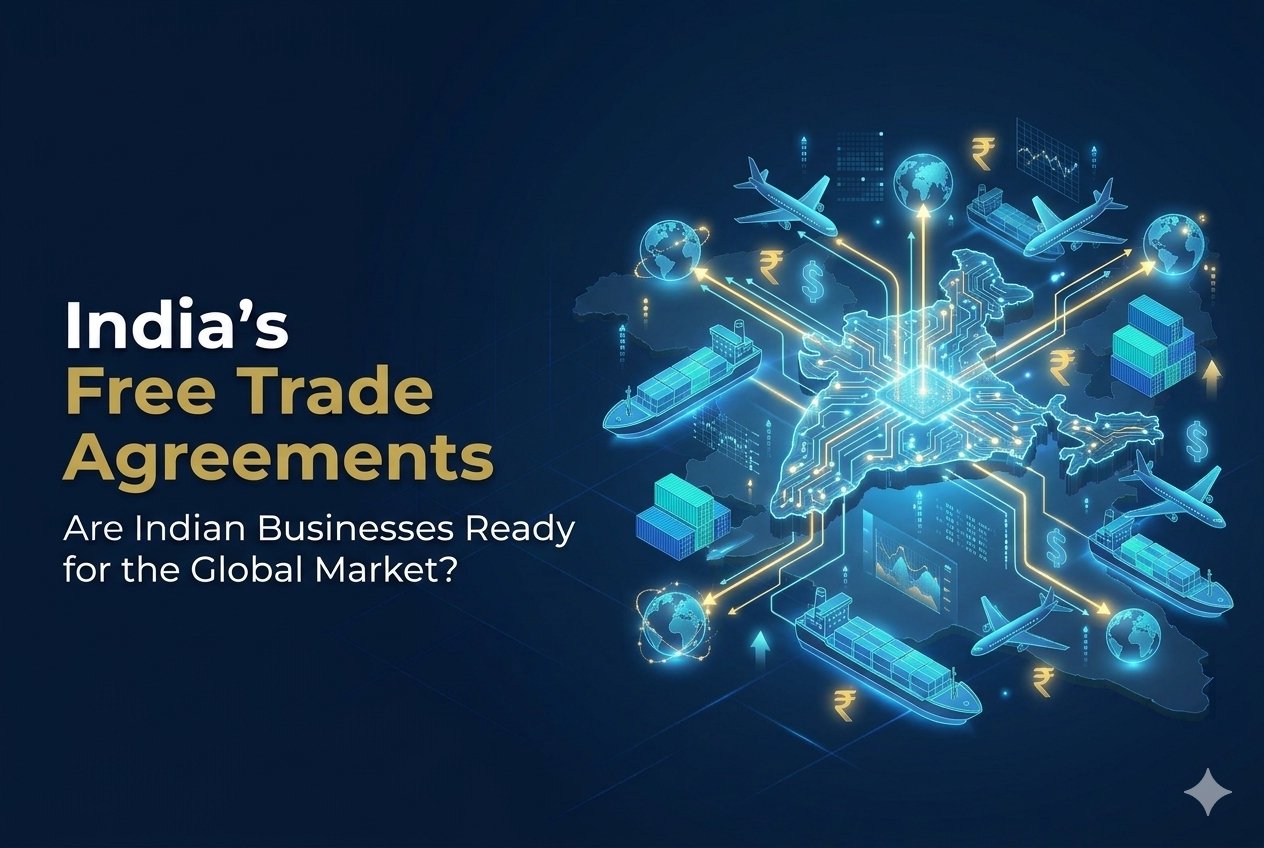
India is taking significant steps in this direction through a growing network of Free Trade Agreements (FTAs).
Recent agreements with the United Kingdom, Oman and New Zealand, alongside the India-European Union trade negotiations, reflect India’s ambition to strengthen its position in global commerce.
But an important question remains: Are Indian businesses, particularly MSMEs, prepared to convert these international trade opportunities into actual business growth?
1. What Are Free Trade Agreements?
A Free Trade Agreement is an arrangement between two or more countries that reduces or eliminates certain trade barriers and facilitates economic cooperation.
These agreements may cover:
- Reduction or elimination of customs duties.
- Market access for goods and services.
- Investment protection and facilitation.
- Intellectual property rights.
- Customs procedures and trade documentation.
- Professional mobility and economic cooperation.
The objective is to make international trade more efficient, competitive and accessible.
However, the benefits depend on the specific terms negotiated under each agreement.
2. India’s New Trade Partnerships: What’s Changing?
India’s trade strategy has gained momentum through several important agreements.
A. India–UK Comprehensive Economic and Trade Agreement (CETA)
The India–UK CETA entered into force on 15 July 2026.
It provides preferential market access for Indian exporters, with nearly 99% of India’s exports eligible for zero-duty access to the UK market.
Sectors such as textiles, leather, footwear, engineering goods and other manufactured products stand to benefit from improved market access.
B. India–Oman Comprehensive Economic Partnership Agreement (CEPA)
The India–Oman CEPA became effective on 1 June 2026.
The agreement strengthens economic cooperation between the two countries and provides opportunities for Indian businesses across goods and services.
It is particularly relevant for exporters seeking to expand their presence in the Gulf region.
C. India–New Zealand Free Trade Agreement
The India–New Zealand FTA entered into force on 20 October 2026.
One of its important features is zero-duty access for 100% of Indian exports to New Zealand from the date of implementation.
The agreement also provides for New Zealand to facilitate USD 20 billion in investment into India over time.
It creates opportunities for Indian exporters, including MSMEs, farmers, artisans and manufacturers.
D. India–European Union Free Trade Agreement
India and the European Union concluded negotiations on their FTA on 27 January 2026.
The agreement represents a major development in India’s international trade strategy.
It is expected to create opportunities across manufacturing, services, technology and investment.
However, the agreement must complete the required signing and ratification processes before entering into force.
3. Which Indian Industries Could Benefit?
The expanding trade network creates opportunities across several industries.
Textiles and Apparel
Indian textile manufacturers may benefit from improved access to international markets, stronger export demand and opportunities to serve global fashion brands.
Pharmaceuticals
Preferential trade arrangements and stronger economic cooperation can create opportunities for Indian pharmaceutical companies, subject to applicable regulatory and product approval requirements.
Engineering and Manufacturing
Engineering goods, automobile components, machinery and industrial products may gain improved competitiveness in partner markets.
Agriculture and Food Processing
Indian agricultural exporters and food-processing businesses may benefit from improved market access, although sanitary and phytosanitary standards remain important.
Information Technology and Professional Services
Trade agreements can also support services exports, professional mobility and cross-border business cooperation, depending on the specific commitments negotiated.
4. The MSME Opportunity: Can Small Businesses Go Global?
One of the most promising aspects of India’s expanding FTA network is the opportunity it creates for Micro, Small and Medium Enterprises.
Traditionally, international trade has been dominated by businesses with substantial financial resources, established distribution networks and international market experience.
However, preferential trade access can help smaller businesses explore new export destinations.
For example:
- A textile manufacturer can explore new overseas buyers.
- A leather goods producer can enter international supply chains.
- An engineering MSME can supply components to foreign manufacturers.
- A food-processing business can explore new export markets.
Nevertheless, access to international markets is only the first step.
MSMEs also need export financing, quality certifications, digital infrastructure, logistics support and awareness of international trade regulations.
5. The Hidden Challenge: Rules of Origin and Compliance
A common misconception is that an FTA automatically makes every product duty-free.
In reality, businesses must satisfy the conditions specified in the relevant agreement.
One of the most important requirements is the Rules of Origin.
These rules determine whether a product qualifies as originating from a particular country and is therefore eligible for preferential tariff treatment.
Businesses may need to establish:
- Where the product was manufactured.
- Whether sufficient processing took place.
- Whether prescribed local value addition requirements were satisfied.
- Whether the required Certificate of Origin is available.
- Whether documentation and verification requirements are fulfilled.
Failure to satisfy these requirements may result in the denial of preferential tariff benefits.
In addition, exporters must comply with destination-country quality standards, product regulations, customs procedures and other non-tariff requirements.
6. The Role of Finance and Compliance Professionals
The expansion of India’s trade agreements creates new responsibilities and opportunities for finance professionals.
Their contribution can extend beyond accounting and taxation to international business strategy.
Some important areas include:
Customs and Indirect Taxation: Understanding customs duties, preferential tariff rates and applicable import-export procedures.
Foreign Exchange Management: Ensuring compliance with applicable FEMA and RBI requirements for cross-border transactions.
Transfer Pricing: Evaluating international related-party transactions and compliance with applicable transfer pricing regulations.
Export Finance: Assessing working capital requirements, foreign exchange exposure and export credit facilities.
Risk Management: Evaluating currency fluctuations, payment risks, geopolitical uncertainties and international supply-chain disruptions.
As international business becomes more complex, professionals with knowledge of finance, taxation, international trade and regulatory compliance can play an increasingly valuable role.
7. The Risks: Is Greater Market Access Always an Advantage?
While FTAs create opportunities, they also expose domestic businesses to increased international competition.
Indian manufacturers may face pressure from foreign competitors with advanced technology, larger production capacities or lower operating costs.
Other challenges include:
- Currency fluctuations.
- International logistics costs.
- Changing trade policies.
- Product quality and certification requirements.
- Compliance expenses.
- Dependence on overseas markets.
Therefore, trade liberalisation must be accompanied by domestic competitiveness, technological development and appropriate support for vulnerable sectors.
8. What Should Indian Businesses Do Next?
To benefit from India’s expanding trade network, businesses should adopt a proactive approach.
- Identify countries where their products enjoy preferential market access.
- Study the applicable tariff concessions and product-specific Rules of Origin.
- Strengthen product quality and international certifications.
- Explore export financing and appropriate foreign exchange risk management.
- Build relationships with overseas buyers and distributors.
- Develop digital platforms and international marketing capabilities.
Businesses that understand the commercial and regulatory provisions of FTAs will be better positioned to convert market access into sustainable export growth.
Conclusion: From Trade Agreements to Trade Opportunities
India’s expanding network of Free Trade Agreements represents an important step towards deeper integration with the global economy.
These agreements can open international markets, support MSMEs, encourage investment and strengthen India’s participation in global value chains.
However, signing an agreement is not the same as achieving export success.
The real challenge lies in ensuring that Indian businesses have the financial strength, technological capabilities, quality standards and regulatory understanding required to compete internationally.
India has been opening doors to global markets. The next step is to ensure that Indian businesses are ready to walk through them.