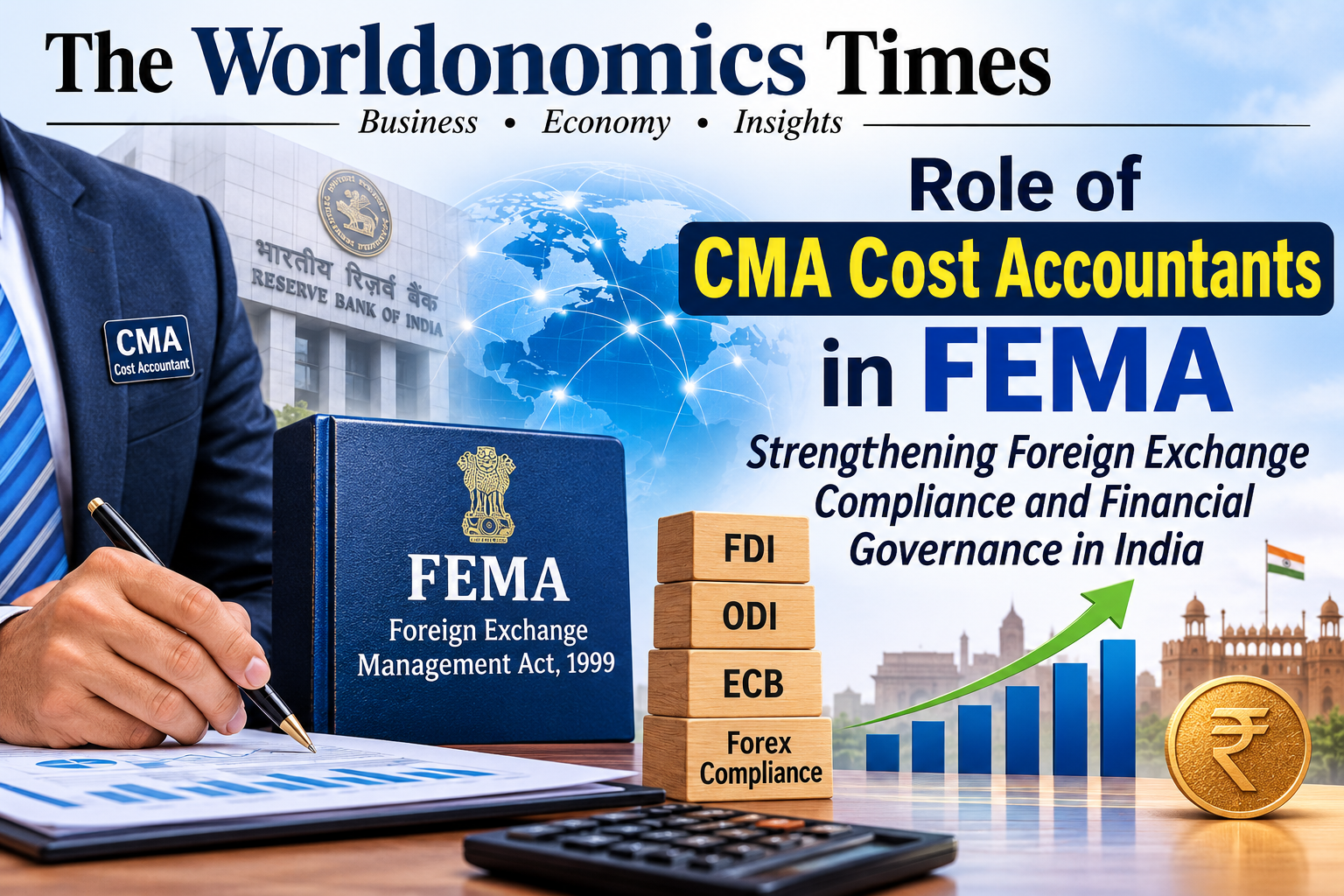
By The Worldonomics Times
Introduction
In an increasingly globalised economy, Indian businesses are expanding their operations beyond national boundaries through foreign investments, international trade, overseas subsidiaries, foreign collaborations and cross-border financial transactions. These activities require strict compliance with the Foreign Exchange Management Act (FEMA), 1999, which governs foreign exchange transactions in India.
The role of Cost and Management Accountants (CMAs) has become increasingly important in helping businesses maintain financial discipline, ensure regulatory compliance and manage foreign exchange-related risks. With their expertise in cost management, financial analysis, auditing and corporate governance, CMAs can support organisations in meeting FEMA requirements and maintaining transparency in international financial transactions.
Understanding FEMA and Its Importance
The Foreign Exchange Management Act, 1999, was introduced to facilitate external trade and payments and promote the orderly development and maintenance of the foreign exchange market in India. It replaced the earlier Foreign Exchange Regulation Act (FERA), 1973.
FEMA provides the regulatory framework for various foreign exchange activities, including:
- Foreign Direct Investment (FDI) in Indian companies.
- Overseas Direct Investment (ODI) by Indian entities.
- External Commercial Borrowings (ECBs).
- Import and export transactions.
- Foreign currency payments and receipts.
- Transfer of shares involving non-residents.
- Foreign currency accounts and cross-border remittances.
The Reserve Bank of India (RBI), the Central Government and authorised dealer banks play important roles in administering the FEMA framework.
Role of CMA Cost Accountants in FEMA Compliance
Cost and Management Accountants can contribute significantly to FEMA compliance through their professional knowledge and financial expertise.
1. Financial Reporting and Regulatory Compliance
CMAs help businesses maintain accurate financial records relating to foreign investments, international transactions and foreign currency payments. Proper documentation and reconciliation are essential for demonstrating compliance with applicable FEMA regulations.
They can assist management in identifying reporting requirements, maintaining transaction records and coordinating with authorised dealer banks and other professionals.
2. Foreign Direct Investment (FDI) Compliance
Foreign Direct Investment is an important source of capital for Indian businesses. However, companies receiving foreign investment must comply with applicable sectoral caps, entry routes, pricing guidelines and reporting requirements.
CMAs can support organisations by analysing investment valuations, reviewing financial records, monitoring capital structures and assisting with relevant documentation. They can also help management understand the financial implications of foreign equity participation.
3. Overseas Direct Investment (ODI)
Indian companies investing in foreign subsidiaries, joint ventures and overseas businesses must comply with the applicable ODI framework.
CMAs can assist in evaluating overseas investment proposals, analysing projected returns, examining financial risks and monitoring the performance of foreign subsidiaries. They can also support the preparation and review of financial information required for regulatory reporting.
4. External Commercial Borrowings (ECBs)
External Commercial Borrowings provide Indian businesses with access to international sources of finance. However, ECB transactions are subject to specific conditions relating to eligible borrowers, recognised lenders, permitted end uses, borrowing limits and reporting.
CMAs can help companies evaluate the cost of overseas borrowing, assess repayment capacity, analyse interest and currency exposure, and monitor compliance with applicable ECB conditions.
Their financial analysis can also help businesses compare domestic borrowing with international financing options.
5. Import and Export Transaction Monitoring
International trade involves foreign currency receipts and payments, making FEMA compliance essential for exporters and importers.
CMAs can help businesses reconcile export proceeds, monitor outstanding export receivables, review import payment records and analyse foreign exchange gains and losses.
They can also assist management in establishing internal controls to reduce the risk of delayed realisation, incorrect accounting and documentation gaps.
6. Internal Audit and Risk Management
One of the significant contributions of CMAs is strengthening internal financial controls.
Through internal audits and management reviews, CMAs can examine foreign exchange transactions, identify compliance gaps, evaluate financial risks and recommend corrective measures.
They can help organisations develop standard operating procedures for foreign investments, foreign currency payments, overseas borrowings and international trade transactions.
7. Foreign Exchange Risk Management
Currency fluctuations can significantly affect the profitability of businesses engaged in international trade and investment.
CMAs can analyse exchange rate movements, calculate foreign currency exposure and evaluate the financial impact of currency fluctuations. They can also assist management in assessing appropriate hedging strategies, including forward contracts and other permitted instruments.
Such analysis enables businesses to make informed financial decisions and protect their operating margins.
Professional Opportunities for CMAs
The growing complexity of international business transactions creates opportunities for CMAs in several areas:
- FEMA compliance advisory and financial consulting.
- FDI and ODI transaction analysis.
- ECB cost and repayment analysis.
- Internal and compliance audits.
- Foreign exchange risk assessment.
- Financial due diligence.
- International business valuation support.
- Regulatory reporting assistance.
- Corporate financial governance.
CMAs can work with manufacturing companies, MSMEs, multinational corporations, exporters, importers, financial institutions and professional consulting organisations.
Importance of Professional Coordination
Although CMAs play an important role in financial analysis, internal controls and compliance support, certain FEMA certifications, legal opinions and statutory assignments are subject to specific regulatory and professional eligibility requirements.
Therefore, organisations should ensure that assignments are undertaken by appropriately authorised professionals. CMAs can work alongside Chartered Accountants, company secretaries, legal experts and authorised dealer banks to develop a comprehensive FEMA compliance framework.
Conclusion
The role of Cost and Management Accountants in FEMA compliance extends beyond traditional cost accounting and financial reporting. Their expertise in financial management, internal auditing, risk assessment and strategic decision-making makes them valuable contributors to India’s expanding international business environment.
As cross-border investments, overseas borrowings and international trade continue to grow, the demand for effective foreign exchange compliance and financial governance is likely to increase.
By combining professional competence with updated knowledge of RBI regulations and FEMA provisions, CMAs can help businesses minimise regulatory risks, improve financial transparency and strengthen their global competitiveness. Their contribution can play an important role in building a more compliant, efficient and financially resilient Indian economy.