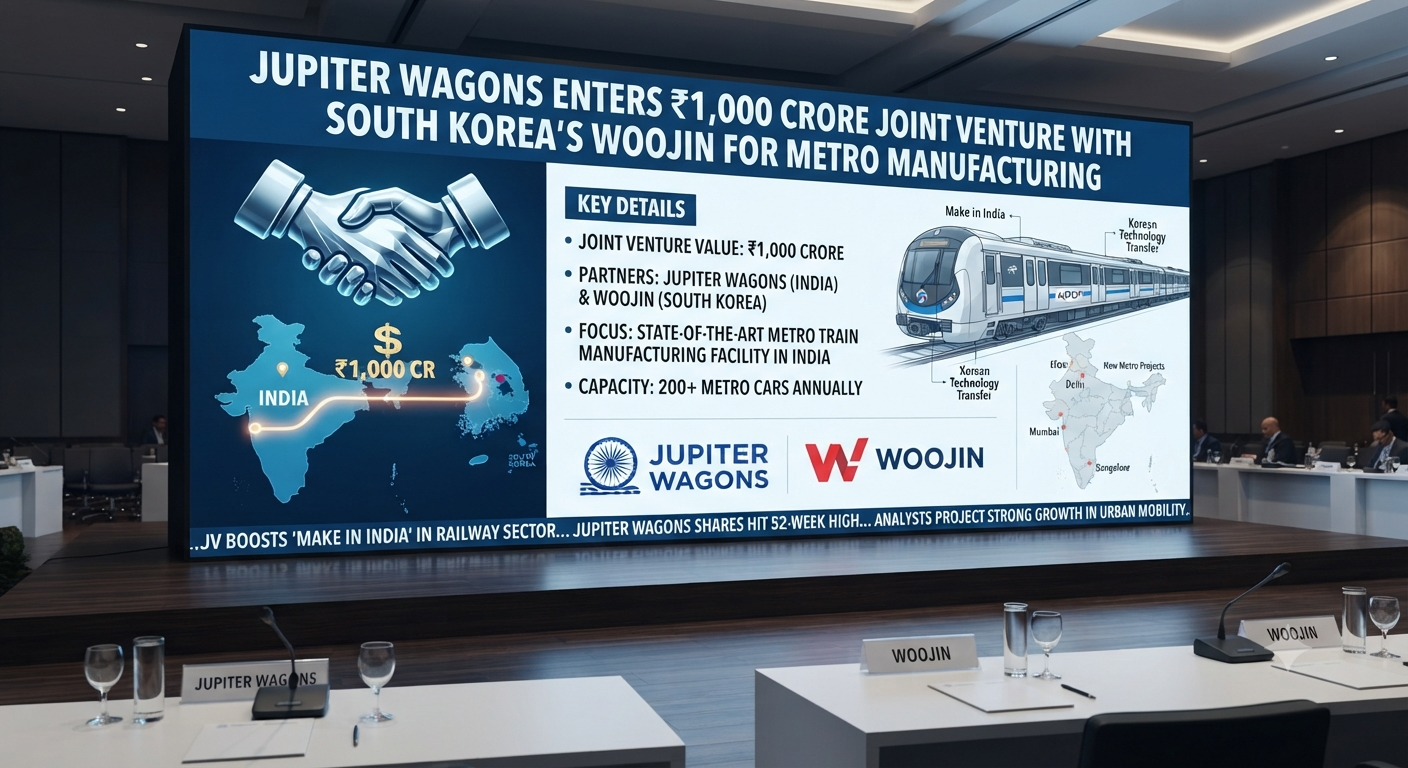
Jupiter Wagons Limited has entered into an 80:20 joint venture agreement with South Korea-based Woojin Industrial Systems Co. Ltd. to manufacture complete metro coaches and railway propulsion systems in India. The proposed venture, involving an estimated investment of ₹1,000 crore, marks Jupiter Wagons’ entry into two technology-intensive segments of the railway manufacturing industry and represents a significant expansion beyond its traditional freight wagon and railway component businesses.
The company announced on November 23, 2026, that it had executed a framework agreement with Woojin to jointly pursue rolling stock opportunities in India through a consortium and a joint venture company. Jupiter Wagons will hold an 80% stake, while Woojin will own the remaining 20%.
The partnership combines Jupiter Wagons’ domestic manufacturing capabilities and industry presence with Woojin’s expertise in metro rolling stock, propulsion technology and train control systems. It is expected to support local manufacturing, technology transfer and the development of advanced railway products under the Make in India initiative.
80:20 Joint Venture to Manufacture Complete Metro Coaches
Under the proposed arrangement, Jupiter Wagons will hold the majority ownership and lead the Indian venture, while Woojin will provide technical expertise and technology for manufacturing metro coaches and associated railway systems.
The joint venture plans to manufacture complete metro trainsets in India rather than limiting its operations to individual railway components.
Its proposed product portfolio will include:
- Complete metro coaches and trainsets
- Railway propulsion systems
- Train Control and Management Systems (TCMS)
- Automatic door systems
- Bogies and related components
- Aluminium car body shells
The inclusion of these products will allow the venture to participate in multiple stages of passenger rolling stock manufacturing, from coach structures and mechanical components to electrical propulsion and train control technologies.
The companies also intend to jointly participate in metro rail tenders, creating opportunities to supply complete trainsets to infrastructure projects across the country.
₹1,000 Crore Investment for a Dedicated Manufacturing Facility
The proposed joint venture is expected to involve an investment of approximately ₹1,000 crore to establish a dedicated manufacturing facility in India.
The planned facility will include infrastructure for manufacturing aluminium car bodies, which are increasingly important in modern passenger train design because of their potential to reduce vehicle weight and improve energy efficiency.
The manufacturing location has not yet been finalised, and the company has not announced a commissioning schedule or specific annual production capacity.
Jupiter Wagons is expected to lead the Indian consortium and take responsibility for financing the establishment and operations of the proposed venture, including land, plant, machinery and working capital.
The investment reflects the scale of infrastructure and technical capabilities required to manufacture complete metro coaches and advanced railway propulsion equipment domestically.
Woojin to Transfer Technology to India
Technology transfer is one of the most important elements of the partnership.
Woojin Industrial Systems will provide its technical know-how to support the local design, engineering, manufacturing, testing, commissioning and maintenance of railway systems.
The collaboration is expected to cover propulsion systems, Electric Multiple Units (EMUs), Train Control and Management Systems and allied technologies for metro coaches, Vande Bharat trains and other railway projects.
Propulsion systems are among the most critical components of modern electric trains. They control the delivery of electrical power to traction motors, enabling trains to accelerate, regulate speed and apply regenerative braking.
Woojin brings more than five decades of engineering experience in railway systems. Its track record includes supplying more than 2,200 metro and commuter cars in South Korea since 2019, as well as technology associated with the country’s KTX high-speed train fleet.
For Jupiter Wagons, access to this expertise could accelerate its entry into advanced passenger rolling stock manufacturing while supporting the development of domestic engineering capabilities. <Cite refs={[“turn540551search16″,”turn540551search6″,”turn540551search2”]} />
Propulsion Technology Could Extend Beyond Metro Trains
Although metro coach manufacturing is a central part of the agreement, the joint venture’s potential market extends to several other railway segments.
The propulsion systems developed through the partnership are intended to serve:
- Metro trainsets
- Vande Bharat trains
- Electric Multiple Units (EMUs)
- Semi-high-speed trains
- High-speed railway projects
This broader scope could create opportunities beyond individual metro projects and allow the venture to participate in India’s expanding electric passenger rail ecosystem.
The demand for advanced propulsion and train control systems is closely linked to the development of modern railway networks. As operators seek improved energy efficiency, reliability and passenger capacity, locally manufactured technology could become increasingly important.
However, participation in these markets will depend on technical validation, tender eligibility, regulatory requirements and the company’s ability to secure contracts.
Jupiter Wagons Expands Beyond Freight Railway Manufacturing
The partnership represents a strategic change in Jupiter Wagons’ business portfolio.
The company has traditionally operated in freight wagons, bogies, couplers and other railway components. Its manufacturing activities also include railway wheels, axles and wheelsets through Jupiter Tatravagonka Railwheel Factory.
Entering complete metro coach and propulsion manufacturing would expand its role across the railway value chain.
Instead of concentrating primarily on freight equipment and individual components, Jupiter Wagons will be positioned to pursue opportunities in passenger rolling stock and advanced electrical systems.
The move could also strengthen its ability to participate in larger railway projects that require multiple integrated technologies and manufacturing capabilities.
For Woojin, the partnership provides an Indian manufacturing platform and an opportunity to participate in the country’s expanding railway infrastructure market.
Opportunities and Execution Challenges Ahead
India’s investment in metro networks, passenger rail modernisation and higher-speed train services provides a potential market for the proposed venture.
Domestic manufacturing could help reduce dependence on imported railway technologies, strengthen local supply chains and create opportunities for engineering, manufacturing and maintenance activities.
Nevertheless, the proposed ₹1,000 crore investment and technology transfer will require effective execution.
The partners will need to establish the manufacturing facility, develop local supplier networks, complete technology integration and meet the technical standards required for railway projects.
Winning metro and propulsion contracts will also be essential to building a sustainable business. The framework agreement establishes the partnership and its intended scope, but it does not itself represent an awarded metro manufacturing order.
Investors will therefore be watching the finalisation of the joint venture, manufacturing location, investment progress and subsequent tender participation.
The Worldonomics Times View
Jupiter Wagons’ partnership with Woojin Industrial Systems represents an important step in the evolution of India’s railway manufacturing sector. The move takes the company beyond freight wagons and components into complete metro coaches and advanced propulsion systems, two areas requiring specialised engineering and technology capabilities.
The 80:20 ownership structure gives Jupiter Wagons majority control, while Woojin’s proposed technology transfer provides access to established railway engineering expertise. The estimated ₹1,000 crore manufacturing investment also signals the scale of the company’s ambitions in passenger rolling stock.
However, the long-term success of the venture will depend on more than the announcement itself. Timely facility development, effective localisation, successful technology integration and the ability to secure competitive railway contracts will determine whether the partnership translates into sustainable business growth.
Conclusion: Jupiter Wagons’ proposed ₹1,000 crore joint venture with South Korea’s Woojin Industrial Systems marks a significant expansion into metro coach manufacturing and railway propulsion technology. With Jupiter holding an 80% stake and Woojin providing technical expertise and technology transfer, the partnership aims to manufacture complete metro trainsets and critical railway systems in India. Its wider focus on Vande Bharat, EMUs and high-speed train applications could create additional opportunities, provided the companies successfully execute their investment and secure commercial contracts.