Regulator flags failure to maintain records relating to unpublished price-sensitive information; case highlights the importance of insider-trading controls and corporate governance
New Delhi | 4 November 2026
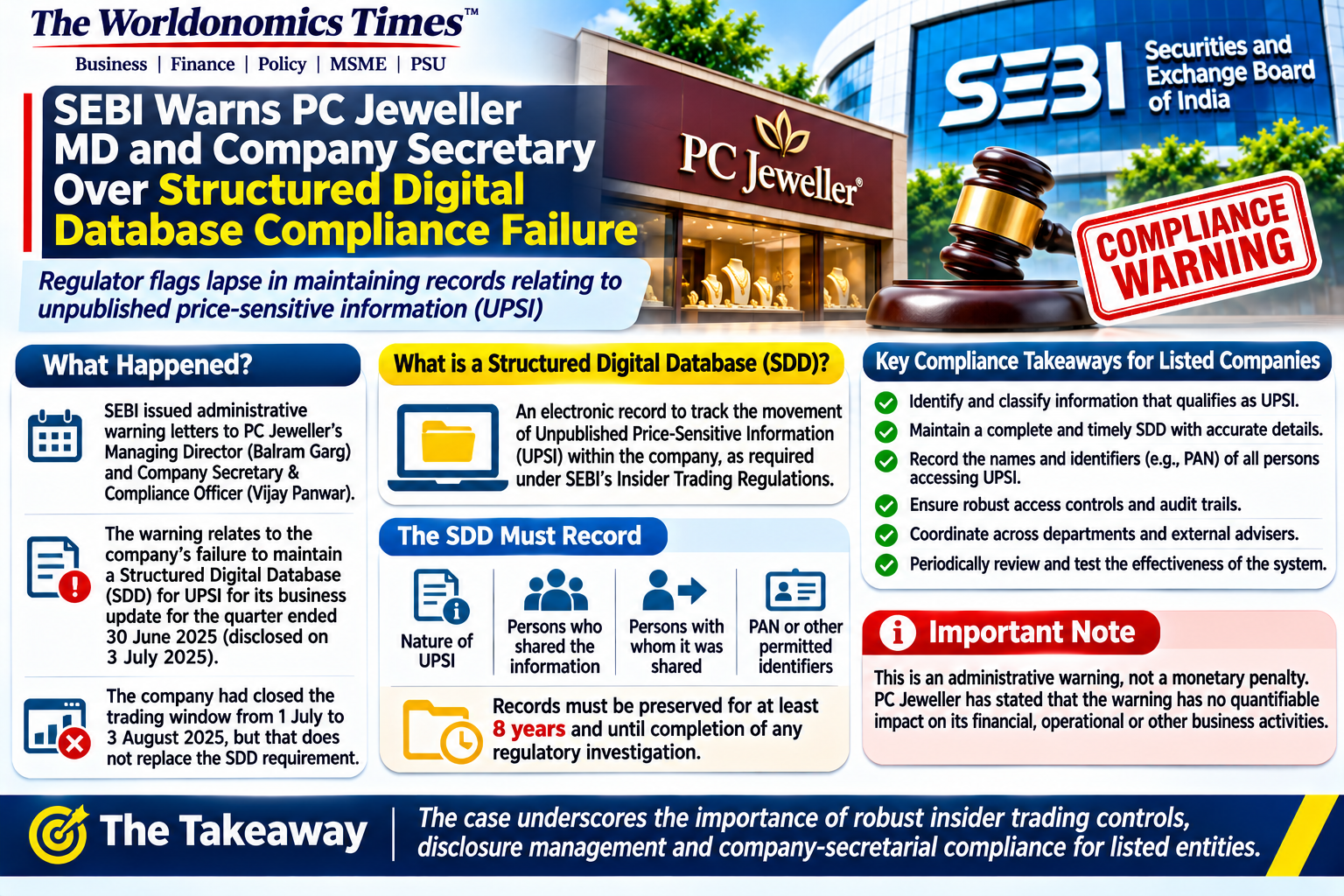
The Securities and Exchange Board of India (SEBI) has issued administrative warning letters to PC Jeweller’s Promoter and Managing Director, Balram Garg, and Company Secretary and Compliance Officer, Vijay Panwar, over the company’s failure to maintain a structured digital database (SDD) relating to unpublished price-sensitive information (UPSI). The action brings renewed attention to the importance of regulatory record-keeping, insider-trading prevention and corporate-secretarial compliance in listed companies.
PC Jeweller disclosed the regulatory development through a stock exchange filing. According to the company, the warning letters were received on 30 October 2026 and related to a business update for the quarter ended 30 June 2025, which was disclosed to the stock exchanges on 3 July 2025. <Link ref=”turn313540search3″ title=”PC Jeweller’s exchange filing”/>.
The matter is significant because the structured digital database is an important component of SEBI’s framework for preventing insider trading and ensuring that the flow of sensitive corporate information can be properly monitored.
What triggered SEBI’s warning?
The regulatory action relates to the non-maintenance of the structured digital database in connection with unpublished price-sensitive information associated with PC Jeweller’s quarterly business update for the June 2025 quarter.
In its disclosure, the company acknowledged that it had not maintained the required database for the business update published on 3 July 2025.
PC Jeweller also stated that the trading window for designated persons and their immediate relatives had remained closed from 1 July 2025 until 3 August 2025. The company’s financial results for the quarter ended 30 June 2025 were announced on 1 August 2025, and the trading restrictions continued for two days thereafter.
The company referred to these safeguards while explaining the circumstances surrounding the lapse. However, the closure of a trading window and maintenance of an SDD are separate compliance requirements. Observing one does not automatically replace the other.
SEBI’s warning was administrative in nature. PC Jeweller stated that the action had no quantifiable impact on its financial, operational or other business activities. The company did not report a monetary penalty in connection with these warning letters. <Link ref=”turn313540search0″ title=”ETLegalWorld report”/>.
What is a Structured Digital Database?
A structured digital database is an internal electronic record that helps a listed company track the movement of unpublished price-sensitive information among individuals and organisations.
Under Regulation 3(5) of the SEBI (Prohibition of Insider Trading) Regulations, 2015, the board of directors or heads of the organisation responsible for handling UPSI must ensure that the database records:
- The nature of the unpublished price-sensitive information.
- The names of persons who have shared the information.
- The names of persons with whom the information has been shared.
- Their Permanent Account Numbers (PANs), or other legally authorised identifiers where PAN is unavailable.
The regulation also requires adequate internal controls, time-stamping and audit trails to ensure that the database cannot be tampered with. The database must be maintained internally and cannot simply be outsourced as a compliance responsibility.
Regulation 3(6) further requires the database to be preserved for at least eight years after completion of the relevant transactions. Where the regulator initiates an investigation or enforcement proceeding, relevant records must be preserved until the proceeding is completed. <Link ref=”turn515216search12″ title=”SEBI Insider Trading Regulations”/>.
Why is UPSI tracking important?
Unpublished price-sensitive information is information relating to a company that is not generally available and which, if published, is likely to materially affect the price of its securities.
Such information may include financial results, changes in capital structure, mergers and acquisitions, major business developments, changes in key managerial personnel and other material events covered under the applicable regulations.
When such information is shared internally or with external advisers, auditors, consultants, legal professionals or other authorised parties, the company must be able to establish who accessed it and when.
This is where the SDD becomes particularly important. It provides a traceable record that can assist the company and regulators in examining whether sensitive information was shared appropriately and whether adequate safeguards were in place.
A properly maintained database also supports internal investigations if an information leak or suspected insider-trading incident arises.
Implications for company secretaries and compliance officers
The PC Jeweller matter highlights the growing importance of the company secretary and compliance officer in ensuring that regulatory requirements are implemented in day-to-day corporate operations.
Their responsibilities extend beyond filing periodic disclosures with stock exchanges. They also involve coordinating with management, finance, legal, human resources, investor relations and other departments to ensure that sensitive information is handled in accordance with applicable regulations.
An effective compliance framework should include:
1. Centralised UPSI identification: Companies should establish procedures to identify information that qualifies as UPSI and determine when it becomes restricted information.
2. Timely database entries: Details of information-sharing events should be recorded promptly, rather than reconstructed after a disclosure or regulatory query.
3. Accurate identification: PANs or other permitted identifiers of individuals and entities accessing UPSI should be properly recorded.
4. Audit trails and access controls: The system should maintain reliable timestamps, restricted access and safeguards against unauthorised changes.
5. Departmental coordination: All departments and external advisers involved in handling sensitive information should follow documented protocols.
6. Periodic review: The compliance team should regularly test the completeness and accuracy of database entries and report gaps to the appropriate management or board-level authority.
Trading window closure is not a substitute for database maintenance
One of the important compliance lessons from this case is the distinction between trading-window restrictions and structured digital database requirements.
A trading-window closure restricts designated persons and their immediate relatives from dealing in securities during specified periods under the company’s insider-trading code.
An SDD, on the other hand, records the movement of UPSI and identifies the persons who shared or received it. The two mechanisms serve related but different purposes within the insider-trading compliance framework.
Therefore, even where a company has implemented trading restrictions, it must separately ensure that the required information-sharing records are properly maintained.
A reminder for listed companies
SEBI’s administrative warning to PC Jeweller’s senior officials serves as a reminder that compliance with insider-trading regulations requires both preventive controls and reliable documentation.
For listed entities, the quality of governance is reflected not only in public disclosures and financial reporting but also in the internal systems used to protect confidential information.
As regulatory oversight and technology-driven surveillance continue to evolve, companies need to ensure that their compliance systems are accurate, timely and auditable.
The PC Jeweller case reinforces a clear message for boards, company secretaries and compliance teams: closing the trading window is important, but maintaining a complete and reliable record of unpublished price-sensitive information is equally essential.