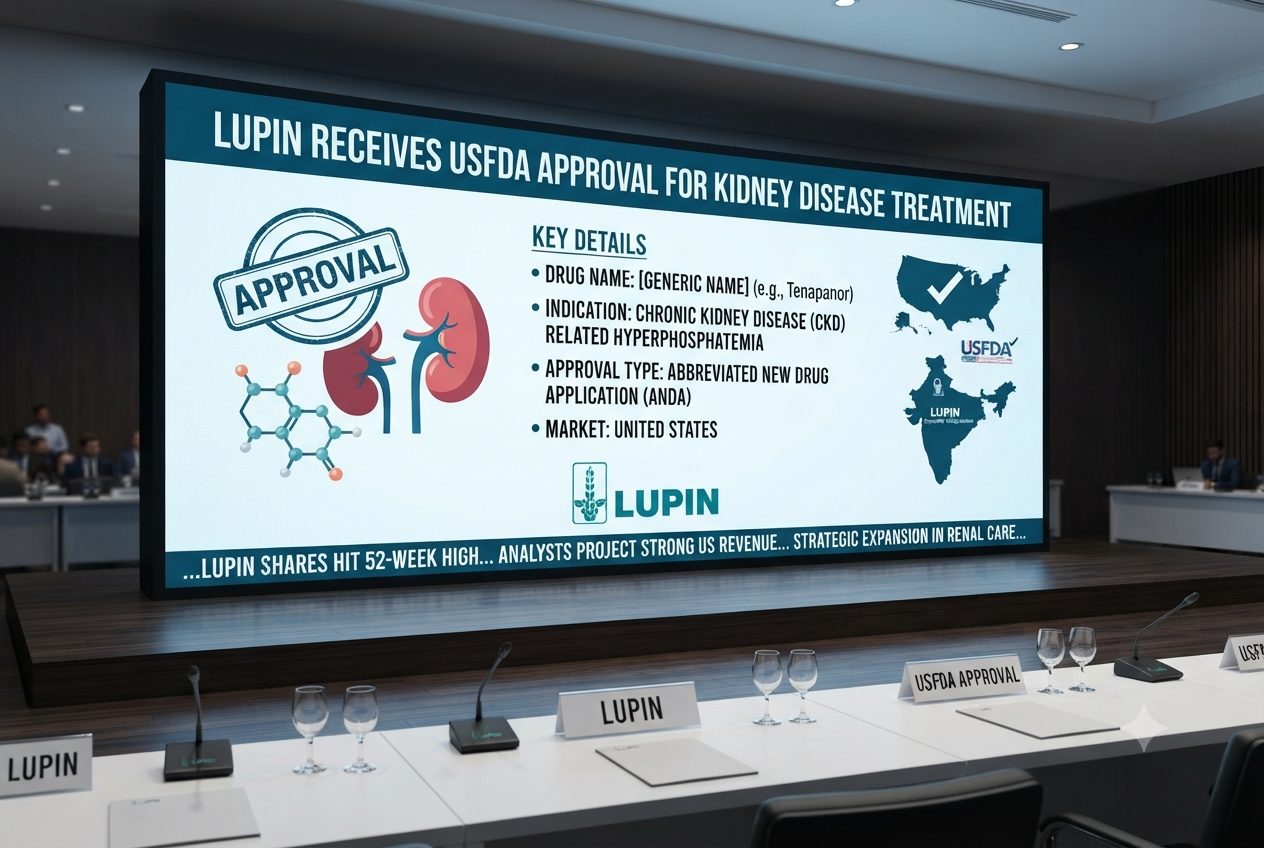
Lupin Limited has received approval from the United States Food and Drug Administration (USFDA) for its generic Ferric Citrate Tablets, 210 mg, strengthening the company’s presence in the US pharmaceutical market and expanding its portfolio of treatments for chronic kidney disease (CKD).
The Mumbai-headquartered pharmaceutical company announced on November 23, 2026, that the USFDA had approved its Abbreviated New Drug Application (ANDA) for Ferric Citrate Tablets. The generic product is bioequivalent to Auryxia Tablets, 210 mg, the reference-listed drug associated with Keryx Biopharmaceuticals.
The approval gives Lupin an opportunity to participate in a US market where the reference product recorded estimated annual sales of $58.1 million for the 12 months ended September 2026, according to IQVIA data cited by the company.
The development is strategically important for Lupin as it continues to strengthen its US generics portfolio and expand its presence in specialised therapeutic segments.
USFDA Approves Ferric Citrate Tablets, 210 mg
The USFDA approval covers Lupin’s Ferric Citrate Tablets at a strength of 210 mg. The product is a generic equivalent of Auryxia, which is used in the management of certain conditions associated with chronic kidney disease.
Bioequivalence means that the generic medicine has demonstrated comparable performance to the reference product under applicable regulatory standards. ANDA approval allows a generic manufacturer to market an approved equivalent medicine in the United States, subject to applicable regulatory and commercial requirements.
For Lupin, securing this approval adds another product to its established US pharmaceutical business. It also provides an opportunity to compete in a therapeutic category where patients require ongoing treatment and consistent access to medicines.
The approval is not for a newly developed drug molecule. Instead, it represents regulatory clearance for Lupin’s generic version of an existing treatment.
Two Important Uses in Chronic Kidney Disease
Ferric Citrate Tablets are indicated for two specific conditions in adults with chronic kidney disease, depending on whether the patient is receiving dialysis.
1. Management of hyperphosphatemia in dialysis patients
The medicine is indicated to control elevated serum phosphorus, also known as phosphate, levels in adults with CKD who are undergoing dialysis.
Hyperphosphatemia occurs when phosphate levels in the blood become abnormally high. It is a recognised complication of advanced kidney disease because damaged kidneys may be unable to remove sufficient phosphate from the body.
Ferric citrate works as a phosphate binder. It binds dietary phosphate in the gastrointestinal tract, helping reduce the amount absorbed into the bloodstream.
2. Treatment of iron deficiency anaemia in non-dialysis patients
The second indication covers adults with chronic kidney disease who have iron deficiency anaemia but are not receiving dialysis.
Iron is essential for the production of haemoglobin, the protein in red blood cells responsible for carrying oxygen throughout the body. Insufficient iron can contribute to anaemia, fatigue and reduced physical capacity.
Ferric citrate provides an oral treatment option for managing iron deficiency in this patient population, under appropriate medical supervision.
These two indications broaden the relevance of the product across different groups of adults living with chronic kidney disease.
US Market Opportunity Estimated at $58.1 Million
The approval also brings a measurable commercial opportunity for Lupin.
According to IQVIA data for the 12 months ended September 2026, the reference product Auryxia had estimated annual US sales of approximately $58.1 million.
This figure provides an indication of the existing market for ferric citrate tablets in the United States. However, it should not be interpreted as a sales forecast for Lupin.
Actual commercial performance will depend on factors such as the timing of product launch, pricing, competition from other generic manufacturers, distribution arrangements and market demand.
The US generic pharmaceutical market is highly competitive, with manufacturers seeking to secure regulatory approvals for products across a wide range of therapeutic categories. Companies must balance pricing strategies with manufacturing costs, regulatory compliance and supply reliability.
For Lupin, the Ferric Citrate approval represents an additional opportunity to diversify its revenue base and strengthen its position in the US market.
Lupin Continues to Expand Its US Generics Portfolio
The latest approval is consistent with Lupin’s broader strategy of developing and commercialising generic, complex generic and specialty pharmaceutical products.
The company has a significant presence in the United States, one of the world’s largest pharmaceutical markets. Its portfolio covers several therapeutic areas, including cardiovascular diseases, respiratory conditions, diabetes, gastrointestinal disorders and women’s health.
Lupin operates manufacturing facilities and research centres supporting its pharmaceutical business across international markets. Its regulatory approvals in the US are important because they allow the company to introduce additional products while building on its existing commercial and distribution capabilities.
Expanding the product portfolio can also help reduce reliance on individual medicines and create opportunities across multiple therapeutic categories.
The Ferric Citrate approval adds a product associated with kidney disease management to this portfolio, strengthening Lupin’s presence in another important area of healthcare.
Competition and Commercial Challenges Ahead
Although the USFDA approval is a positive development, the commercial success of the product is not guaranteed.
The US generic pharmaceutical industry faces intense price competition, particularly when multiple manufacturers enter the same product category. Generic medicines can improve affordability and increase treatment options, but competition can also place pressure on manufacturers’ profit margins.
Lupin will need to establish competitive pricing, maintain consistent product availability and work effectively with distributors and healthcare supply channels.
Regulatory compliance and manufacturing quality will also remain essential. Pharmaceutical companies operating in the United States must maintain strict standards covering product quality, safety, manufacturing processes and regulatory reporting.
The company’s ability to convert regulatory approvals into sustainable sales will therefore be an important factor in determining the financial contribution of the new product.
The Worldonomics Times View
Lupin’s USFDA approval for Ferric Citrate Tablets, 210 mg, is a positive development for its US generics business and its broader kidney disease treatment portfolio. The product’s two approved indications address phosphate control in dialysis patients and iron deficiency anaemia in adults with chronic kidney disease who are not on dialysis.
The estimated $58.1 million annual US market for the reference product provides a commercial opportunity, although Lupin’s eventual market share will depend on launch timing, competition and pricing conditions.
More broadly, the approval highlights the importance of regulatory execution and portfolio diversification in the global pharmaceutical industry. Companies that consistently add differentiated and commercially viable products can strengthen their market presence and create additional growth opportunities.
Conclusion: Lupin has received USFDA approval for its generic Ferric Citrate Tablets, 210 mg, marking another addition to its US pharmaceutical portfolio. Bioequivalent to Auryxia, the medicine is indicated for controlling elevated phosphate levels in adults with chronic kidney disease undergoing dialysis and treating iron deficiency anaemia in eligible non-dialysis patients. With the reference product’s estimated annual US sales reaching $58.1 million, the approval offers Lupin a new commercial opportunity. Its ultimate contribution will depend on successful market entry, competitive positioning and consistent product supply.