Five of Eight Units Now Operational; Major Milestone for India’s Northeast Hydropower Development
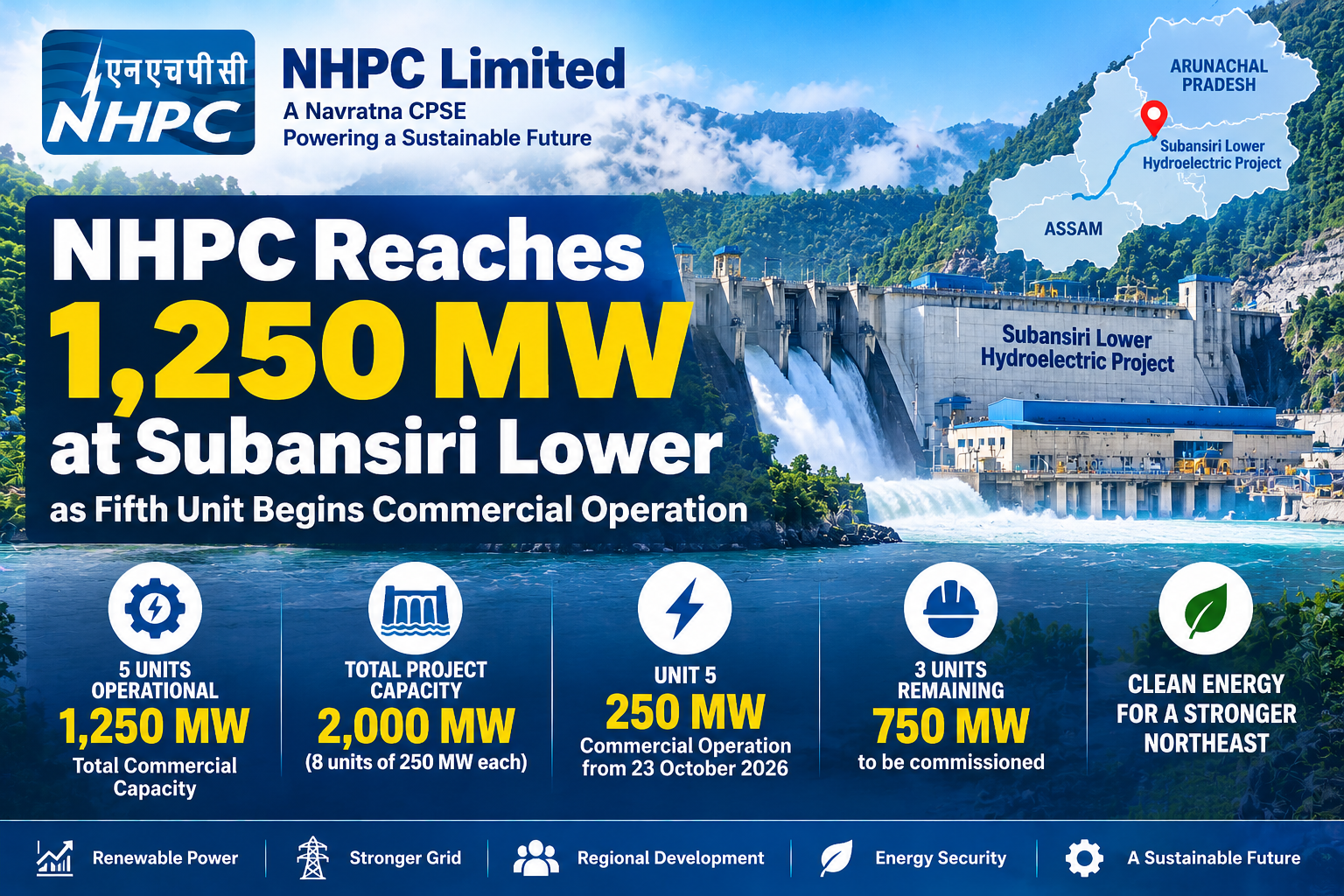
New Delhi: NHPC Limited has achieved a significant milestone in India’s hydropower sector with the commencement of commercial operation of the fifth 250 MW generating unit of its flagship 2,000 MW Subansiri Lower Hydroelectric Project. The Commercial Operation Date (CoD) of Unit 5 became effective from 00:00 hours on October 23, 2026, taking the project’s commercially operational capacity to 1,250 MW.
Located at Gerukamukh along the Assam–Arunachal Pradesh border, the Subansiri Lower project is being developed with eight generating units of 250 MW each. With Unit 5 now commercially operational, five units have achieved CoD, while three units representing another 750 MW remain to be commissioned. NHPC has stated that the commercial operation dates of the remaining units will be communicated in due course.
Fifth Unit Adds Another 250 MW
Unit 5 marks the latest addition to the project’s generating capacity. Before its commercial operation, four units with an aggregate capacity of 1,000 MW were already commercially operational.
The fifth unit was earlier synchronized with the National Grid on October 12, 2026, in the presence of senior officials from the Ministry of Power. Following testing and the required commissioning process, NHPC declared its commercial operation from October 23.
The achievement means that the Subansiri Lower project has now crossed the halfway mark in terms of its total installed capacity, with 62.5% of the 2,000 MW project commercially operational.
The remaining three units—each with a capacity of 250 MW—will take the project to its full installed capacity once commissioned.
Strategic Importance for Northeast India
The significance of Subansiri Lower extends beyond its generating capacity. The project is strategically positioned in the Northeast, a region with substantial untapped hydropower potential.
The addition of 250 MW strengthens the regional power system and contributes to the availability of renewable electricity. The North Eastern Regional Power Committee (NERPC) has already recorded the allocation of power from the Subansiri Lower project following the commercial operation of Unit V.
For a rapidly developing region, dependable electricity infrastructure is critical for industrial activity, infrastructure development, urbanisation and improving the overall quality of power supply.
Hydropower also offers an important advantage in a power system increasingly dominated by variable renewable sources. Solar and wind generation fluctuate according to weather and time of day, while hydropower can provide greater operational flexibility when water resources are available.
Engineering and Project Execution Milestone
The commissioning of Unit 5 also reflects the complex engineering requirements involved in large hydropower projects.
Each 250 MW generating unit involves major civil, electro-mechanical and electrical infrastructure, including turbines, generators, transformers, control systems and grid-connection facilities.
NHPC has credited the project team and associated stakeholders for the progress achieved. Company communications have highlighted the contribution of project personnel, contractors and other agencies involved in the commissioning process.
The company has described the achievement as an important step toward realizing the project’s full 2,000 MW potential.
Five Units Operational, Three Still to Go
The current status of Subansiri Lower can be summarised as follows:
| Parameter | Status |
|---|---|
| Total project capacity | 2,000 MW |
| Number of generating units | 8 |
| Capacity per unit | 250 MW |
| Units commercially operational | 5 |
| Current operational capacity | 1,250 MW |
| Remaining units | 3 |
| Remaining capacity | 750 MW |
The commercial operation of the fifth unit therefore represents substantial progress, but the project’s full potential will only be realised when all eight units become operational.
Recent project activity has also included major electro-mechanical work on the remaining units. In September, NHPC completed the lowering of the 395-tonne stator for Unit 7, another important step in the construction and commissioning process.
Contribution to India’s Clean Energy Transition
India’s electricity demand continues to rise as the economy expands and electrification accelerates. At the same time, the country is seeking to increase the contribution of non-fossil-fuel-based electricity.
Hydropower can play a complementary role alongside solar, wind, nuclear and other energy sources. Large hydro projects provide renewable generation capacity and can support grid stability, particularly when integrated with a diversified electricity portfolio.
The Subansiri Lower project therefore assumes significance not merely as an NHPC project but as part of India’s broader clean-energy infrastructure.
Once all eight units are operational, the project will provide a substantial additional block of hydropower capacity to the national and regional electricity system.
NHPC’s Larger Strategic Role
For NHPC, the progress at Subansiri Lower reinforces its position as one of India’s key public-sector organisations in hydropower development.
The company has increasingly been focusing on expanding its renewable energy portfolio while continuing to develop large hydroelectric projects. The Subansiri Lower project is particularly important because of its scale and location.
NHPC CMD Bhupender Gupta has described the achievement of 1,250 MW operational capacity as a defining milestone for the company’s hydropower journey and emphasised the project’s importance for energy security, clean-energy generation and socio-economic development in the Northeast.
What Comes Next?
The immediate focus will be on completing and commissioning the remaining three units.
If the remaining 750 MW is successfully brought into commercial operation, the project will reach its full 2,000 MW installed capacity. That would represent a major addition to India’s hydropower infrastructure and further strengthen electricity availability in the Northeast.
The commissioning of each additional unit will depend on completion of civil and electro-mechanical works, testing, grid integration and other statutory and technical requirements.
Conclusion
The commencement of commercial operation of Unit 5 of the Subansiri Lower Hydroelectric Project is a major milestone for NHPC and India’s power sector.
With five of eight 250 MW units now operational, the project has reached 1,250 MW of commercial capacity, bringing it significantly closer to its ultimate 2,000 MW potential.
For the Northeast, the project represents an important piece of energy infrastructure. For NHPC, it demonstrates continued progress on one of its largest hydropower developments. And for India’s energy transition, every additional unit of reliable renewable generation strengthens the country’s ability to meet growing electricity demand while diversifying its power mix.
The next milestone will be the commissioning of the remaining three units—and the eventual realization of the full 2,000 MW Subansiri Lower project.