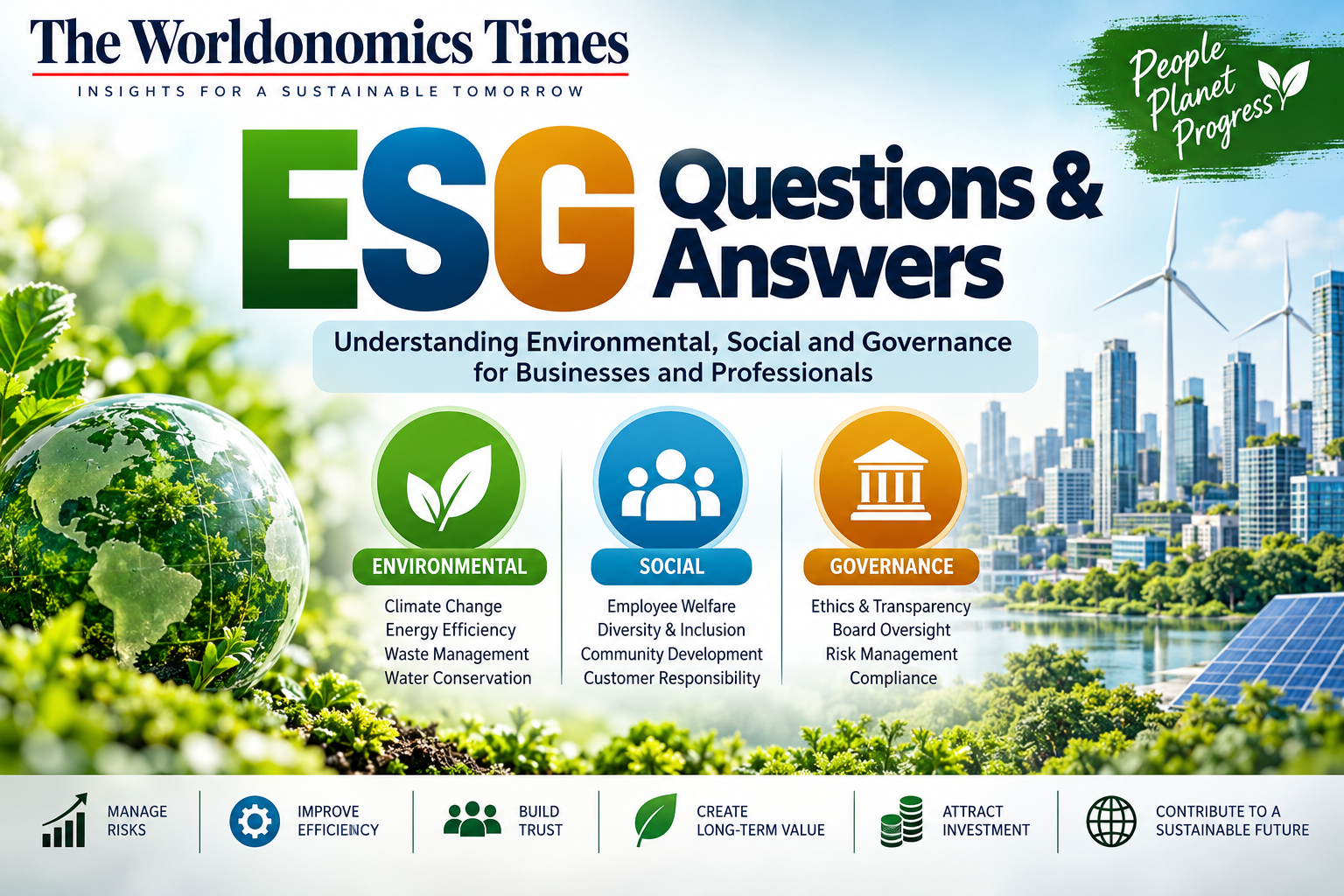
Understanding the U.S. ESG Disclosure Framework in 2026
Environmental, Social and Governance (ESG) reporting in the United States is developing through a combination of federal securities regulation, state legislation, stock-market requirements, industry rules and voluntary reporting frameworks.
Unlike the European Union, the United States does not currently have one comprehensive federal ESG reporting law applicable to all companies. The regulatory landscape is therefore more fragmented and increasingly influenced by individual states, particularly California.
As of October 2026, the U.S. Securities and Exchange Commission (SEC) has proposed rescinding its 2024 climate-related disclosure rules. At the same time, California is implementing mandatory greenhouse-gas reporting requirements for large companies doing business in the state.
Q1. What is ESG reporting?
ESG reporting is the process through which a company discloses information about its environmental, social and governance performance, risks, opportunities, policies, targets and impacts.
Q2. Is ESG reporting mandatory in the United States?
There is no single nationwide ESG reporting law covering every U.S. company.
However, certain ESG and climate-related information may be mandatory under federal securities rules, state legislation and sector-specific requirements.
Q3. Which federal agency is most important for ESG reporting?
The U.S. Securities and Exchange Commission (SEC) is the principal federal regulator relevant to ESG disclosures by public companies and securities issuers.
Q4. Does the United States have a federal ESG law?
No. The U.S. does not currently have one comprehensive federal ESG statute comparable to the EU’s corporate sustainability reporting framework.
ESG reporting obligations arise from different regulatory and legal sources.
Q5. What happened to the SEC’s 2024 climate disclosure rules?
The SEC adopted climate-related disclosure rules on March 6, 2024.
The rules were subsequently stayed on April 4, 2024, following legal challenges. In March 2025, the SEC announced that it would end its defense of the rules.
In May 2026, the SEC proposed rescinding the 2024 rules entirely.
Q6. Are the SEC’s 2024 climate rules currently in force?
No. The 2024 rules were stayed and have not become operational requirements for companies.
As of October 2026, the SEC has proposed rescinding them completely, but the rescission process itself is a rulemaking process.
Q7. What does the proposed SEC rescission mean for companies?
If finalized, the rescission would remove the specific climate disclosure framework adopted in 2024.
Companies would nevertheless remain subject to existing securities-law disclosure requirements, including disclosure of material risks and financial information.
Q8. Does this mean U.S. companies can completely ignore climate risk?
No.
A company may still need to disclose material climate-related risks where those risks are relevant under existing securities disclosure requirements.
The important distinction is between mandatory climate-specific reporting and existing materiality-based disclosure obligations.
Q9. What is materiality in U.S. ESG reporting?
Materiality generally focuses on information that a reasonable investor would consider important when making an investment or voting decision.
This investor-focused approach is different from the broader concept of impact materiality used in some international ESG frameworks.
Q10. What are Scope 1, Scope 2 and Scope 3 emissions?
Scope 1: Direct greenhouse-gas emissions from sources owned or controlled by a company.
Scope 2: Indirect emissions associated with purchased or acquired electricity, steam, heating or cooling.
Scope 3: Other indirect emissions throughout the company’s value chain.
Q11. Is Scope 3 reporting mandatory throughout the United States?
No.
There is currently no nationwide requirement making Scope 3 reporting mandatory for every U.S. company.
However, specific state requirements can require Scope 3 reporting.
Q12. Which U.S. state has become particularly important for mandatory ESG reporting?
California.
California has enacted two major climate disclosure laws:
- SB 253 – Climate Corporate Data Accountability Act
- SB 261 – Climate-Related Financial Risk Act
These laws have significant implications for large companies doing business in California.
Q13. What is California SB 253?
SB 253 requires qualifying large business entities doing business in California to disclose greenhouse-gas emissions.
The law applies to U.S.-formed entities with annual revenues exceeding $1 billion that do business in California.
Q14. Does SB 253 apply only to California companies?
No.
The law can apply to entities formed under the laws of California, another U.S. state, the District of Columbia or federal law, provided they meet the applicable revenue and California-business requirements.
Q15. What emissions must companies report under SB 253?
The law covers:
- Scope 1 emissions
- Scope 2 emissions
- Scope 3 emissions
Scope 1 and Scope 2 reporting begins in the initial reporting cycle, while Scope 3 reporting follows in subsequent years.
Q16. When is the first California SB 253 reporting deadline?
CARB currently identifies November 10, 2026 as the deadline for reporting Scope 1 and Scope 2 emissions for the first reporting cycle.
Q17. Is SB 253 currently being implemented?
Yes.
The California Air Resources Board (CARB) is developing and administering the reporting framework.
CARB has released reporting guidance and resources for the 2026 reporting cycle.
Q18. What is CARB?
CARB stands for the California Air Resources Board.
It is responsible for administering California’s climate and greenhouse-gas regulatory programs, including the corporate climate disclosure framework.
Q19. What is California SB 261?
SB 261 addresses climate-related financial risk.
It applies to qualifying business entities with annual revenues exceeding $500 million that do business in California.
Q20. Is SB 261 currently enforceable?
The situation is different from SB 253.
Following a court injunction, CARB states that it is not enforcing SB 261, and covered entities may voluntarily publish their climate-related financial risk reports while the litigation continues.
Q21. What is a climate-related financial risk report?
It generally addresses how climate-related risks could affect a company’s business, financial position, strategy and operations, together with measures adopted to reduce or adapt to those risks.
Q22. Does SB 261 require greenhouse-gas emissions reporting?
SB 261 primarily focuses on climate-related financial risk, whereas SB 253 is the California law specifically focused on corporate greenhouse-gas emissions.
Q23. Why is California important for companies outside the state?
A company does not necessarily escape California requirements simply because it is incorporated elsewhere.
Companies incorporated in another U.S. state—or potentially operating through complex corporate structures—may be covered if they satisfy the statutory requirements and do business in California.
Q24. Can an Indian company be affected by U.S. ESG regulations?
Potentially, yes.
An Indian company with U.S. operations, subsidiaries or other qualifying business activities may need to assess whether it falls within applicable U.S. federal or state requirements.
Q25. Can a multinational company face both U.S. and EU ESG reporting requirements?
Yes.
A multinational group may simultaneously face U.S. securities disclosures, California climate reporting and EU sustainability reporting requirements depending on its corporate structure, listing status, revenue and operations.
Q26. Are private companies subject to ESG reporting?
Private companies are generally outside the SEC’s public-company reporting regime.
However, private companies may still face ESG reporting obligations through state legislation, contractual requirements, lenders, investors, customers or supply-chain requirements.
Q27. Are U.S. listed companies required to publish ESG reports?
Not necessarily as a separate ESG report.
However, listed companies may be required to disclose material information under securities laws.
Companies may also voluntarily publish sustainability or ESG reports to satisfy investor and stakeholder expectations.
Q28. What is the difference between mandatory and voluntary ESG reporting?
Mandatory reporting is required by applicable law or regulation.
Voluntary reporting is undertaken by companies to provide investors, customers, employees and other stakeholders with additional information.
Many U.S. companies continue to publish voluntary ESG or sustainability reports despite changes in federal regulation.
Q29. Why do companies voluntarily report ESG information?
Common reasons include:
- Investor expectations
- Customer requirements
- Access to capital
- Reputation
- Supply-chain requirements
- Risk management
- Employee expectations
- International reporting requirements
- Preparation for future regulation
Q30. What ESG topics are commonly reported in the United States?
Common topics include:
- Climate change
- Greenhouse-gas emissions
- Energy
- Water
- Waste
- Diversity and inclusion
- Employee welfare
- Occupational health and safety
- Human rights
- Business ethics
- Anti-corruption
- Cybersecurity
- Board governance
- Risk management
Q31. Does the U.S. follow the EU’s double-materiality approach?
Generally, no.
The U.S. securities disclosure framework traditionally emphasizes information material to investors.
The EU sustainability framework uses a broader double-materiality approach, considering both financial materiality and impact materiality.
Q32. Is climate risk part of enterprise risk management?
Increasingly, companies integrate climate-related risks into enterprise risk management.
Risks can include:
- Physical risks
- Regulatory risks
- Technology risks
- Market risks
- Supply-chain disruption
- Litigation
- Reputation
- Transition risks
Q33. What are physical climate risks?
Physical risks arise from climate-related events or long-term changes.
Examples include:
- Floods
- Hurricanes
- Wildfires
- Drought
- Extreme heat
- Water shortages
- Rising sea levels
Q34. What are transition risks?
Transition risks arise from the shift toward a lower-carbon economy.
They can result from:
- New regulations
- Carbon pricing
- Technology changes
- Changing consumer preferences
- Investor expectations
- Changes in energy markets
Q35. Is ESG reporting relevant to U.S. financial institutions?
Yes.
Banks, asset managers, insurers and other financial institutions face ESG-related expectations from investors, regulators, clients and counterparties.
Their requirements may differ depending on their activities and applicable regulations.
Q36. Are ESG funds regulated in the United States?
Investment products marketed using ESG or sustainability-related terminology can be subject to securities and investment-adviser regulations.
Fund managers must ensure that their disclosures and marketing accurately represent their investment strategies.
Q37. What is greenwashing?
Greenwashing occurs when a company exaggerates, misrepresents or inadequately substantiates its environmental or sustainability claims.
It can create legal, regulatory and reputational risks.
Q38. Can ESG claims create securities-law risks?
Yes.
If ESG-related statements are materially misleading or omit required material information, they can potentially create securities-law or litigation risks.
Q39. What role does the board play in ESG?
The board can oversee:
- ESG strategy
- Climate risk
- Sustainability targets
- Risk management
- Compliance
- ESG-related disclosures
- Stakeholder expectations
Q40. What role does the CFO play in ESG reporting?
The CFO increasingly plays a central role because ESG information is becoming connected with financial planning, risk management and corporate reporting.
Responsibilities may include:
- ESG budgeting
- Data controls
- Carbon accounting
- Financial impact assessment
- Internal controls
- Disclosure review
- Assurance coordination
Q41. What role can CPAs play in ESG reporting?
CPAs can contribute to:
- ESG data assurance
- Internal controls
- Reporting
- Carbon accounting
- Risk assessment
- Financial impact analysis
- Disclosure processes
Q42. What role can CMAs play in U.S. ESG reporting?
Management accountants can help connect ESG performance with business economics.
They can contribute to:
- ESG budgeting
- Cost analysis
- Carbon costing
- Performance measurement
- ESG KPIs
- Management dashboards
- Scenario analysis
- Investment decisions
- Sustainability-linked performance measurement
Q43. Why is ESG data governance important?
ESG reporting requires reliable data from many departments.
A company may need data from:
- Finance
- Operations
- Human resources
- Procurement
- Facilities
- Supply chain
- Legal
- Risk management
- IT
Strong data governance helps improve consistency and auditability.
Q44. Is ESG assurance mandatory in the United States?
There is no single nationwide ESG assurance requirement covering all companies.
Assurance requirements depend on the applicable law, reporting framework and disclosure.
Q45. Why is third-party assurance important?
Independent assurance can improve:
- Credibility
- Data reliability
- Investor confidence
- Internal controls
- Regulatory readiness
- Comparability
Q46. What is the significance of the GHG Protocol?
The Greenhouse Gas Protocol provides widely used methodologies for measuring and reporting corporate greenhouse-gas emissions.
It is particularly relevant to companies developing emissions inventories.
Q47. Does U.S. ESG reporting use international frameworks?
Many U.S. companies voluntarily use international or market-based frameworks and standards.
Depending on their stakeholders and markets, companies may use frameworks associated with the GHG Protocol, ISSB, TCFD, SASB and other sustainability reporting approaches.
Q48. Why should U.S. companies maintain ESG data even when federal requirements change?
Because ESG data can still be required by:
- State regulations
- International regulations
- Customers
- Investors
- Lenders
- Supply-chain partners
- Internal risk-management systems
Regulatory changes do not eliminate the business value of reliable ESG data.
Q49. What should a company do to prepare for mandatory ESG reporting?
A practical ESG reporting readiness plan should include:
- Identify applicable federal and state requirements.
- Determine whether the company falls within California SB 253 or other state requirements.
- Map Scope 1, Scope 2 and relevant Scope 3 emissions.
- Establish ESG data ownership.
- Create internal controls over ESG information.
- Conduct a materiality assessment.
- Establish ESG policies and governance.
- Integrate ESG risks into enterprise risk management.
- Document methodologies and assumptions.
- Prepare for independent assurance where required or appropriate.
Q50. What is the future of mandatory ESG reporting in the United States?
The U.S. ESG reporting environment is likely to remain fragmented and evolving.
At the federal level, the SEC’s 2024 climate disclosure rules are facing proposed rescission. At the state level, California is moving ahead with corporate greenhouse-gas reporting under SB 253, while SB 261 remains subject to a court-related enforcement pause.
For companies, the practical lesson is clear: ESG compliance in the United States cannot be viewed only through the lens of federal regulation. State laws, international operations, investor expectations and supply-chain requirements can all create ESG reporting responsibilities.
Conclusion
Mandatory ESG reporting in the United States is fundamentally different from the centralized approach emerging in the European Union.
There is currently no single U.S. federal ESG reporting statute applicable to all companies. Instead, the framework combines securities-law disclosure principles, state-level climate legislation and industry-specific requirements.
The SEC’s 2024 climate disclosure rules remain stayed while the Commission pursues proposed rescission. Meanwhile, California’s SB 253 creates a significant mandatory greenhouse-gas reporting regime for qualifying large companies doing business in California. SB 261 remains subject to an enforcement injunction and is currently being treated by CARB as voluntary.
For finance professionals, including CA, CMA and CPA professionals, ESG reporting is increasingly becoming an extension of corporate reporting, financial control, risk management and strategic decision-making.
The most effective approach for companies is therefore not simply to wait for regulations. Building reliable ESG data, governance, internal controls and reporting systems today can help businesses respond to changing regulations, investor expectations and international market requirements.
The Worldonomics Times will continue tracking developments in ESG regulations across the United States, Europe, India and other major economies.