Higher investment and turnover thresholds give growing enterprises more room to scale while retaining MSME benefits
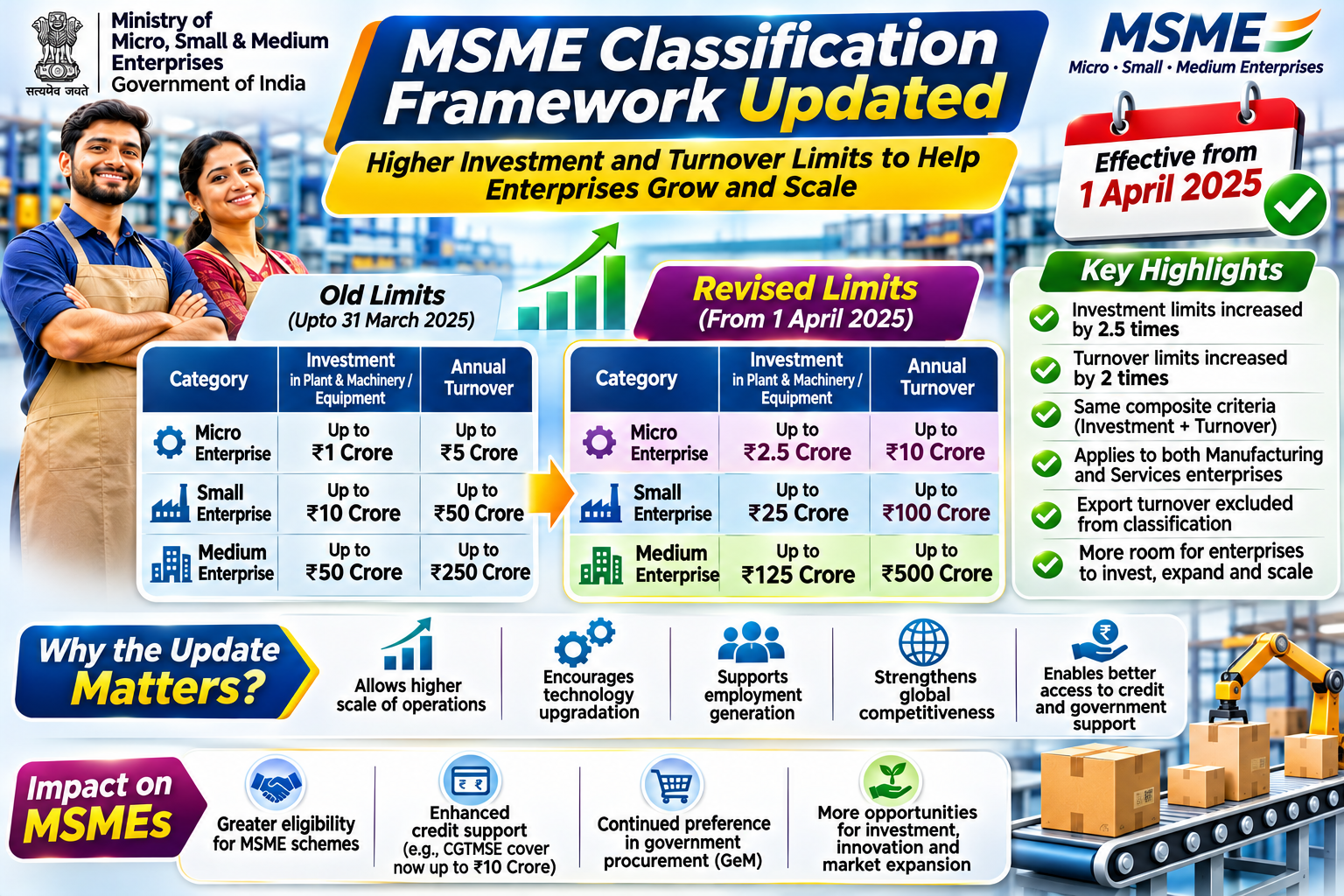
New Delhi, November 2026: India’s MSME classification framework has undergone a significant change, giving enterprises substantially higher investment and turnover limits to qualify as Micro, Small or Medium Enterprises. The revised framework came into effect from 1 April 2025 following the Ministry of Micro, Small and Medium Enterprises notification dated 21 March 2025.
The revision was announced in the Union Budget 2025-26 with the objective of helping MSMEs achieve greater economies of scale, adopt technology, access capital more effectively and strengthen their competitiveness. The Government increased the investment limits by 2.5 times and the turnover limits by two times across all three MSME categories.
The change is particularly important because classification determines an enterprise’s eligibility for several government programmes, credit-related support, procurement preferences and other MSME-focused measures.
New MSME Classification Limits
The revised framework uses a composite criterion based on investment in plant and machinery or equipment and annual turnover. The same classification applies to both manufacturing and services enterprises.
| Category | Investment Limit | Turnover Limit |
|---|---|---|
| Micro Enterprise | Up to ₹2.5 crore | Up to ₹10 crore |
| Small Enterprise | Up to ₹25 crore | Up to ₹100 crore |
| Medium Enterprise | Up to ₹125 crore | Up to ₹500 crore |
The earlier limits were ₹1 crore/₹5 crore for Micro, ₹10 crore/₹50 crore for Small and ₹50 crore/₹250 crore for Medium enterprises respectively.
This represents a major expansion of the MSME universe, particularly for enterprises that have been growing rapidly but previously faced the possibility of moving outside the MSME framework.
Why the Revision Matters
One of the biggest concerns for a growing MSME is the possibility that expansion could cause it to lose its MSME status.
A manufacturer may invest in new machinery, increase production capacity and expand sales. Under the previous thresholds, such growth could quickly push the enterprise beyond the applicable investment or turnover ceiling.
The revised limits provide considerably more headroom.
For example, an enterprise with investment of ₹20 crore and annual turnover of ₹80 crore can now remain within the Small Enterprise classification, provided it satisfies the applicable conditions. Under the previous framework, both figures would have exceeded the Small Enterprise limits.
This creates greater room for businesses to invest in technology, machinery, employees, product development and market expansion without immediately moving outside the MSME framework.
Both Investment and Turnover Matter
Entrepreneurs should understand that MSME classification is not based on investment alone or turnover alone.
It is a composite framework. Therefore, enterprises should monitor both parameters carefully.
For example, a business could have investment below the prescribed threshold but turnover above the limit. Similarly, investment could become the determining factor even when turnover remains within the applicable range.
The classification therefore requires enterprises to maintain accurate financial and statutory records.
The Government’s Udyam system uses information linked with relevant government databases for classification, making accurate reporting increasingly important.
Export Growth Gets Additional Importance
Another important feature of the MSME classification framework is the treatment of export turnover.
The composite classification framework introduced in 2020 provided that turnover relating to exports is excluded while calculating turnover for MSME classification. This approach is designed to prevent export-oriented enterprises from losing MSME status merely because their international sales increase.
For India’s exporters, this is significant.
An enterprise can therefore focus on increasing international business without treating export growth in the same manner as domestic turnover for the classification calculation, subject to the applicable rules.
This supports the broader policy objective of encouraging MSMEs to become part of global value chains.
Impact on Credit and Government Support
The revised classification is not simply a change in numbers. It can influence access to the wider MSME support ecosystem.
The Government has linked MSME development with measures covering Priority Sector Lending, public procurement preferences and various schemes and programmes. The Ministry has stated that the revised framework is intended to encourage higher efficiency, technological upgrading, better access to capital and greater global competitiveness.
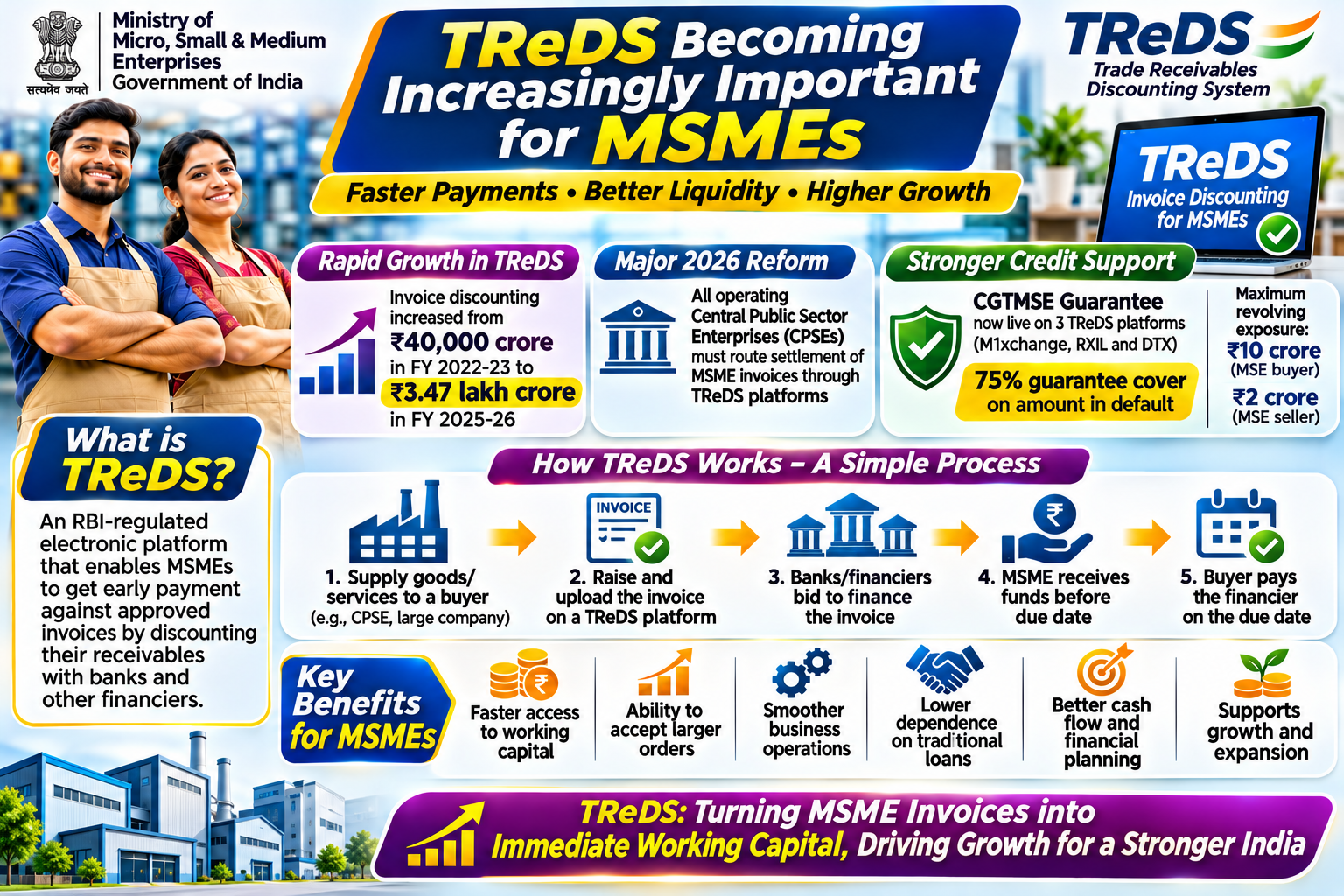
The Union Budget 2025-26 also announced an enhancement in credit guarantee cover for Micro and Small Enterprises from ₹5 crore to ₹10 crore, with the Government projecting significant additional credit availability over the following five years.
Thus, the classification revision forms part of a broader strategy to enable MSMEs to scale.
What About Enterprises That Were Reclassified?
The revised thresholds also created an important transition issue for enterprises whose classification changed because of the new limits.
The Office of the Development Commissioner (MSME) issued a clarification in October 2025 stating that the enhanced investment and turnover limits notified on 21 March 2025 apply from 1 April 2025 for all purposes.
This clarification is important for enterprises, banks, government departments and other stakeholders when determining the applicable MSME status.
Entrepreneurs should therefore review their Udyam Registration details and ensure that their financial information and enterprise classification are properly reflected.
Udyam Registration Remains Central
The Udyam Registration Portal remains the principal digital platform for MSME registration. The Government describes Udyam Registration as a free, paperless and digital registration process designed to facilitate access to MSME schemes and benefits.
Businesses should keep their registration information updated and maintain consistency between their Udyam information, income-tax records, GST data and financial statements.
For growing enterprises, regular review is particularly important because investment and turnover can change from year to year.
A Framework Designed for Growth
The revised classification represents a shift from viewing MSME status primarily as a restrictive size definition towards a framework that gives successful enterprises more room to expand.
A manufacturer that invests in modern machinery, a technology company that increases revenue, a service enterprise expanding into new markets or an exporter developing international customers can now operate within significantly higher MSME thresholds.
This larger operating space can support investment, employment generation, technology adoption and market expansion.
Conclusion
India’s updated MSME classification framework is an important policy change for entrepreneurs planning their next stage of growth.
With the Micro limit now at ₹2.5 crore investment and ₹10 crore turnover, the Small limit at ₹25 crore and ₹100 crore, and the Medium limit at ₹125 crore and ₹500 crore, businesses have substantially greater room to scale while remaining within the MSME ecosystem.
For entrepreneurs, the key message is to grow without losing sight of classification compliance. Regularly monitor investment and turnover, keep Udyam Registration updated, maintain accurate financial records and understand how MSME status interacts with credit, procurement and government support.
The revised framework ultimately aims to create more space for India’s enterprises to invest, innovate, expand and compete globally.