New Delhi, November 2026:
For India’s Micro, Small and Medium Enterprises (MSMEs), working capital is often the difference between accepting a new order and turning it away. A business may have a healthy order book, strong customers and adequate production capacity, yet face financial pressure because payments against completed supplies are delayed.
The Trade Receivables Discounting System (TReDS) is increasingly emerging as an important solution to this challenge. What began as a mechanism for financing MSME receivables has now become a significant part of India’s broader MSME payment and financing ecosystem.
The importance of TReDS has increased substantially in 2026 following major policy and regulatory developments, including the mandatory routing of MSME invoices of Central Public Sector Enterprises (CPSEs) through TReDS.
What is TReDS?
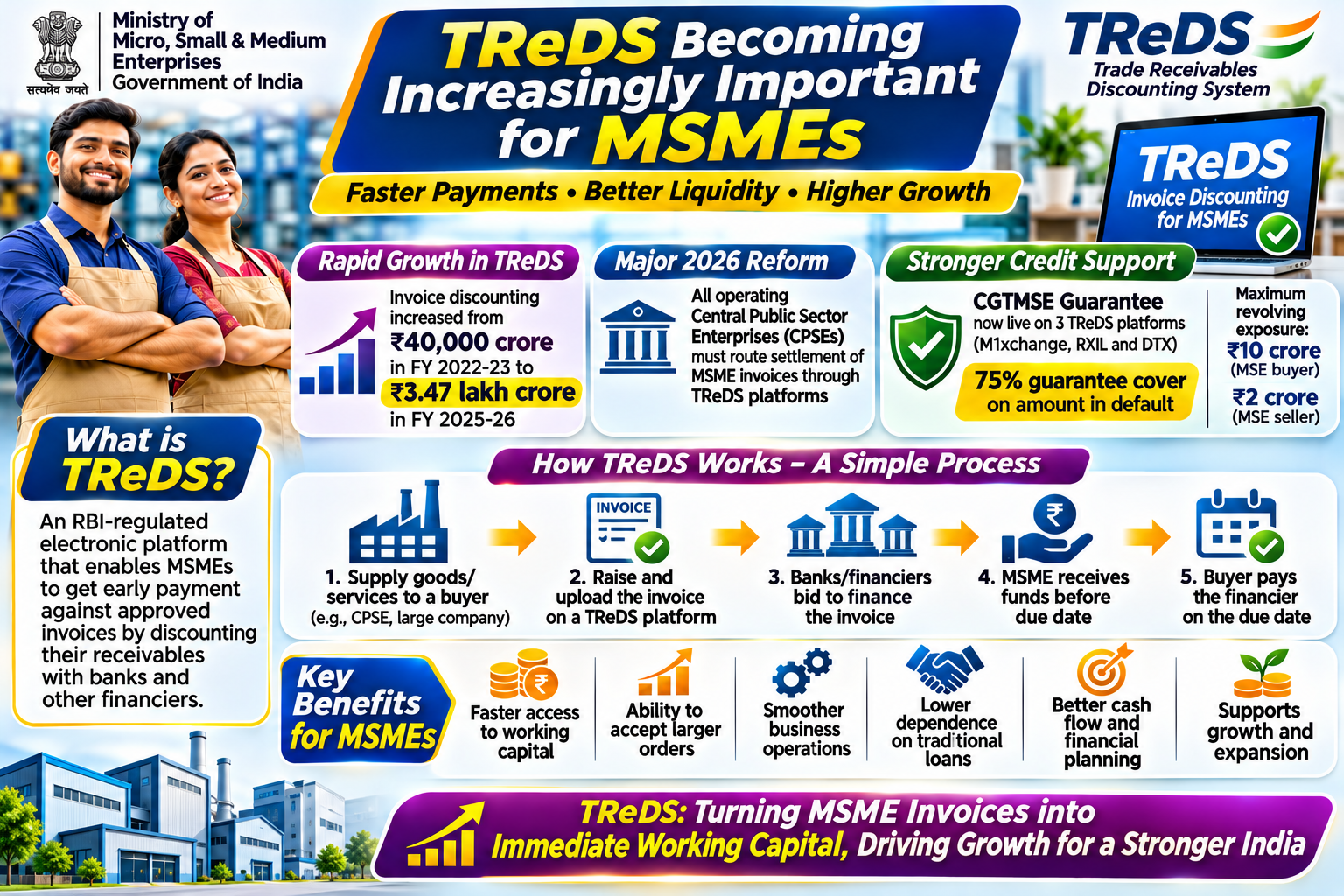
TReDS is an electronic platform regulated by the Reserve Bank of India (RBI) that enables MSMEs to convert their approved trade receivables into cash before the actual payment due date.
The basic process is straightforward. An MSME supplies goods or services to an eligible buyer and raises an invoice. Once the buyer accepts the invoice, it can be uploaded onto a TReDS platform. Banks and other eligible financiers then bid to finance the receivable.
The MSME can receive funds before the original payment date, while the financier receives payment from the buyer when the invoice becomes due.
This creates a three-way benefit: the MSME receives faster liquidity, the buyer retains its agreed payment cycle, and financiers obtain an opportunity to finance a documented trade receivable.
TReDS Has Grown Rapidly
The growth of TReDS demonstrates its increasing relevance to India’s MSME ecosystem.
According to the Ministry of MSME, invoice discounting through TReDS increased from approximately ₹40,000 crore in FY 2022-23 to ₹3.47 lakh crore in FY 2025-26.
This expansion indicates that TReDS is moving beyond being a niche financing mechanism and becoming an important channel for working-capital management.
For MSMEs supplying large companies, government departments and PSUs, the ability to unlock money against approved invoices can significantly improve cash-flow planning.
Major 2026 Reform: CPSE Invoices Through TReDS
One of the most important developments came in June 2026.
The Ministry of MSME notified that all operating Central Public Sector Enterprises must route settlement of invoices for goods and services procured from MSMEs through RBI-authorised TReDS platforms. The notification was issued on 30 June 2026 and implemented a key commitment of the Union Budget 2026-27.
The reform is significant because CPSEs represent a major institutional buyer base for MSMEs.
The government has also introduced transparency requirements. CPSEs are required to disclose relevant information regarding MSME invoices routed and settled through TReDS and obtain statutory auditor certification relating to TReDS registration and compliance.
For MSME suppliers, this can create a more structured pathway from invoice generation to financing and settlement.
Why TReDS Matters for MSME Working Capital
Delayed payments can create a chain reaction.
An MSME may complete an order today but have to wait weeks or months for payment. During this period, it still needs money to purchase raw materials, pay salaries, meet electricity bills, transport goods and accept new orders.
TReDS can break this cycle.
Instead of waiting until the buyer’s payment date, an eligible MSME can seek financing against an accepted invoice. The resulting liquidity can be used to fund the next production cycle.
This is particularly valuable for businesses experiencing rapid growth. Higher sales can actually increase working-capital requirements because the company must finance production before collecting receivables.
Therefore, sales growth without working-capital planning can create financial stress. TReDS provides MSMEs with another tool to manage this gap.
New Credit Guarantee Support Strengthens TReDS
Another important development in 2026 is the integration of the Credit Guarantee Fund Trust for Micro and Small Enterprises (CGTMSE) with the TReDS ecosystem.
In September 2026, the Ministry of MSME announced that CGTMSE guarantee coverage had gone live on three TReDS platforms—M1xchange, RXIL and DTX (KredX).
The initiative is designed to reduce credit risk for financiers and facilitate greater financing of eligible receivables.
The government stated that the special provision provides 75% guarantee cover on the amount in default, subject to the applicable framework. The maximum revolving exposure specified is ₹10 crore for an MSE buyer and ₹2 crore for an MSE seller.
This development could further strengthen confidence among financiers participating in TReDS transactions.
TReDS and the MSMED Act 2026
The increasing importance of TReDS has also been reflected in the Micro, Small and Medium Enterprises Development (Amendment) Bill, 2026, passed by Parliament in August 2026.
The amended framework provides for CPSEs to settle invoices relating to procurement from MSMEs through TReDS. It also creates an enabling mechanism for States to encourage their public sector enterprises and other entities to use TReDS for invoice settlement.
This represents a shift from treating delayed payments simply as a dispute-resolution issue toward creating systems that can facilitate timely liquidity in the first place.
How MSMEs Can Make Better Use of TReDS
MSMEs should consider TReDS as part of their regular financial-management strategy rather than merely an emergency source of funds.
Businesses should:
- Maintain an active Udyam Registration.
- Ensure invoices and purchase orders are properly documented.
- Confirm buyer acceptance of invoices promptly.
- Monitor receivables and payment cycles systematically.
- Evaluate financing costs before discounting invoices.
- Compare available financier bids where applicable.
- Maintain accurate GST, banking and accounting records.
- Understand the terms applicable to each transaction.
- Integrate receivables monitoring with accounting and cash-flow planning.
For MSMEs supplying PSUs and large corporates, TReDS can become particularly relevant as institutional adoption expands.
TReDS Can Change the MSME Growth Model
The larger significance of TReDS is not simply faster payment. It is about making receivables more financially useful.
An MSME with ₹1 crore of approved invoices due after 45 or 60 days may otherwise have to wait for that money. Through invoice discounting, the business can potentially unlock liquidity earlier and deploy it toward production, inventory, wages or new orders.
This can help businesses move from a cycle of “complete order → wait for payment → face cash shortage” toward a more efficient cycle of “complete order → unlock receivable → reinvest in growth.”
TReDS therefore has the potential to support not only liquidity but also business expansion.
A New Era for MSME Receivables
The combination of mandatory CPSE participation, growing invoice-discounting volumes, RBI regulation and CGTMSE-backed support is making TReDS increasingly important for India’s MSMEs.
The platform’s growth from around ₹40,000 crore of invoice discounting in FY 2022-23 to ₹3.47 lakh crore in FY 2025-26 demonstrates the scale of this transformation.
For MSMEs, the message is clear: an invoice should not necessarily mean waiting for cash until the due date.
As India’s formal digital business ecosystem expands, TReDS can become an important bridge between sales, receivables, financing and growth. MSMEs that understand and actively use this ecosystem may be better positioned to manage working capital, accept larger orders and participate more confidently in India’s growing corporate and PSU supply chains.
TReDS is increasingly becoming more than an invoice-discounting platform—it is emerging as an important financial infrastructure for India’s next phase of MSME growth.