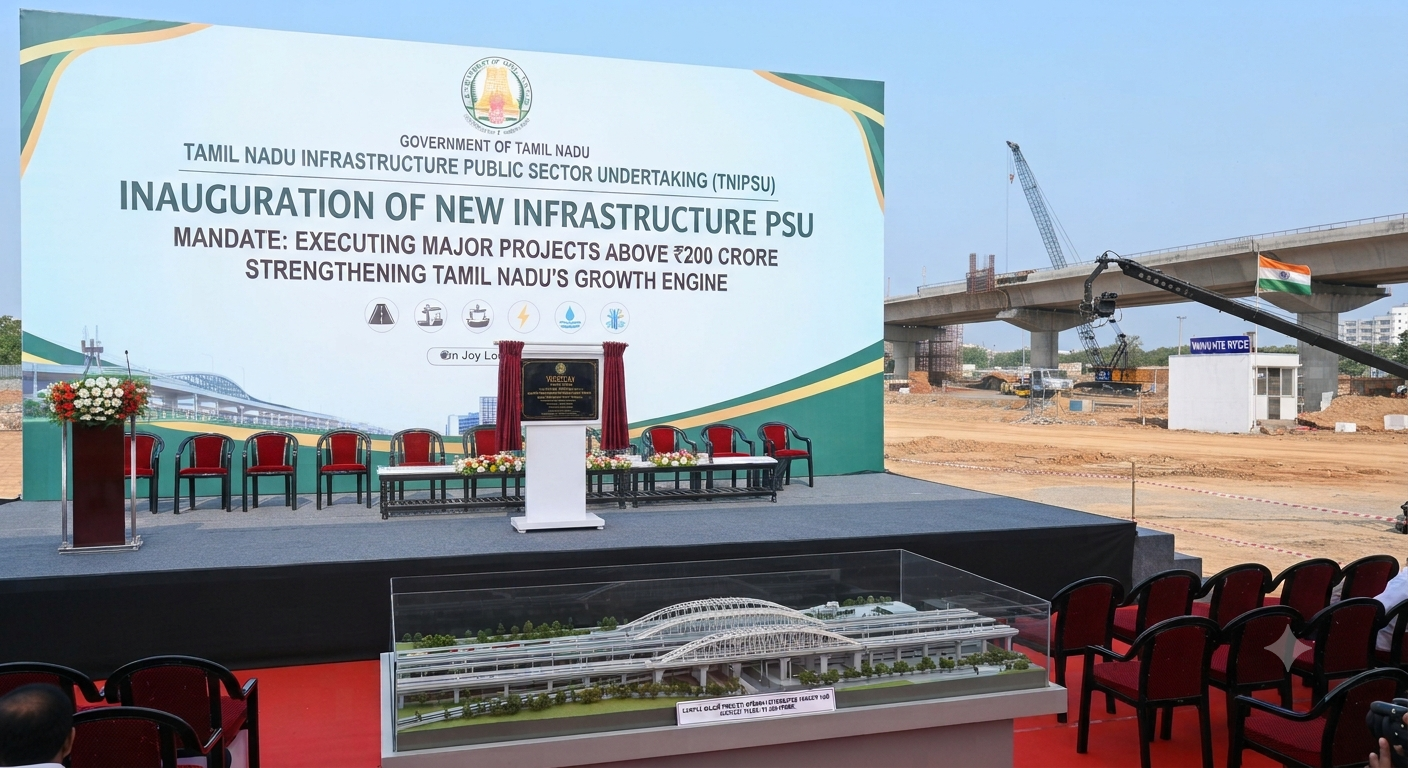
The Tamil Nadu government has approved the establishment of the Tamil Nadu Infrastructure and Construction Corporation (TNICC), a wholly owned state public sector undertaking (PSU) aimed at strengthening the execution of large-scale government infrastructure and construction projects. The new corporation will be responsible for handling state government construction works valued at more than ₹200 crore, creating a dedicated institutional mechanism for managing major development projects.
The decision was formalised through a Government Order issued by the Public Works Department on November 6, 2026, following an announcement made by Public Works and Sports Development Minister Aadhav Arjuna in the State Assembly on August 18. The initiative reflects the state’s effort to improve project planning, streamline implementation and strengthen professional management of large infrastructure investments.
The corporation is expected to operate broadly on the model of NBCC (India) Limited, the central public sector enterprise known for project management and construction-related services. It will also follow an implementation framework similar to the Tamil Nadu State Highways Authority (TANSHA), which was established to accelerate major road infrastructure projects.
TNICC to Manage Government Projects Above ₹200 Crore
Under the approved framework, TNICC will undertake state government construction projects with a value exceeding ₹200 crore. Its responsibilities will include floating and managing tenders, coordinating project implementation and providing professional services to government departments.
An important feature of the proposed structure is the separation of project management from actual construction. TNICC will manage the tendering and project coordination process, while selected contractors will execute the construction work.
All projects will be awarded through open competitive bidding on the state’s e-procurement portal, in accordance with the Tamil Nadu Transparency in Tenders Act. This approach is intended to promote transparency, competitive pricing and accountability in the implementation of major public works.
The corporation will also provide project formulation, architectural design, project management consultancy and quality control services to government departments.
Beyond Construction: Developing Revenue-Generating Infrastructure
TNICC’s mandate extends beyond the execution of conventional government buildings. The corporation will also be authorised to develop infrastructure on unused government land, creating opportunities for the state to generate additional revenue from underutilised public assets.
Its proposed areas of development include:
- Townships and integrated urban developments
- Industrial hubs and manufacturing-related infrastructure
- Technology parks and IT cities
- Business parks and commercial developments
- Government buildings on unused public land
The corporation will also be eligible to participate in tenders floated by private companies, subject to the prescribed procedures. This could allow it to expand its project management capabilities beyond state government assignments and compete for opportunities in national and international construction markets.
The proposed commercial approach is intended to help TNICC become a professionally managed and financially sustainable organisation over time. Revenue could be generated through project management consultancy, architectural services, quality control and other infrastructure-related assignments.
Modelled on NBCC and TANSHA
The creation of TNICC reflects Tamil Nadu’s growing interest in specialised public institutions for managing complex infrastructure projects.
NBCC (India) Limited has established a significant presence in project management consultancy, redevelopment and construction-related assignments. By adopting a broadly similar model, Tamil Nadu aims to build an organisation with professional expertise, operational flexibility and the ability to manage large-value projects.
The state has also drawn on the experience of TANSHA, established in 2024 to support the implementation of major highway infrastructure projects. TNICC will extend this institutional approach to large building construction and broader infrastructure development.
A dedicated corporation could help streamline coordination between government departments, consultants, contractors and other stakeholders. It may also support better project monitoring, quality assurance and implementation timelines.
Capital Structure and Financial Framework
According to the reported government order, TNICC will initially have an authorised share capital of ₹15 lakh and paid-up capital of ₹10 lakh. The government may subsequently consider administrative and financial approval for a ₹1 crore corpus, based on a board-approved business plan or Detailed Project Report and the availability of budgetary provisions.
Each project assigned to the corporation will have separate funding arrangements, along with a specified agency fee payable by the department using its services. This structure is intended to make project costs and management responsibilities more clearly defined.
Any future increase in capital, expansion of operations or creation of additional manpower will be considered separately. The corporation’s long-term financial sustainability will therefore depend on its ability to manage projects efficiently and generate revenue through its professional services.
Supporting Tamil Nadu’s Infrastructure Ambitions
Tamil Nadu has been witnessing increasing demand for infrastructure as urbanisation, industrial development and commercial activity expand across the state.
Large public projects require coordinated planning, technical expertise, transparent procurement and consistent monitoring. A dedicated institution could help address administrative and operational challenges associated with projects involving multiple departments and contractors.
The development of industrial hubs, technology parks, IT cities and business parks could also support investment, employment generation and economic activity. By developing underutilised government land, TNICC may create opportunities to unlock public assets while supporting planned urban and commercial development.
However, the corporation’s effectiveness will depend on the quality of its project pipeline, professional staffing, financial discipline and ability to maintain transparency in procurement and execution.
The Worldonomics Times View
The establishment of the Tamil Nadu Infrastructure and Construction Corporation is a significant institutional development in the state’s approach to public infrastructure delivery. By creating a dedicated PSU for projects exceeding ₹200 crore, the government is seeking to bring greater professional management and coordination to large construction assignments.
The proposed NBCC-inspired model could help Tamil Nadu strengthen its project management capabilities, while the TANSHA-style framework offers an established state-level approach to tendering and implementation. The corporation’s additional mandate to develop unused government land and provide consultancy services also creates potential for revenue generation beyond traditional government assignments.
Nevertheless, the success of TNICC will depend on more than its organisational structure. Transparent tendering, realistic project timelines, strong technical oversight and effective contractor management will be essential. The government must also ensure that the corporation complements existing departments and agencies rather than creating overlapping responsibilities.
If implemented with clear accountability and professional standards, TNICC could become an important instrument for accelerating infrastructure development across Tamil Nadu. Its ability to deliver projects efficiently while maintaining financial and operational discipline will determine its long-term value to the state’s economy.
Conclusion: Tamil Nadu’s approval of TNICC marks a move towards a more specialised and professionally managed system for executing major infrastructure projects. With a mandate covering government construction works above ₹200 crore, consultancy services and revenue-generating developments, the corporation could play an important role in shaping the state’s next phase of infrastructure growth.