New Delhi: State-owned Oil India Limited (OIL) has announced a significant natural gas discovery in the shallow offshore waters of the Krishna-Godavari (KG) Basin, marking another important step in India’s efforts to expand domestic hydrocarbon exploration and strengthen energy security.
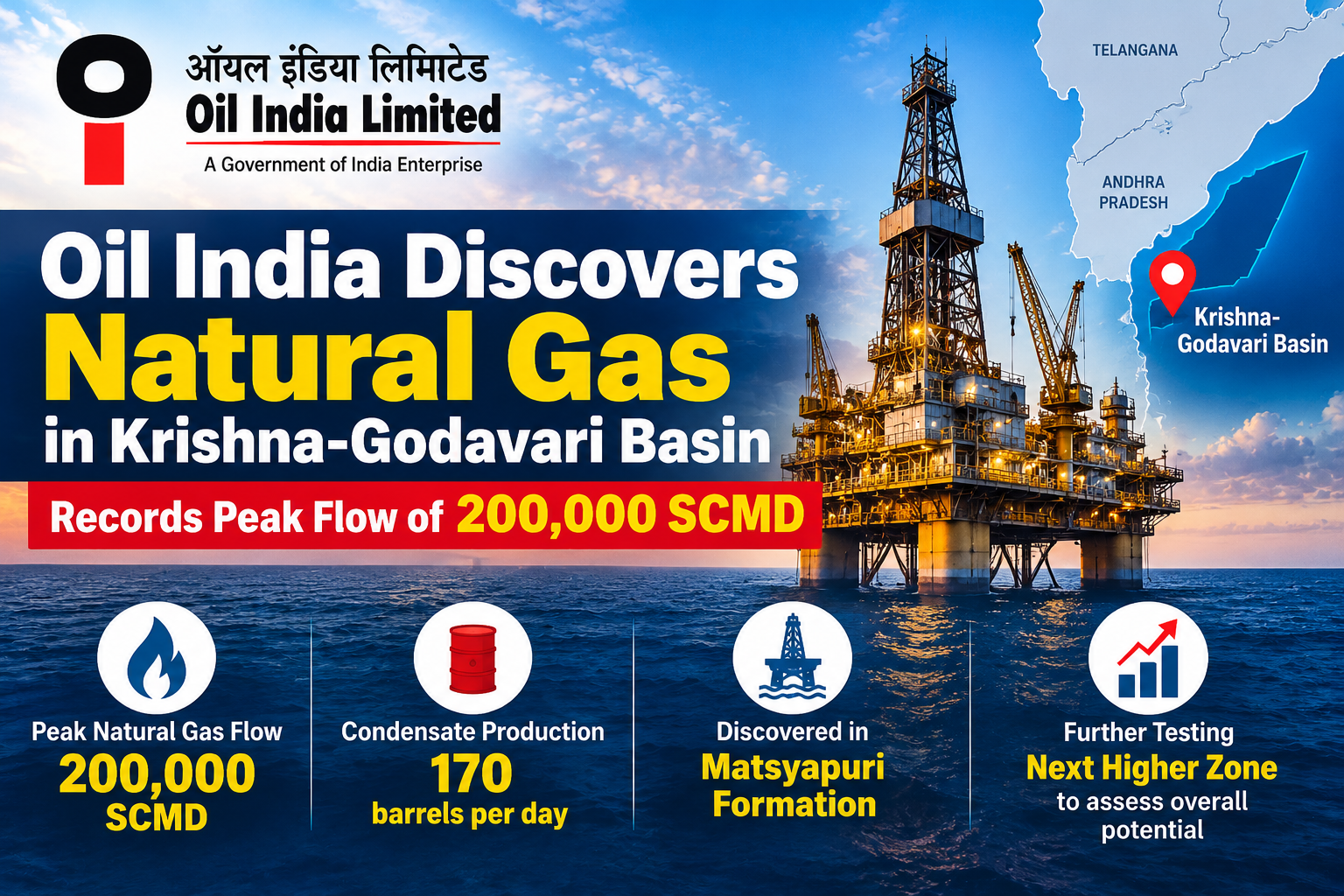
The discovery was made in the previously unappraised Matsyapuri formation through the Godavari-1 appraisal well in the KG-DSF/GSKW/2018 offshore block. During continuous testing, the well recorded a peak natural gas flow of 200,000 Standard Cubic Metres Per Day (SCMD). Oil India also reported condensate production of approximately 170 barrels per day.
The development is significant for Oil India’s upstream portfolio as well as India’s broader objective of increasing indigenous oil and gas production.
Discovery in the Matsyapuri Formation
The Godavari-1 well is located in a shallow-water offshore block awarded to Oil India under the government’s Discovered Small Field (DSF) bidding rounds. Oil India operates the block as the sole operator.
Hydrocarbons were encountered in a selected pay zone at a depth of approximately 2,024 to 2,027 metres. Production testing of the zone began on 16 October 2026.
According to the company’s results, the well initially flowed natural gas at approximately 100,000 SCMD, while the maximum flow rate reached 200,000 SCMD during continuous testing. The well also produced around 170 barrels per day of condensate.
The reported results confirm the presence of hydrocarbons in the tested zone, although further appraisal will be necessary before the overall resource potential can be determined.
Further Testing Planned
Oil India is preparing to test the next higher hydrocarbon-bearing zone in the Godavari-1 well.
The additional testing will help the company understand the extent and characteristics of the hydrocarbon-bearing formations and assess the broader potential of the block.
At present, Oil India has not disclosed an estimate of recoverable resources associated with the discovery. The company has also not announced a commercial production timeline.
Therefore, while the initial flow results are encouraging, the ultimate economic significance of the discovery will depend on further appraisal, resource assessment, development costs and commercial feasibility.
Importance of the Krishna-Godavari Basin
The Krishna-Godavari Basin is one of India’s most important sedimentary basins for oil and natural gas exploration. Located along the country’s eastern coast, the basin has attracted substantial exploration and development activity from both public-sector and private-sector energy companies.
The region has become particularly important for India’s natural gas ambitions, with offshore discoveries contributing to efforts to increase domestic production.
Oil India’s latest discovery adds another development to the continuing exploration activity in the basin.
The company is also pursuing exploration opportunities in other offshore areas, reflecting the broader strategy of expanding India’s domestic hydrocarbon resource base.
Boost to India’s Energy Security
India remains significantly dependent on imports to meet its oil and natural gas requirements. Consequently, every commercially viable domestic hydrocarbon discovery has strategic importance.
Increasing indigenous production can help diversify India’s energy supply sources, reduce exposure to international commodity-price volatility and strengthen long-term energy security.
Natural gas has a particularly important role in India’s energy strategy because it can support power generation, fertiliser production, industrial applications, city gas distribution and other sectors.
The government has set an objective of increasing the share of natural gas in India’s energy mix to 15% by 2030, compared with approximately 6% currently. Developing additional domestic gas resources is therefore an important part of achieving that objective.
Government Push for Offshore Exploration
The Oil India discovery comes amid an increased policy focus on offshore exploration.
The government has been encouraging exploration in India’s sedimentary basins and providing support for deepwater and ultra-deepwater exploration. The Samudra Manthan initiative, announced as part of this broader strategy, is designed to support large-scale seismic surveys, exploratory drilling and offshore infrastructure.
According to recent reporting, the programme has an outlay of around ₹84,084 crore through 2030-31, with support for exploration activities including deepwater and ultra-deepwater wells.
Such initiatives could encourage more exploration activity and improve the country’s understanding of its offshore resource potential.
Significance for Oil India’s Upstream Strategy
For Oil India, the Godavari-1 discovery represents an opportunity to strengthen its presence in offshore exploration.
The company has traditionally been associated with hydrocarbon production in Assam and the northeastern region, but its exploration portfolio has expanded into several other sedimentary basins.
Offshore exploration carries greater technical and financial challenges compared with conventional onshore operations. However, successful discoveries can provide access to potentially significant resources and contribute to long-term production growth.
The latest discovery demonstrates the value of continuing exploration and appraisal activities in India’s under-explored formations.
Condensate Adds to the Significance
Alongside the natural gas flow, the well recorded approximately 170 barrels per day of condensate.
Condensate is a valuable liquid hydrocarbon that can be recovered alongside natural gas from certain reservoirs. Its presence can potentially improve the economics of a gas discovery, although a complete commercial assessment requires detailed reservoir evaluation.
The reported condensate production therefore provides an additional positive technical indicator from the initial testing programme.
Exploration Does Not Yet Mean Commercial Production
While the reported peak flow of 200,000 SCMD is significant, it is important to distinguish between an exploration-test result and established commercial reserves.
The company still needs to complete further testing and geological evaluation before determining the size of the resource and its commercial development potential.
Future appraisal results will therefore be closely watched by the energy industry.
If subsequent testing confirms sustainable production rates and commercially viable resources, the discovery could eventually contribute to Oil India’s domestic gas production portfolio.
Strategic Importance for Public Sector Energy Companies
The discovery also highlights the role of India’s public-sector energy companies in strengthening domestic energy capabilities.
Oil India, ONGC and other government-controlled energy enterprises continue to invest in exploration, production and technology to identify new domestic resources.
At a time of heightened global energy-market volatility, building domestic production capacity has become increasingly important.
New discoveries can potentially support India’s energy requirements while creating opportunities for domestic engineering, drilling, oilfield services and infrastructure companies.
Outlook
The immediate focus for Oil India will be on further testing of the Godavari-1 well and evaluating the hydrocarbon-bearing zones.
The company will need to determine the extent of the discovery, estimate recoverable resources and assess the technical and economic feasibility of development.
The results of these activities will determine whether the discovery can eventually move from the exploration stage towards commercial production.
For India’s energy sector, however, the discovery itself is an encouraging development, particularly as the country seeks to increase domestic natural gas availability.
Conclusion
Oil India’s natural gas discovery in the Matsyapuri formation of the Krishna-Godavari Basin marks another important development in India’s domestic hydrocarbon exploration programme.
The Godavari-1 appraisal well recorded a peak gas flow of 200,000 SCMD, along with approximately 170 barrels per day of condensate, during testing.
Further testing of the next higher zone is now being prepared, while the company has yet to disclose an estimate of recoverable resources or a commercial development timeline.
The discovery comes at a strategically important time for India, as the country seeks to strengthen energy security, increase domestic natural gas production and reduce dependence on imported energy.
If subsequent appraisal confirms commercially viable resources, the discovery could become another contributor to India’s expanding domestic gas supply base.
For Oil India, it represents a positive step in expanding its exploration portfolio and strengthening its position in India’s evolving upstream energy landscape.
— The Worldonomics Times