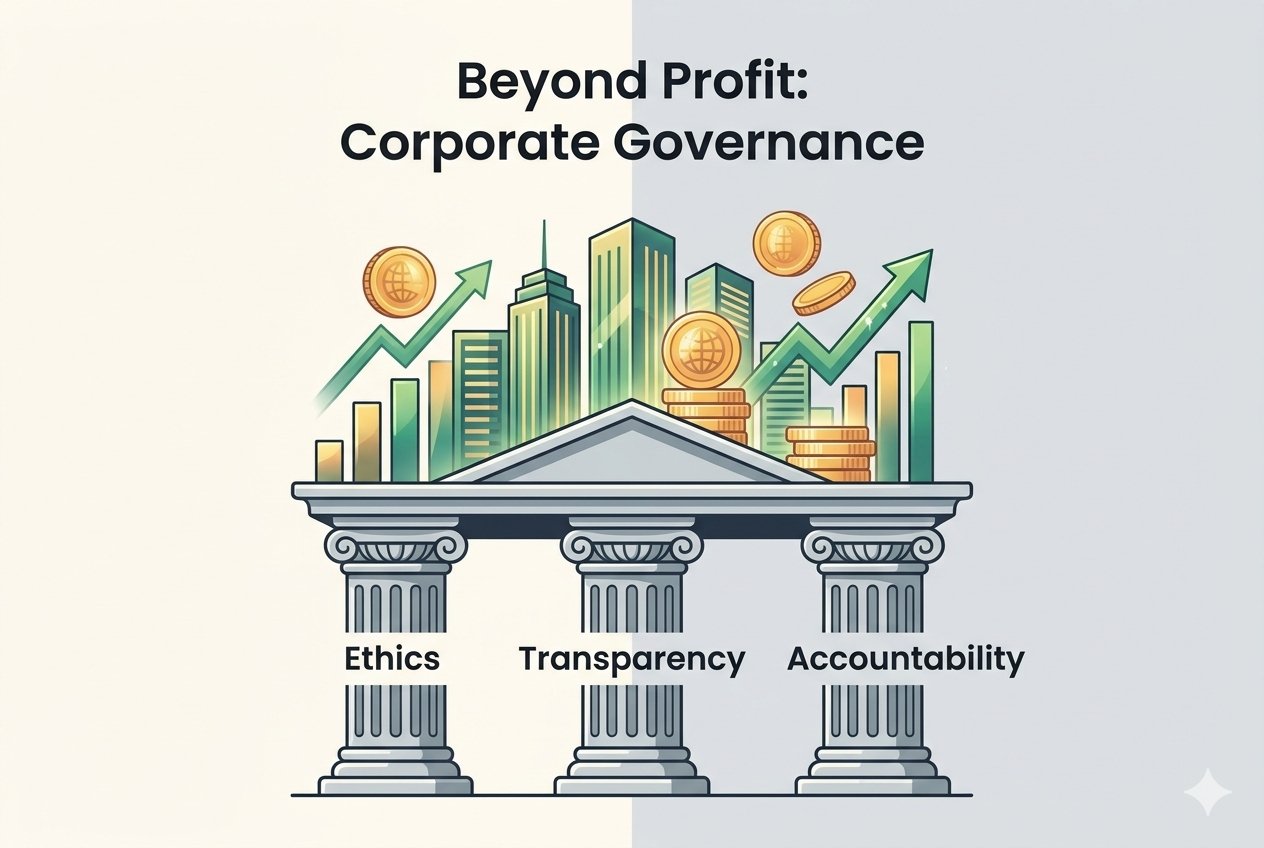
Profit may measure a company’s financial performance, but governance determines whether that success can be trusted and sustained.
In the corporate world, success is often measured through revenue growth, profitability, market share and shareholder returns. Businesses celebrate rising profits, expanding operations and increasing valuations.
But there is a fundamental question that often receives less attention:
Can a company truly be successful if it generates profits but fails to maintain transparency, accountability and ethical business practices?
The answer lies in corporate governance.
Corporate governance is not merely a legal requirement or a collection of compliance procedures. It is the framework through which companies are directed, controlled and held accountable. It defines how decisions are made, how risks are managed and how the interests of shareholders and other stakeholders are protected.
In today’s competitive business environment, good governance is no longer optional. It is a foundation for sustainable growth.
1. Profitability Without Accountability Is a Risk
A company may report impressive financial results, attract investors and expand its market presence. However, financial performance alone cannot reveal the complete picture of an organisation.
Weak internal controls, misleading financial disclosures, conflicts of interest and poor risk management can remain hidden behind apparently strong financial statements.
Corporate history has repeatedly demonstrated that organisations can face serious financial and reputational damage when accountability and transparency are compromised.
The lesson is simple: financial success without responsible management can become a significant business risk.
2. The Role of the Board: Leadership Beyond Decision-Making
The Board of Directors plays a crucial role in ensuring effective corporate governance.
Its responsibilities extend beyond approving business strategies and reviewing financial performance.
An effective board must:
- Ensure accountability of management.
- Protect shareholders’ interests.
- Monitor financial reporting and internal controls.
- Oversee risk management systems.
- Promote ethical decision-making.
- Ensure compliance with applicable laws and regulations.
An independent and effective board can help prevent excessive concentration of power and encourage decisions that support the long-term interests of the organisation.
3. Financial Transparency: The Language of Trust
Financial statements are more than numbers presented in annual reports. They communicate the financial position, performance and risks of a business.
Investors, lenders, employees and other stakeholders rely on accurate and transparent financial information to make informed decisions.
This is where accounting, auditing and internal financial controls become particularly important.
A strong financial reporting system helps identify irregularities, improve accountability and strengthen investor confidence.
For finance professionals, this responsibility goes beyond preparing statements. It involves ensuring that financial information represents the true economic position of an organisation.
Transparency is not just about disclosing information; it is about ensuring that the information disclosed can be trusted.
4. Corporate Governance and the Role of Finance Professionals
In an evolving business environment, finance professionals have a responsibility that extends beyond traditional accounting functions.
Cost accountants, chartered accountants, auditors and finance executives contribute to governance through:
- Financial analysis and performance monitoring.
- Cost control and resource optimisation.
- Internal audit and risk assessment.
- Regulatory compliance.
- Strengthening internal financial controls.
- Supporting ethical and informed business decisions.
Finance professionals often act as an important link between business strategy, financial discipline and organisational accountability.
Their role is not simply to report what happened, but also to help organisations understand risks and make better decisions.
5. Technology Is Changing Corporate Governance
Digital transformation, artificial intelligence and data analytics are changing how organisations monitor their operations and manage risks.
Real-time financial dashboards, automated compliance systems and advanced data analytics can improve transparency and strengthen internal controls.
However, technology alone cannot guarantee good governance.
Data manipulation, cybersecurity threats, algorithmic bias and inadequate oversight can create new governance challenges.
Technology must therefore be supported by human judgement, accountability and clearly defined responsibilities.
6. From Compliance to Corporate Culture
One of the biggest misconceptions about corporate governance is that it is achieved simply by following legal requirements.
Compliance establishes the minimum standard, but ethical leadership creates the culture.
A company with strong governance does not wait for regulatory intervention to act responsibly. It builds transparency into everyday decisions, encourages employees to raise concerns and ensures that accountability applies at every level.
The objective should be to move beyond a compliance-driven approach towards a governance-driven culture.
Conclusion: Sustainable Success Begins With Trust
In the long run, businesses are not remembered only for the profits they generate, but also for the values, credibility and responsibility they demonstrate.
Strong corporate governance protects stakeholders, strengthens investor confidence, reduces organisational risks and supports sustainable business growth.
For India, as its corporate sector expands and attracts greater domestic and international investment, building a culture of transparency and accountability will become increasingly important.
Profit can make a company successful today, but good governance gives it the credibility to succeed tomorrow.
Because beyond every successful business is something more valuable than profit: TRUST.
— Ankita Nag
Author | The Worldonomics Times