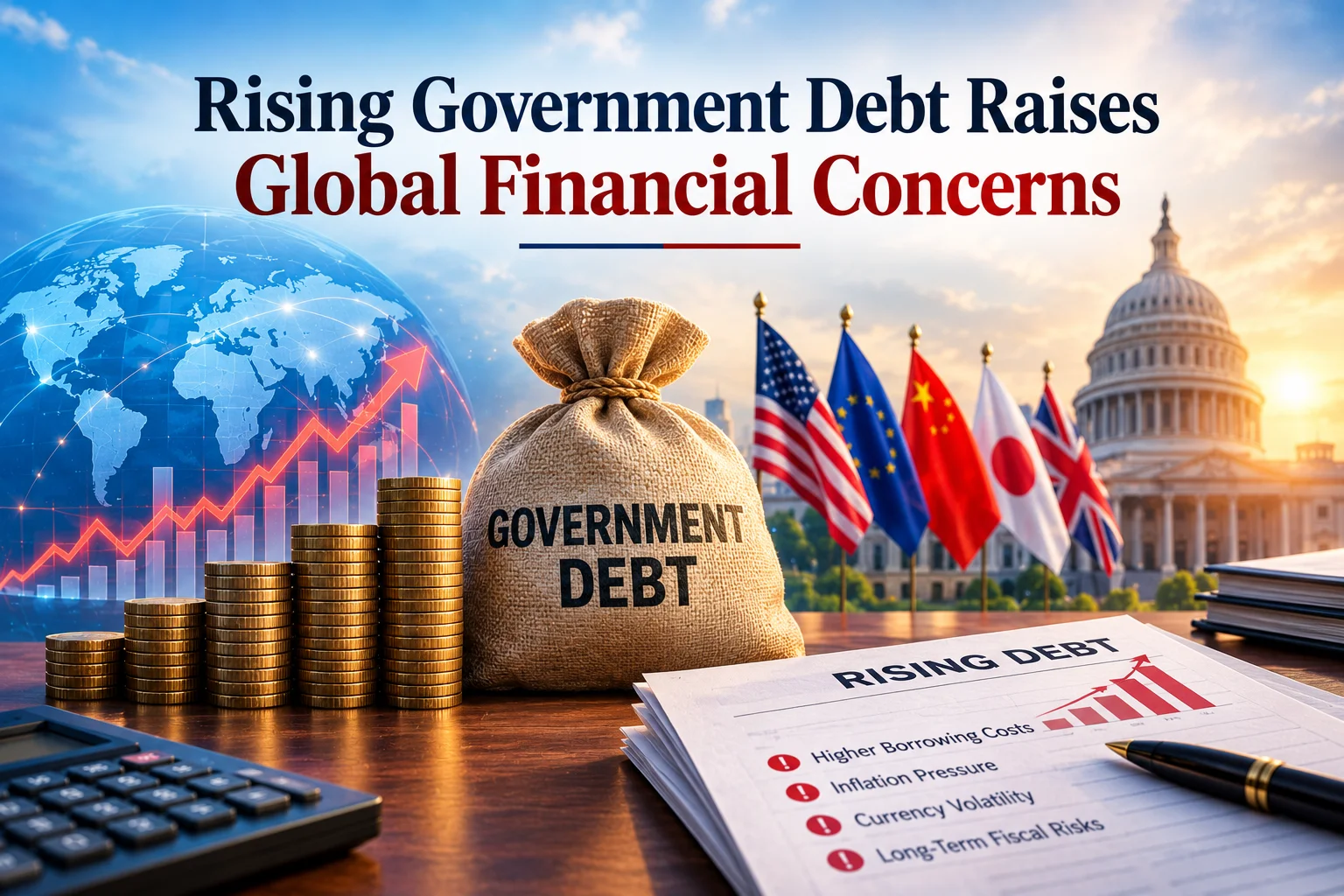
Rising government borrowing is limiting the financial flexibility of several major economies.
By The Worldonomics Times | Global Economy
Rising public debt has become one of the most significant challenges facing the global economy. Governments across major economies are borrowing heavily to finance public expenditure, infrastructure development, defence requirements, social welfare programmes and economic support measures. While borrowing can help countries manage economic shocks and fund long-term development, persistently high debt levels are raising concerns about fiscal sustainability and financial stability.
The challenge is becoming more complicated as interest payments increase and governments face competing spending priorities. Higher borrowing costs are reducing the financial flexibility of several countries, leaving policymakers with fewer resources to respond to future economic disruptions.
According to the International Monetary Fund’s October 2026 Fiscal Monitor assessment, global public debt reached approximately 94% of global gross domestic product in 2025 and is projected to approach 100% by 2029. This rising debt burden highlights the growing pressure on public finances and the importance of maintaining credible long-term fiscal policies.
Government Borrowing Continues to Increase
Public borrowing expanded significantly during the COVID-19 pandemic, when governments introduced emergency spending programmes to support households, businesses and healthcare systems. Although many economies have recovered, government expenditure remains elevated in several countries.
Defence spending, ageing populations, healthcare requirements, infrastructure investment and energy security have created additional demands on public budgets. At the same time, slower economic growth and uncertain international trade conditions have made it more difficult for some governments to increase tax revenues.
Major economies, including the United States, Japan and several European countries, face different but substantial fiscal challenges. Their debt levels, interest costs and economic structures vary, but all must balance public spending with the need to maintain investor confidence.
The problem is not simply the amount of debt outstanding. The ability of governments to generate sufficient revenue, maintain economic growth and meet interest payments is equally important in determining whether public borrowing remains sustainable.
Rising Interest Payments Reduce Fiscal Flexibility
One of the most important consequences of increasing public debt is the growing cost of servicing government borrowing.
When governments issue bonds, they promise to repay investors with interest. As existing debt matures and is refinanced at higher market rates, borrowing expenses can increase further.
The IMF’s 2026 assessment highlights that global government interest payments have increased by almost half over three years, rising from approximately 2% to nearly 3% of global GDP.
This creates a difficult situation for governments. A larger share of public revenue must be allocated to interest payments rather than education, healthcare, infrastructure and other development priorities.
Countries with high debt and relatively weak revenue growth are particularly vulnerable. If borrowing costs remain elevated, governments may need to increase taxes, reduce expenditure or borrow additional funds to meet existing obligations.
Such adjustments can become politically difficult, especially when households and businesses are already facing higher living costs.
Bond Markets Monitor Government Financial Risks
Government bonds are among the most important instruments in international financial markets. They provide governments with funding and offer investors assets for managing savings, liquidity and portfolio risk.
However, rising public debt can influence how investors assess the financial position of governments. If investors become concerned about a country’s ability to manage its borrowing, they may demand higher interest rates before purchasing its bonds.
Higher bond yields increase the cost of future government borrowing and can create additional pressure on national budgets. They may also influence corporate borrowing costs, mortgage rates and investment decisions across the wider economy.
The IMF’s October 2026 Global Financial Stability Report warned that rising sovereign bond yields, inflation pressures, fiscal imbalances and substantial government debt issuance could create risks for financial markets.
Large movements in government bond yields can also affect banks, pension funds, insurance companies and investment funds that hold significant amounts of sovereign debt. Consequently, fiscal difficulties in one major economy may have wider international financial consequences.
Public Debt Can Affect Private Investment
Another concern is the potential impact of government borrowing on private-sector investment.
When governments borrow heavily from financial markets, they compete with businesses and households for available financing. If this contributes to higher interest rates, companies may face increased costs when funding expansion, purchasing equipment or developing new projects.
This process is commonly known as crowding out. It can reduce private investment, particularly when financial resources are limited or interest rates are already elevated.
However, the effect is not automatic. Government borrowing used for productive infrastructure, education, technology and transport development can strengthen economic capacity and encourage private investment over time.
The long-term impact therefore depends on how borrowed funds are used, the strength of economic growth and the ability of governments to maintain sustainable fiscal positions.
Emerging Economies Face Greater Vulnerability
Developing economies often face additional difficulties because they may have smaller tax bases, higher borrowing costs and greater exposure to international financial market movements.
Countries that borrow in foreign currencies can become particularly vulnerable when their domestic currencies weaken. A depreciation increases the local-currency cost of servicing external debt, placing additional pressure on public finances.
Higher global interest rates can also encourage international investors to move capital towards assets offering stronger returns in advanced economies. This may increase financing challenges for developing countries.
As a result, some emerging economies may have to reduce development spending or postpone infrastructure projects to meet debt obligations.
The IMF has also highlighted that increased borrowing by major advanced economies can reduce the availability of investment funds for other sovereign borrowers, adding to financing challenges in lower-income countries.
The Worldonomics View
Rising public debt should not automatically be treated as a sign of economic weakness. Responsible borrowing can support infrastructure, strengthen public services, finance innovation and help economies recover from unexpected crises.
However, borrowing becomes a serious concern when debt increases faster than the economy’s capacity to generate income and public revenue. Governments must ensure that additional debt supports productive investment rather than creating permanent financial obligations without corresponding economic benefits.
Fiscal discipline should focus on improving spending efficiency, strengthening tax collection and prioritising investments that contribute to long-term productivity. Governments should also maintain transparent borrowing strategies and avoid relying excessively on short-term financing.
International cooperation and credible fiscal policies will be important in maintaining confidence in sovereign bond markets and protecting global financial stability.
Conclusion
Rising public debt is creating difficult choices for governments across the world. Higher interest payments, increasing expenditure requirements and uncertain economic conditions are reducing fiscal flexibility and raising concerns about long-term financial stability.
Although public borrowing remains an important economic tool, its sustainability depends on responsible financial management and the ability to generate stronger economic growth.
For the global economy, the priority is not simply to reduce borrowing but to ensure that public debt remains manageable, productive and supported by credible fiscal policies. The decisions governments make today will play an important role in determining their financial resilience in the years ahead.