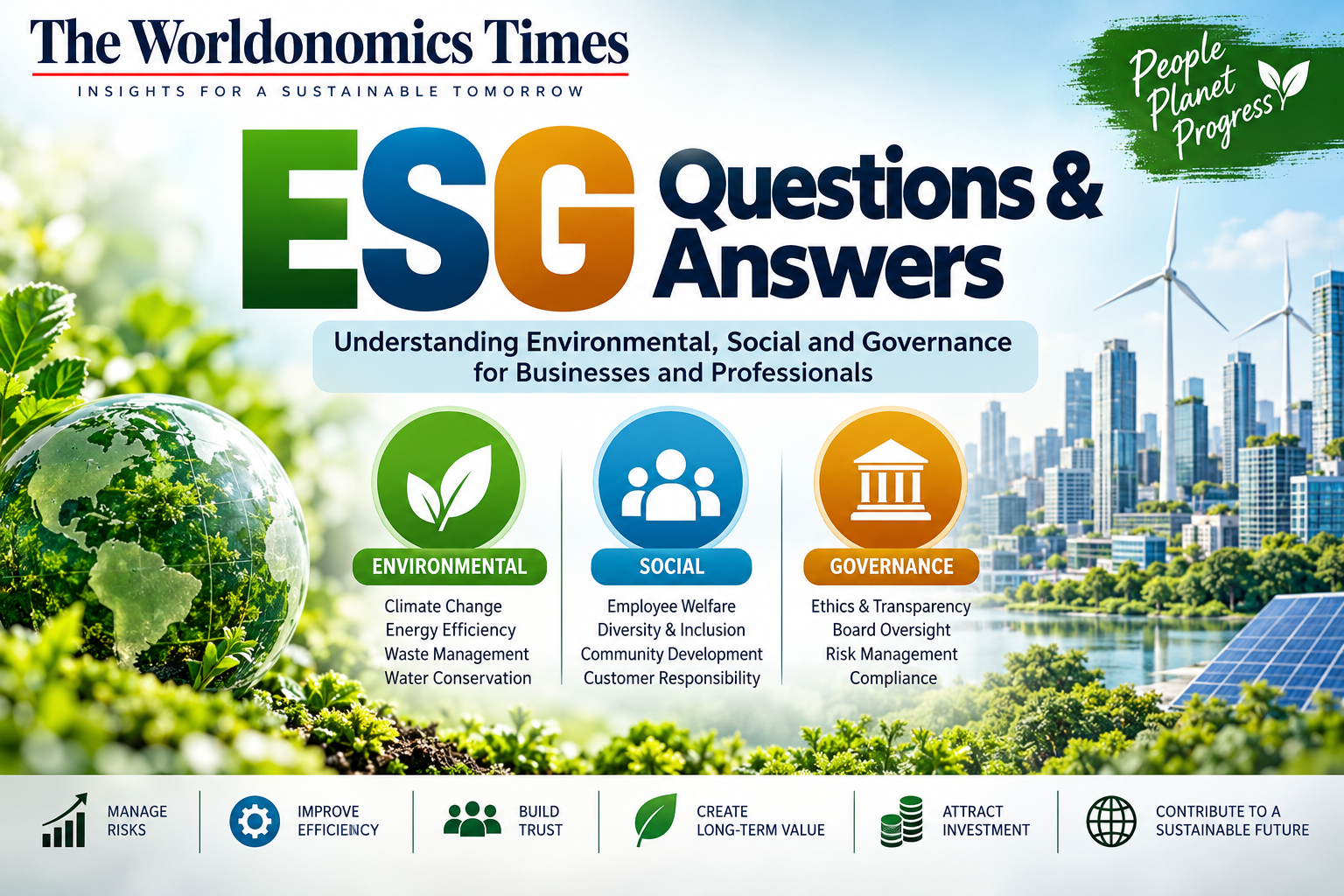
Environmental, Social and Governance (ESG) has moved far beyond being a sustainability or corporate social responsibility function. It is increasingly connected with financial performance, risk management, capital allocation, disclosures, internal controls, assurance, supply-chain management and long-term business strategy.
For Chartered Accountants (CAs) and Cost and Management Accountants (CMAs), this transformation creates a significant professional opportunity.
The International Sustainability Standards Board (ISSB) framework places sustainability-related financial disclosures around four core areas: governance, strategy, risk management, and metrics and targets. This makes ESG highly relevant to finance professionals because these areas require reliable data, controls, analysis, measurement and connection with financial information.
1. Why ESG Is Becoming Important for CA and CMA Professionals
Traditionally, CAs and CMAs have been associated with accounting, audit, taxation, costing, budgeting, financial reporting and management information.
ESG now adds another dimension.
Companies increasingly need professionals who can answer questions such as:
- What is the financial impact of climate risk?
- How much does carbon reduction cost?
- What are the company’s ESG-related risks?
- How reliable is ESG data?
- How should ESG KPIs be measured?
- How can sustainability targets be incorporated into budgets?
- How does ESG affect capital expenditure?
- Can ESG performance be linked with management incentives?
- How can sustainability information be assured?
- How should ESG information be connected with financial reporting?
These are areas where CA and CMA skills are particularly valuable.
2. Understanding the ESG Reporting Framework
A CA or CMA working in ESG should understand the major reporting frameworks applicable to the organisation.
These may include:
- SEBI BRSR and BRSR Core in India
- IFRS S1
- IFRS S2
- GRI Standards
- SASB-based industry metrics
- TCFD-related concepts
- GHG Protocol
- EU CSRD and ESRS
- Climate-related disclosure requirements in other jurisdictions
IFRS S1 and S2 require companies to consider material sustainability-related risks and opportunities and report information across governance, strategy, risk management, and metrics and targets.
A finance professional therefore needs to understand not only accounting standards but also sustainability disclosure requirements.
3. Role of CA in ESG Reporting
Chartered Accountants can contribute to ESG through several professional functions.
Major areas include:
- ESG reporting
- BRSR implementation
- Sustainability assurance
- Internal controls over ESG data
- ESG risk management
- ESG due diligence
- Climate-related financial analysis
- Sustainability-linked financing
- ESG compliance
- Sustainability strategy
ICAI has already established a Sustainability Reporting Standards Board and is actively developing professional capacity in this area. Its 2026 programme includes initiatives covering BRSR, supply-chain due diligence, social impact assessment and linking CSR with ESG.
4. Role of CMA in ESG
Cost and Management Accountants have an especially strong opportunity because ESG increasingly involves measurement and management of resources and costs.
A CMA can help organisations understand:
- Energy cost
- Carbon cost
- Waste cost
- Water cost
- Resource efficiency
- Product-level environmental cost
- Cost of sustainability initiatives
- Cost savings from energy efficiency
- Carbon reduction economics
- Life-cycle costing
- Environmental management accounting
- Sustainability KPIs
For example, if a manufacturing company wants to reduce its energy consumption by 20%, a CMA can calculate the investment required, expected savings, payback period, impact on product cost and long-term financial benefits.
This turns ESG from a reporting exercise into a management tool.
5. ESG Data Management
ESG reporting depends heavily on data.
Data may come from:
- Finance systems
- ERP systems
- HR systems
- Procurement systems
- Utility bills
- Production records
- Vendor declarations
- Environmental monitoring systems
- Logistics records
- Employee databases
CAs and CMAs can help establish controls over this information.
They can ask:
- Who owns the data?
- What is the source?
- Is the data complete?
- Is the calculation methodology documented?
- Is there supporting evidence?
- Who reviews the data?
- Can the information be reproduced?
- Is the same methodology used consistently?
This is similar to financial reporting discipline and therefore provides a natural area of opportunity for finance professionals.
6. ESG Internal Controls
A company may have excellent ESG policies but still produce unreliable ESG information.
For example, electricity consumption may be reported differently by different plants.
A strong ESG control framework should define:
Source → Collection → Calculation → Review → Approval → Disclosure
CAs can help design controls around this process.
CMAs can additionally examine operational data and connect ESG indicators with production and cost information.
7. ESG and Financial Planning
ESG should increasingly become part of financial planning.
A CFO, CA or CMA may need to evaluate:
- Renewable-energy investment
- Energy-efficient machinery
- Waste-reduction projects
- Water conservation projects
- Electric vehicle transition
- Sustainable packaging
- Carbon-reduction projects
- Climate adaptation expenditure
For each project, the professional can analyse:
Investment → Operating Cost → Savings → Risk Reduction → ESG Benefit → Financial Return
This creates a direct connection between sustainability and capital budgeting.
8. ESG Risk Management
ESG risks can have financial consequences.
Examples include:
- Floods affecting factories
- Water shortages affecting production
- Carbon pricing affecting costs
- Labour disputes affecting operations
- Supply-chain disruptions
- Data privacy failures
- Corruption investigations
- Regulatory penalties
- Reputational damage
CAs and CMAs can incorporate these risks into enterprise risk management and financial analysis.
Under ISSB principles, companies identify and disclose material sustainability-related risks and opportunities and explain how they are managed.
9. Climate Risk and Financial Impact
Climate risk is increasingly becoming a financial issue.
Consider a company whose factory is located in a flood-prone area.
A CA or CMA can help estimate:
- Potential production loss
- Asset damage
- Insurance implications
- Business interruption
- Additional operating expenditure
- Working-capital impact
- Financing implications
This allows climate risk to be translated into financial language.
10. Carbon Accounting
Carbon accounting is another emerging opportunity.
Professionals should understand:
- Scope 1 emissions
- Scope 2 emissions
- Scope 3 emissions
- Emission factors
- Activity data
- Carbon intensity
- Organisational boundaries
- Operational boundaries
- Emission reduction targets
The objective is not simply to calculate tonnes of CO₂e.
The professional should also understand:
Carbon → Cost → Risk → Target → Investment → Financial Impact
That is where finance expertise becomes valuable.
11. ESG Budgeting
Companies should consider ESG objectives during annual budgeting.
For example:
| ESG Initiative | Budget Area |
|---|---|
| Solar installation | Capital expenditure |
| Energy efficiency | Capex/Opex |
| Employee training | HR budget |
| Safety improvements | Operations |
| ESG software | Technology |
| Sustainability assurance | Professional fees |
| Waste reduction | Operations |
| Community programmes | CSR/social investment |
CMA professionals can help management determine whether ESG spending is generating measurable financial and operational benefits.
12. ESG Performance Measurement
Management cannot manage what it cannot measure.
Finance professionals can create ESG dashboards containing KPIs such as:
- Energy consumption
- Renewable-energy percentage
- GHG emissions
- Emissions intensity
- Water consumption
- Waste generated
- Waste recycled
- Employee turnover
- Training hours
- Safety incidents
- Gender diversity
- Supplier ESG assessments
- Board diversity
- Ethics complaints
- Cybersecurity incidents
The ISSB framework specifically connects sustainability reporting with metrics and targets used to measure and monitor sustainability-related risks and opportunities.
13. ESG Assurance
One of the most significant opportunities for CAs is sustainability assurance.
ICAI issued SSA 5000 – General Requirements for Sustainability Assurance Engagements in September 2026. The standard provides a principles-based and framework-neutral approach for sustainability assurance and is effective for sustainability assurance engagements relating to periods beginning on or after 1 April 2027.
This indicates the increasing professionalisation of sustainability assurance.
Professionals working in this area will need knowledge of:
- Evidence
- Controls
- Materiality
- Sampling
- Data verification
- Documentation
- Professional judgement
- Independence
- Assurance conclusions
14. ESG Due Diligence
ESG due diligence is becoming relevant to:
- Mergers and acquisitions
- Private equity
- Bank lending
- Supplier onboarding
- Vendor assessment
- Strategic investments
A CA or CMA can examine:
- Environmental liabilities
- Regulatory compliance
- Labour issues
- Litigation
- Governance weaknesses
- Carbon exposure
- Supply-chain risks
- Sustainability commitments
This can help identify risks that may not be visible in conventional financial due diligence.
15. ESG and Cost Management
For CMAs, one of the biggest opportunities lies in integrating sustainability with cost management.
Consider a manufacturing company producing 100,000 units.
If energy consumption falls by 10%, the CMA can calculate:
- Energy savings
- Cost savings
- Emission reduction
- Unit-cost impact
- Production efficiency
- Return on investment
Similarly, waste reduction can be measured through:
Material Cost + Processing Cost + Disposal Cost = Economic Cost of Waste
Reducing waste can therefore improve both ESG performance and profitability.
16. ESG and Supply-Chain Management
Large companies increasingly require suppliers to provide ESG information.
This creates opportunities for CAs and CMAs to help suppliers, particularly MSMEs, prepare:
- ESG policies
- Supplier codes of conduct
- Carbon data
- Labour information
- Governance declarations
- ESG questionnaires
- Sustainability documentation
This is especially important for Indian MSMEs supplying large listed companies or exporting to markets with sustainability requirements.
17. ESG and Sustainable Finance
ESG is increasingly connected with financing.
Professionals may encounter:
- Green loans
- Green bonds
- Sustainability-linked loans
- Sustainability-linked bonds
- Transition finance
- ESG-linked financing conditions
A CA or CMA can help evaluate whether financial targets and sustainability KPIs are properly defined and measurable.
18. ESG and Management Reporting
ESG should not operate as an isolated report prepared once a year.
A better approach is to integrate ESG into the monthly or quarterly management reporting system.
A management dashboard could show:
Financial KPIs + Operational KPIs + ESG KPIs
For example:
Revenue | EBITDA | Energy Intensity | Carbon Emissions | Employee Turnover | Safety Incidents
This provides management with a more complete view of business performance.
19. Role of CA as ESG Consultant
CAs can build specialised ESG advisory practices covering:
- BRSR advisory
- ESG gap assessment
- ESG reporting
- ESG controls
- Sustainability assurance
- ESG due diligence
- Climate-risk assessment
- ESG policy development
- ESG governance
- Supply-chain ESG
- ESG training
ICAI’s current sustainability initiatives demonstrate that ESG is becoming an expanding professional area for CAs rather than merely an additional reporting topic.
20. Role of CMA as ESG Management Consultant
CMAs can specialise in:
- Carbon cost analysis
- Environmental cost management
- Sustainability budgeting
- Resource efficiency
- Life-cycle costing
- Green cost accounting
- ESG performance measurement
- Sustainability dashboards
- ESG-linked cost reduction
- Carbon reduction economics
The CMA’s traditional focus on cost, efficiency and performance measurement fits naturally with ESG management.
21. ESG Skills Every CA and CMA Should Develop
Professionals entering ESG should develop knowledge in five broad areas.
Technical Skills
- BRSR
- BRSR Core
- IFRS S1/S2
- GHG accounting
- ESG KPIs
- Sustainability reporting
- Assurance
Financial Skills
- Capital budgeting
- Financial modelling
- Risk analysis
- Cost management
- Valuation
- Investment analysis
Technology Skills
- Excel
- Power BI
- ERP systems
- ESG software
- Data analytics
- AI-assisted data analysis
Business Skills
- Strategy
- Stakeholder management
- Supply-chain management
- Risk management
- Project management
Professional Skills
- Communication
- Documentation
- Critical thinking
- Professional judgement
- Ethical decision-making
22. ESG Career Opportunities
CA and CMA professionals can explore positions such as:
- ESG Manager
- Sustainability Manager
- ESG Controller
- Sustainability Reporting Specialist
- ESG Assurance Professional
- Climate Risk Analyst
- ESG Consultant
- Sustainability Finance Specialist
- ESG Due Diligence Specialist
- Carbon Accounting Specialist
- ESG Data Analyst
- Sustainable Finance Professional
- ESG Internal Auditor
23. ESG Opportunities for Practising Professionals
ESG also creates opportunities for independent professionals and consulting firms.
Possible services include:
- ESG gap assessment
- BRSR preparation support
- ESG data-system design
- ESG policy development
- ESG training
- ESG dashboard development
- Carbon accounting support
- ESG due diligence
- Supply-chain ESG assessment
- Sustainability assurance, subject to applicable professional and independence requirements
Professionals should carefully consider applicable professional standards, ethics requirements, independence rules and regulatory restrictions before offering particular services.
24. Why Ethics Is Critical in ESG
ESG information can influence investors, lenders, customers, employees and regulators.
Therefore, exaggerating ESG performance can be as problematic as misrepresenting financial information.
A professional should ensure that:
- Data is supported by evidence.
- Methodologies are documented.
- Estimates are disclosed appropriately.
- Negative information is not deliberately hidden.
- Claims are not exaggerated.
- Conflicts of interest are managed.
- Independence requirements are respected.
ICAI’s revised 13th Edition of the Code of Ethics, effective from April 2026, includes sustainability assurance ethics and independence provisions, reflecting the profession’s expanding role in sustainability assurance.
25. A Practical ESG Career Roadmap for CA/CMA Professionals
A professional can build ESG expertise in stages.
Stage 1 – Learn
Understand:
ESG → BRSR → ISSB → GHG → Climate Risk → Assurance
Stage 2 – Practise
Work on:
- ESG data
- KPI dashboards
- Carbon calculations
- ESG policies
- BRSR analysis
Stage 3 – Specialise
Choose an area such as:
- ESG reporting
- ESG assurance
- Carbon accounting
- Climate risk
- Sustainable finance
- ESG costing
- ESG due diligence
Stage 4 – Build Advisory Capability
Develop the ability to advise management rather than merely prepare reports.
Stage 5 – Become a Strategic ESG Professional
The highest-value role is to connect:
ESG + Finance + Risk + Cost + Strategy + Business Value
26. CA vs CMA: Where Can Each Profession Add Value?
| Area | CA Strength | CMA Strength |
|---|---|---|
| ESG Reporting | Very High | High |
| Assurance | Very High | High |
| Financial Impact | Very High | Very High |
| Cost Management | High | Very High |
| Carbon Costing | High | Very High |
| Budgeting | High | Very High |
| Risk Management | Very High | High |
| Internal Controls | Very High | High |
| BRSR | Very High | High |
| Management Accounting | High | Very High |
| ESG Due Diligence | Very High | High |
| Sustainability Strategy | High | Very High |
| Performance Measurement | High | Very High |
The professions are therefore complementary rather than competing.
27. The Future of ESG for Finance Professionals
The future of ESG is likely to be increasingly connected with mainstream corporate reporting.
The ISSB framework is designed as a global baseline for investor-focused sustainability-related financial information, while individual jurisdictions determine how and when requirements are adopted locally.
At the same time, ICAI’s sustainability initiatives and the development of SSA 5000 show that Indian accounting professionals are increasingly being equipped for sustainability reporting and assurance.
The result is a new professional landscape where the finance professional is not merely recording what happened.
The professional is increasingly helping management answer:
What sustainability risks do we face?
What will they cost us?
What opportunities can they create?
How should we measure them?
How should we report them?
How can we assure the information?
28. Key Takeaway for CA and CMA Professionals
ESG should not be viewed as a subject belonging only to environmental specialists.
It is increasingly a multidisciplinary field where accounting, costing, finance, risk, strategy, technology and sustainability intersect.
For CAs, ESG creates opportunities in reporting, assurance, controls, risk, due diligence and advisory.
For CMAs, ESG creates significant opportunities in costing, budgeting, resource efficiency, carbon economics, performance measurement and strategic decision-making.
The winning professional of the future will be able to translate sustainability information into financial and business language.
Conclusion
ESG is creating a new professional frontier for Chartered Accountants and Cost and Management Accountants.
Companies need professionals who can ensure that sustainability information is not merely attractive on paper but is measurable, reliable, controlled, financially relevant and decision-useful.
The opportunity is therefore much larger than ESG reporting.
For CA and CMA professionals, ESG can become a career and advisory platform spanning:
Reporting → Assurance → Risk → Cost → Finance → Strategy → Sustainable Value Creation
The sooner finance professionals build these capabilities, the better positioned they will be to lead the next generation of corporate reporting and sustainable business management.