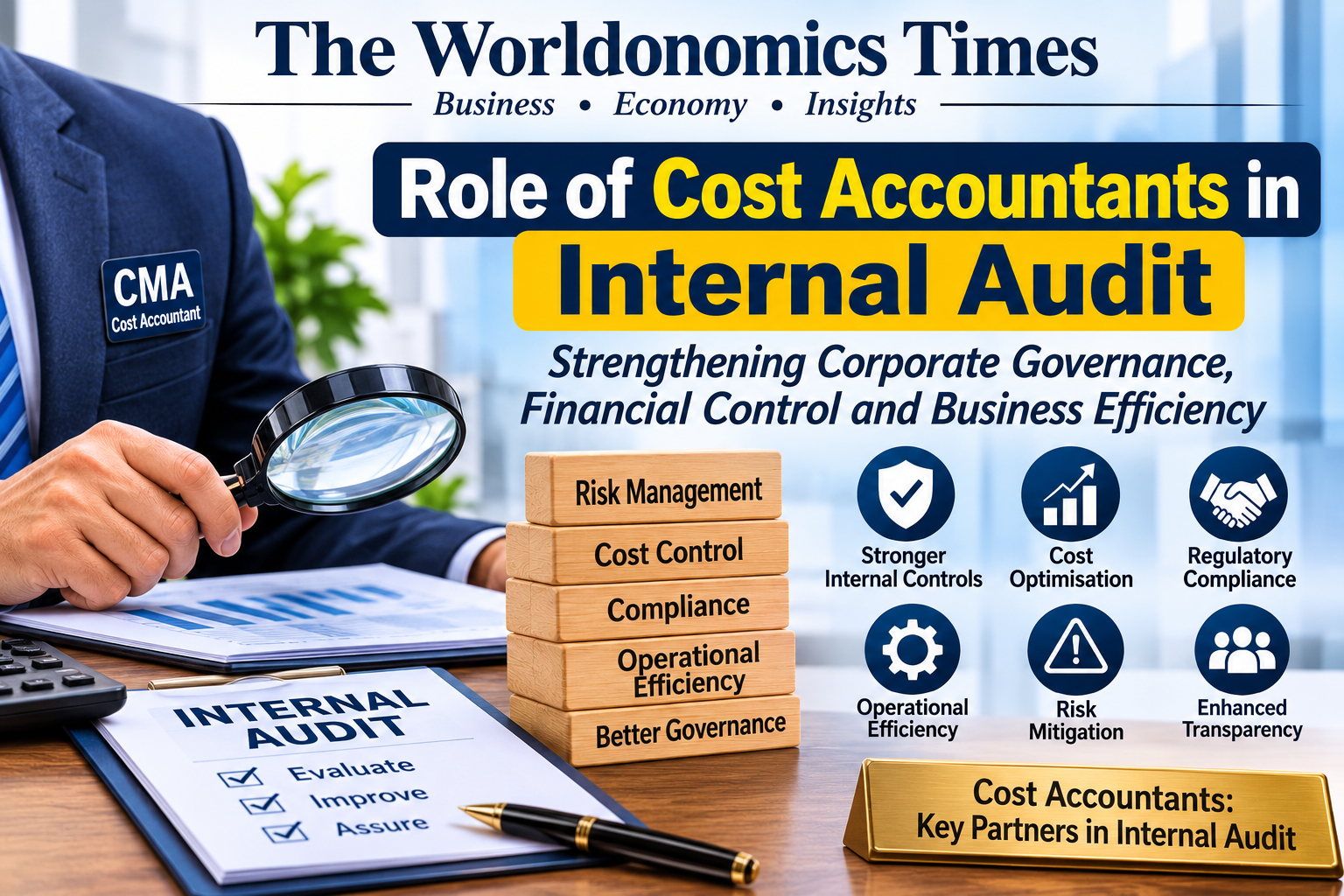
For The Worldonomics Times | CMA Madhuri Kashyap
Internal audit has become an essential function for modern businesses, helping organisations improve financial transparency, strengthen internal controls, identify operational risks and ensure compliance with applicable laws and regulations. In an increasingly competitive business environment, companies need more than traditional accounting practices. They require effective financial monitoring, cost optimisation and risk management systems.
Cost and Management Accountants (CMAs) play an important role in this area. With their professional expertise in cost accounting, financial management, performance evaluation, budgeting and management control systems, CMAs can contribute significantly to the internal audit framework of companies, manufacturing organisations, public sector enterprises and Micro, Small and Medium Enterprises (MSMEs).
Understanding Internal Audit
Internal audit is an independent and objective assurance and consulting activity designed to evaluate and improve an organisation’s operations. It examines whether business processes, financial systems, internal controls and risk management mechanisms are functioning effectively.
Unlike statutory audits, which primarily focus on financial statements and compliance with legal requirements, internal audit has a broader management-oriented approach.
Its major objectives include:
- Ensuring accuracy and reliability of financial information.
- Identifying operational and financial risks.
- Preventing fraud, errors and financial irregularities.
- Improving productivity and operational efficiency.
- Monitoring compliance with laws and regulations.
- Controlling unnecessary expenditure.
- Strengthening corporate governance and accountability.
Why Cost Accountants Are Important in Internal Audit
Cost Accountants possess specialised knowledge of cost structures, resource utilisation, financial analysis and management accounting. Their understanding of how businesses generate revenue and incur expenditure enables them to examine not only whether financial transactions are correctly recorded but also whether organisational resources are being used efficiently.
Their contribution is particularly valuable in manufacturing, infrastructure, engineering, healthcare, logistics, power, textiles and other cost-intensive industries.
Key Areas Where CMAs Contribute to Internal Audit
1. Cost Audit and Cost Control
One of the most significant contributions of Cost Accountants is the examination of cost structures and expenditure patterns. CMAs analyse material consumption, labour costs, production overheads, inventory expenses and other operating costs.
They identify unnecessary expenditure, wastage, inefficient processes and opportunities for cost reduction. Their recommendations help management improve profitability without compromising product quality.
2. Financial Management and Internal Controls
CMAs examine financial systems, accounting procedures, payment processes, procurement activities and cash management.
They evaluate whether adequate internal controls exist to safeguard organisational assets and prevent unauthorised transactions. They also review financial reporting systems to identify errors, inconsistencies and weaknesses.
Effective financial controls help businesses improve accountability and maintain reliable financial information.
3. Inventory and Stock Management Audit
Inventory represents a substantial investment for manufacturing and trading organisations. Poor inventory management can lead to excess stock, shortages, deterioration and unnecessary working capital requirements.
Cost Accountants examine inventory valuation, stock reconciliation, material movement, warehouse management and procurement procedures.
They can recommend techniques such as Economic Order Quantity (EOQ), Just-in-Time (JIT) inventory management and ABC analysis to improve inventory efficiency.
4. Operational Efficiency and Performance Evaluation
Internal audit is not limited to financial transactions. It also examines the efficiency of business operations.
CMAs evaluate production capacity, machine utilisation, labour productivity, resource consumption and departmental performance.
They use performance indicators and cost-benefit analysis to identify operational weaknesses and recommend improvements. Such evaluations are particularly useful for manufacturing companies seeking to increase productivity and reduce operating costs.
5. Risk Management and Fraud Prevention
Every organisation faces financial, operational, regulatory and strategic risks. Internal auditors help management identify these risks before they develop into major problems.
CMAs can examine unusual expenditure patterns, irregular procurement transactions, revenue leakage, payment discrepancies and weaknesses in financial authorisation systems.
By implementing risk-based audit procedures and monitoring corrective actions, they help businesses strengthen their fraud prevention and risk management mechanisms.
6. GST, Taxation and Regulatory Compliance
Businesses must comply with several statutory and regulatory requirements. Errors in tax calculations, documentation, input tax credit claims and statutory payments may create financial and legal consequences.
CMAs can review relevant financial records, examine compliance processes, identify discrepancies and recommend corrective action.
Their knowledge of financial regulations and business transactions makes them valuable members of an organisation’s compliance and internal audit framework.
7. Budgetary Control and Management Reporting
Budgetary control is an important tool for monitoring financial performance.
CMAs compare actual expenditure and revenue with approved budgets, identify significant variances and investigate their underlying causes.
They prepare analytical reports for management, enabling decision-makers to understand financial performance, control expenditure and allocate resources more effectively.
Legal Recognition of CMAs as Internal Auditors in India
The Companies Act, 2013 provides statutory recognition to Cost Accountants in the field of internal auditing.
Section 138 of the Act provides that prescribed classes of companies must appoint an internal auditor, who may be a Chartered Accountant, a Cost Accountant or another professional decided by the Board.
Rule 13 of the Companies (Accounts) Rules, 2014 specifies the classes of companies covered by this requirement.
These include:
- Every listed company.
- Unlisted public companies meeting prescribed paid-up capital, turnover, borrowing or deposit thresholds.
- Private companies meeting prescribed turnover or borrowing thresholds.
The internal auditor may be an individual or an eligible firm or body corporate, and the Audit Committee or Board determines the scope, frequency, functioning and methodology of the audit in consultation with the internal auditor. IndiaCode+1
This statutory framework creates significant professional opportunities for qualified Cost Accountants in corporate India.
Role of ICMAI in Promoting Internal Audit
The Institute of Cost Accountants of India (ICMAI) has taken initiatives to strengthen the professional capabilities of CMAs in internal auditing.
The Institute established the Internal Auditing and Assurance Standards Board (IAASB) to formulate standards, guidance notes and professional resources for members undertaking internal audit assignments.
ICMAI also provides sector-specific guidance covering industries such as engineering, pharmaceuticals, power, telecommunications and plantation. These resources help professionals develop specialised knowledge and improve the quality of internal audit services. ICMAI+2
Emerging Opportunities for CMAs in Internal Audit
With the increasing adoption of digital technologies, the scope of internal auditing is expanding. Businesses are adopting Enterprise Resource Planning (ERP) systems, artificial intelligence, data analytics and automated financial reporting platforms.
CMAs with knowledge of digital auditing tools can analyse large volumes of financial data, identify unusual transaction patterns and monitor business performance more effectively.
There are also growing opportunities in:
- Internal audit consultancy.
- Risk-based internal auditing.
- ESG and sustainability-related controls.
- Forensic accounting and fraud risk assessment.
- Performance and operational audits.
- MSME financial management and process improvement.
- Corporate governance and compliance advisory.
Conclusion
The role of Cost Accountants in internal audit is becoming increasingly important in India’s evolving corporate and industrial environment. Their expertise extends beyond financial accounting to cost optimisation, operational efficiency, risk management, regulatory compliance and strategic financial planning.
By combining technical knowledge with analytical skills and professional independence, CMAs can help organisations identify weaknesses, prevent financial irregularities, improve productivity and strengthen corporate governance.
For Indian businesses, particularly manufacturing companies and MSMEs, an effective internal audit system supported by Cost Accountants can become a powerful instrument for sustainable growth, financial discipline and long-term competitiveness.
As businesses become more complex and regulatory expectations continue to evolve, Cost Accountants have an important opportunity to strengthen their position as trusted professionals in India’s internal audit and corporate governance ecosystem.
The Worldonomics Times | Business • Economy • Insights