New Delhi | 4 November 2026
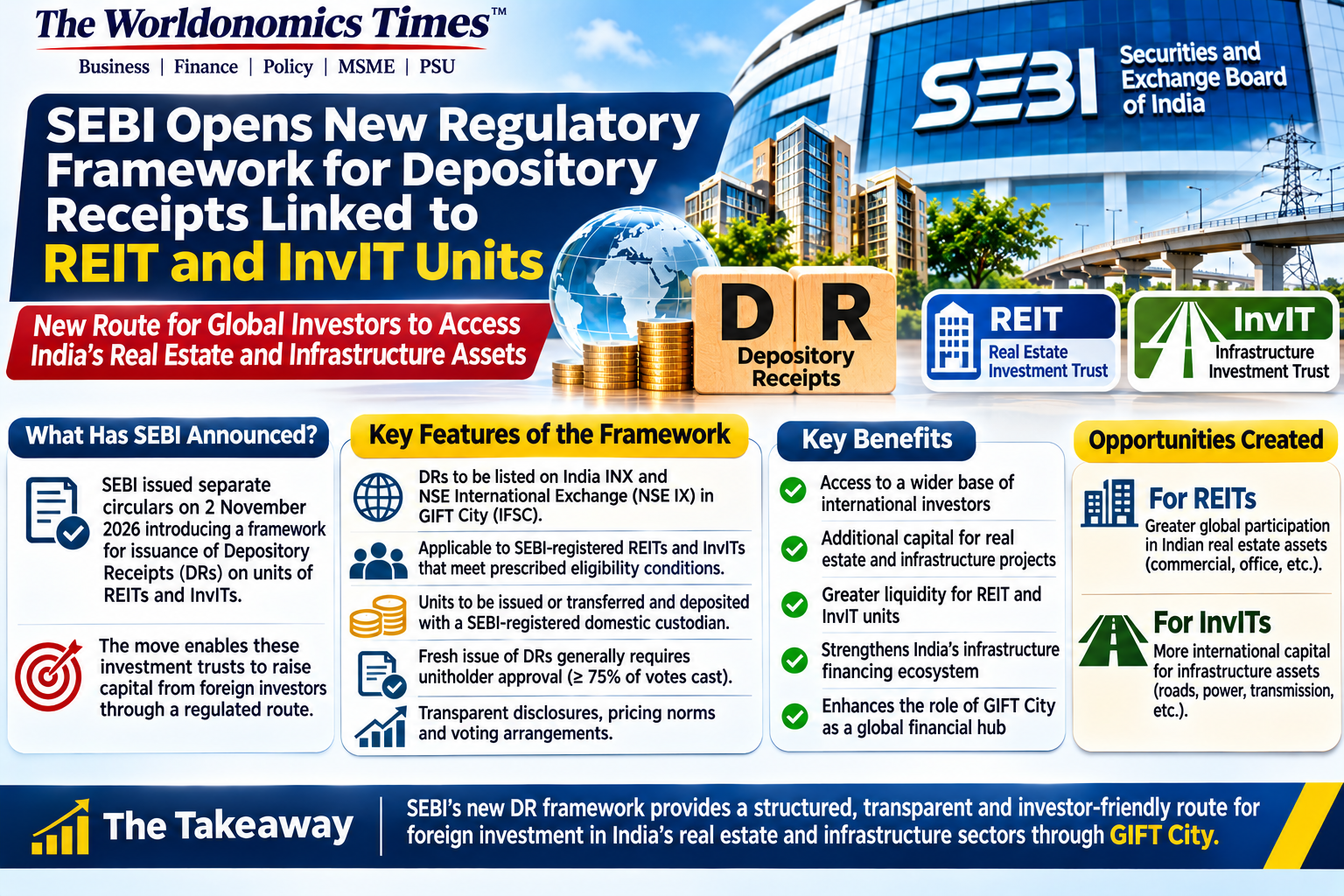
The Securities and Exchange Board of India (SEBI) has introduced a new regulatory framework allowing Real Estate Investment Trusts (REITs) and Infrastructure Investment Trusts (InvITs) to raise capital from foreign investors through the issuance of Depository Receipts (DRs) backed by their units. The move, announced through separate circulars dated November 2, 2026, creates an additional route for Indian real estate and infrastructure investment trusts to access international investors through designated exchanges in the Gujarat International Finance Tec-City (GIFT City).
The regulatory development is expected to provide greater flexibility to REITs and InvITs in accessing foreign capital, while offering eligible non-resident investors an additional avenue to participate in India’s real estate and infrastructure investment opportunities.
The two circulars establish separate operational frameworks for the issuance of Depository Receipts against REIT and InvIT units. They specify eligibility conditions, permissible jurisdictions, listing requirements, investor protections, disclosure obligations and responsibilities of investment managers, custodians and other market participants. Securities and Exchange Board of India+3
What Are Depository Receipts?
A Depository Receipt is a foreign-currency-denominated financial instrument issued by a foreign depository against underlying securities or investment units deposited with a domestic custodian.
In the newly introduced framework, units of an Indian REIT or InvIT will serve as the underlying assets for the Depository Receipts. These instruments will be issued by a foreign depository and listed on specified international exchanges within the permissible jurisdiction.
This structure allows eligible foreign investors to obtain economic exposure to Indian real estate and infrastructure investment trusts through Depository Receipts rather than directly purchasing the underlying units in the domestic market.
The framework establishes a regulated mechanism connecting Indian investment trusts, domestic custodians, Indian depositories, foreign depositories and international exchanges.
GIFT City to Play a Central Role
An important feature of SEBI’s framework is the identification of permissible jurisdictions and international exchanges.
For the purposes of these circulars, the permissible jurisdiction is the International Financial Services Centre (IFSC) in India. The specified exchanges are:
- India International Exchange (India INX).
- NSE International Exchange (NSE IX).
Accordingly, REITs and InvITs registered with SEBI can issue or facilitate the transfer of units for Depository Receipts through the prescribed IFSC framework.
The requirement to list these instruments on specified exchanges creates a structured route for international participation through India’s financial services hub.
This arrangement may also contribute to the development of GIFT City as a platform for international financial transactions and investment products. Securities and Exchange Board of India+1
Eligibility Conditions for REITs and InvITs
SEBI has prescribed eligibility requirements to ensure that only compliant investment trusts and eligible participants can use the new mechanism.
The REIT or InvIT must comply with the applicable SEBI regulations. The trust, its parties, directors, promoters and partners, as well as existing unitholders transferring units, must satisfy specified regulatory conditions.
These include restrictions relating to entities or individuals debarred from accessing the capital market, wilful defaulters and fugitive economic offenders, subject to the exceptions specified in the circulars.
Another important requirement is that the holder of Depository Receipts, including the beneficial owner, must not be a person resident in India. Responsibility for ensuring compliance with this condition rests with the DR holder and its beneficial owners.
These safeguards are intended to maintain regulatory oversight and ensure that the new investment route operates within the prescribed legal framework.
How Will the Issuance Process Work?
Under the framework, REITs and InvITs can issue new units or facilitate the transfer of existing units held by investors for the purpose of issuing Depository Receipts.
The process involves several participants:
- The REIT manager or InvIT investment manager initiates the proposed DR issuance.
- A merchant banker is appointed to oversee the issuance and related regulatory compliances.
- The underlying units are issued or transferred and deposited with a SEBI-registered domestic custodian.
- The foreign depository issues Depository Receipts against the deposited units.
- The DRs are listed on the specified international exchange in the permissible jurisdiction.
The foreign depository cannot issue DRs until the domestic custodian confirms receipt of the underlying units.
For fresh DR issues, the prescribed offer documents must be submitted to SEBI and recognised stock exchanges through the merchant banker. SEBI will endeavour to provide its comments within seven working days, while the recognised stock exchange is required to consider the application and decide on in-principle approval within 15 working days of receiving the application and required documents. Securities and Exchange Board of India+1
Unitholder Approval and Investor Protection
The framework also establishes safeguards concerning the issuance of Depository Receipts.
Any fresh issue of DRs generally requires prior approval of unitholders, with votes in favour representing at least 75% of the total votes cast on the resolution.
An exception applies to simultaneous domestic initial offerings and international DR listings, subject to the prescribed conditions. Further offerings within an already approved overall limit do not require fresh unitholder approval.
Where existing unitholders transfer their units for a DR listing, the REIT or InvIT must provide an opportunity to all existing unitholders to tender their units for participation.
The investment manager must also ensure compliance with applicable minimum public unitholding requirements, investment limits and other regulatory obligations.
These provisions seek to balance fundraising flexibility with the interests of existing investors. Securities and Exchange Board of India+1
Disclosure, Pricing and Governance Requirements
SEBI has also specified obligations relating to pricing, disclosures, voting rights and reporting.
The investment manager must ensure that the issue or transfer price of underlying units is not lower than the applicable price for the corresponding domestic issuance route.
Public disclosures made on the international exchange must also be filed with the recognised Indian stock exchange within 24 hours.
The framework further provides for voting instructions through the foreign depository for voting rights attached to underlying units.
Domestic custodians and Indian depositories must maintain and coordinate transaction records relating to the issuance and cancellation of DRs. This includes information concerning the number of underlying units against which DRs remain outstanding.
These requirements are intended to support transparency, appropriate record-keeping and regulatory monitoring.
Opportunities for India’s Real Estate and Infrastructure Sectors
The new framework could have wider implications for India’s real estate and infrastructure financing ecosystem.
REITs provide investors with an avenue to participate in income-generating real estate assets, including commercial properties and other eligible real estate portfolios.
InvITs provide investment exposure to infrastructure assets such as roads, power transmission networks and other eligible infrastructure projects.
By introducing a structured mechanism for issuing DRs against their units, SEBI has created an additional potential channel for accessing foreign investment.
For REITs, this could help widen the investor base for income-generating property assets. For InvITs, the framework could support greater international investor participation in infrastructure-linked investment opportunities.
The actual scale of fundraising will depend on investor demand, commercial considerations, compliance with eligibility conditions and the ability of individual trusts to access the international market.
Significance for Financial Professionals and Market Participants
The new framework creates additional responsibilities and opportunities for several participants in the financial ecosystem.
Investment managers will need to evaluate the commercial feasibility of DR issuance and ensure compliance with SEBI regulations.
Merchant bankers will play an important role in structuring and overseeing the issuance process. Domestic custodians, foreign depositories and Indian depositories will be responsible for maintaining the underlying securities and transaction records.
For chartered accountants, cost accountants, company secretaries, investment professionals and compliance officers, the framework presents new areas of work involving cross-border capital raising, regulatory reporting, valuation, transaction documentation, financial disclosures and governance.
It also creates opportunities for professionals working in investment banking, infrastructure finance, real estate finance and international financial services.
A New Chapter for GIFT City and India’s Capital Markets
SEBI’s November 2, 2026 circulars represent an important development in the regulatory framework governing REITs and InvITs.
By enabling Depository Receipts backed by investment trust units, the regulator has created an additional mechanism through which eligible foreign investors can access Indian real estate and infrastructure investment opportunities.
The framework also strengthens the potential role of GIFT City and its international exchanges in facilitating cross-border investment products.
While the actual impact will depend on implementation, market participation and fundraising activity, the initiative provides REITs and InvITs with another regulated route to connect with international capital.
For India, the development aligns with broader efforts to deepen capital markets, diversify infrastructure financing channels and strengthen the country’s position as an international financial services destination.
The Worldonomics Times | Banking, Finance & Capital Markets