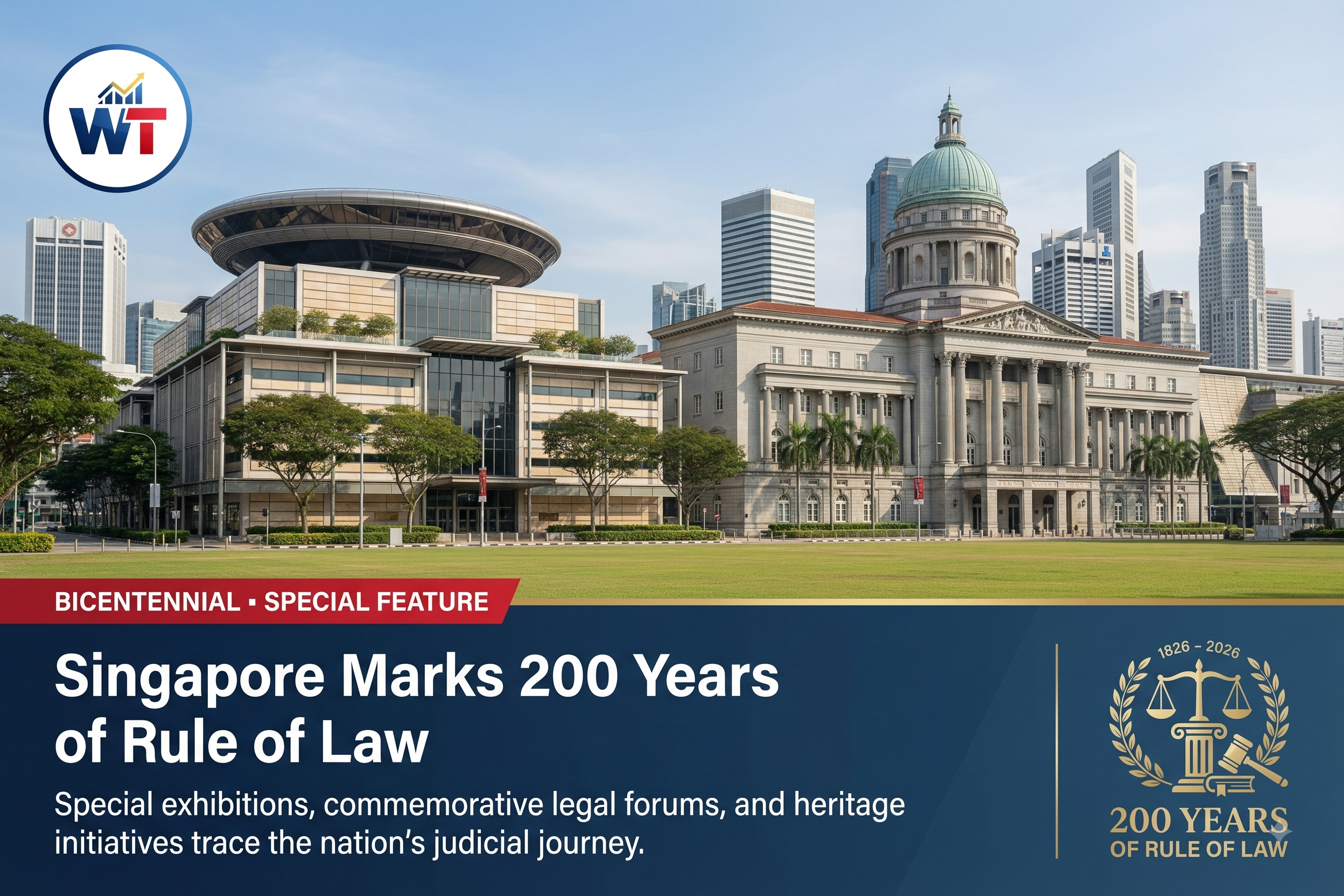
Singapore, November 27, 2026 — Singapore has marked a significant milestone in its legal history, celebrating 200 years since the establishment of the foundations of its modern legal and judicial system. The bicentennial commemorations brought together senior judges, government representatives, lawyers and international judicial leaders to reflect on the country’s legal development and the challenges facing its justice system.
The anniversary traces its origins to November 27, 1826, when the Second Charter of Justice was promulgated. The Charter established the Court of Judicature of Prince of Wales Island, Singapore and Malacca, laying an important foundation for the development of Singapore’s modern courts and legal institutions.
A historic bicentennial sitting was held at the Supreme Court on Friday, bringing together Singapore’s judicial leadership, members of the legal profession and senior judicial representatives from 21 jurisdictions. The event marked two centuries of legal development while directing attention towards the future of justice in an increasingly complex society.
Two Centuries of Legal Development
The Second Charter of Justice represented an important stage in the formal development of Singapore’s legal institutions. Over the following two centuries, the country’s legal framework evolved alongside major political, economic and social transformations.
From its colonial beginnings, Singapore developed a distinct legal system shaped by local circumstances, institutional reforms and the growing needs of an international business centre. The Judiciary gradually strengthened its institutional independence, developed Singapore-specific jurisprudence and modernised the administration of justice.
Successive generations of judges, lawyers, policymakers and legal academics contributed to this transformation. Major judicial reforms, particularly from the 1990s onwards, helped improve case management, address court backlogs and make legal proceedings more efficient.
Today, Singapore’s legal system plays an important role in supporting commercial activity, resolving disputes, protecting legal rights and maintaining public confidence in institutions. Its courts also contribute to the country’s position as an international centre for commercial dispute resolution.
Justice Must Remain Accessible to Everyone
A central message emerging from the bicentennial celebrations was that the effectiveness of a legal system should not be measured only by the quality of its institutions or the complexity of its legal framework. It must also be judged by whether ordinary people can understand their rights, obtain assistance and secure meaningful remedies.
Minister for Law Edwin Tong emphasised that the law and the institutions built around it must ultimately serve the people. Legal disputes often involve deeply personal matters, including family relationships, employment, livelihoods and businesses built over many years.
Chief Justice Sundaresh Menon similarly highlighted the importance of viewing the justice system from the perspective of the people who use it. Procedures that appear straightforward to judges and lawyers may be difficult for individuals encountering the courts for the first time.
The Judiciary has therefore continued to simplify court processes, improve communication and strengthen support for court users. Its Access to Justice Division, established to identify and address barriers, forms part of wider efforts to make legal services and judicial processes easier to navigate.
Expanding Legal Aid and Improving Dispute Resolution
Access to justice also depends on whether individuals can afford legal assistance and understand the options available when disputes arise.
The Ministry of Law has highlighted several initiatives aimed at improving access, including expanding legal aid, institutionalising criminal defence aid and simplifying dispute resolution. Strengthening the enforcement of court and tribunal orders is another priority, ensuring that successful legal claims can translate into practical outcomes.
These measures are particularly relevant for individuals and families who may lack the financial resources or legal knowledge required to navigate complicated proceedings.
Alternative dispute resolution mechanisms can also help parties resolve disagreements without relying exclusively on lengthy court proceedings. Mediation and other less adversarial processes may provide more practical solutions, particularly in family and community disputes.
The broader objective is to build a system that combines legal sophistication with accessibility, ensuring that people can obtain assistance before problems become more difficult and expensive to resolve.
Artificial Intelligence and the Future of the Judiciary
Technology is expected to play an increasingly important role in shaping Singapore’s legal system over the coming decades. Artificial intelligence, in particular, offers opportunities to improve research, process complex information and make certain legal services more efficient.
Chief Justice Menon noted that AI could help widen access to justice and enable legal professionals to work more effectively with large volumes of information. However, he also cautioned against excessive reliance on technology, pointing to the possibility of inaccurate outputs and errors concealed by convincing language.
The challenge for courts will be to adopt useful technologies while maintaining judicial independence, professional accountability and public confidence.
Legal leaders also identified other pressures, including an ageing population, changing social expectations, geopolitical uncertainty and the need to attract and develop talented legal professionals.
These developments will require continued investment in training, institutional innovation and responsible regulation. Technology may change how legal work is performed, but the principles of fairness, impartiality and accountability will remain essential.
Preserving Public Trust in Legal Institutions
Another major theme of the bicentennial discussions was the importance of maintaining public trust. A credible rule-of-law system requires clear and stable laws, independent and effective courts, equality before the law and the exercise of public power within legal limits.
Attorney-General Lucien Wong emphasised that the rule of law must operate in practice rather than remain an abstract principle. Public confidence depends on institutions demonstrating accountability, consistency and respect for legal boundaries.
Chief Justice Menon also highlighted the importance of cooperation and appropriate boundaries between the different branches of government. Courts must interpret and apply the law while ensuring that executive power remains within lawful limits.
The Global Rule of Law Conference, held from November 25 to 26, provided an international platform for judicial leaders and legal experts to discuss these issues. Participants examined the relationship between legal institutions, economic development, international cooperation and social stability.
The Worldonomics Times View
Singapore’s 200-year legal milestone is more than a commemoration of institutional history. It provides an opportunity to consider how the rule of law must continue to evolve to meet the needs of a changing society.
A strong legal system requires more than well-established courts and comprehensive legislation. It must be accessible to people from different backgrounds, provide practical remedies and maintain public confidence through fairness, transparency and accountability.
The growing role of artificial intelligence and digital services creates opportunities to improve efficiency, but technological progress must not come at the expense of accuracy, human judgement or public trust. Equally important is ensuring that legal assistance remains within reach of individuals and businesses that need it.
As Singapore enters the third century of its modern judicial history, its challenge will be to preserve the institutional foundations developed over generations while responding to new social, economic and technological realities.
Ultimately, the success of the next chapter will depend not simply on how advanced the legal system becomes, but on whether people continue to experience it as fair, understandable and accessible. The enduring value of the rule of law lies in its ability to protect rights, resolve disputes and deliver justice in everyday life.