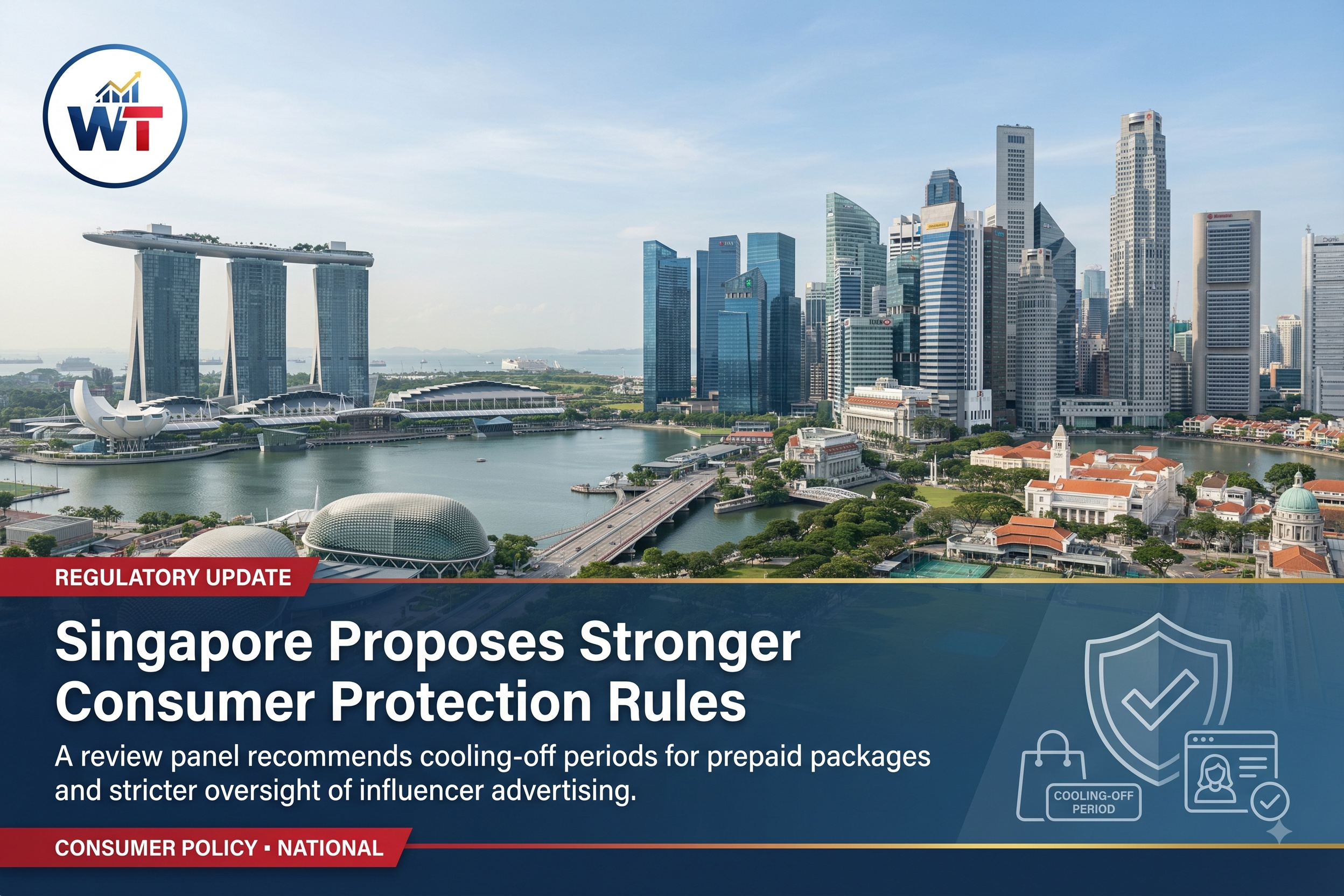
Singapore is considering a stronger consumer protection framework following a comprehensive review panel’s recommendations to address emerging risks in online shopping, prepaid service packages, influencer advertising and entertainment ticketing.
On November 27, 2026, the Consumer Protection Review Panel submitted seven recommendations to the government, proposing measures designed to strengthen consumer rights, improve transparency and provide more effective avenues for resolving disputes.
Among the most notable proposals are a mandatory cooling-off period for prepaid packages in high-risk sectors, stronger oversight of influencer advertising disclosures and improved safeguards against ticketing scams.
The recommendations come as Singapore’s consumer marketplace continues to evolve, with digital platforms, social media promotions and advance-payment business models becoming increasingly common.
Cooling-Off Period for Prepaid Packages
One of the panel’s key recommendations is to introduce a mandatory cooling-off period for prepaid services in high-risk sectors, particularly beauty and wellness.
Consumers frequently purchase expensive packages for services such as facial treatments, slimming programmes, beauty procedures and wellness memberships. These packages may require substantial upfront payments, sometimes following intensive sales presentations or pressure-selling tactics.
The panel believes consumers should have an opportunity to reconsider such purchases after leaving the sales environment.
Under the proposed arrangement, customers who make significant financial commitments under undue sales pressure would receive a limited period to cancel their purchases without penalty.
Industry feedback suggested that a period of five to seven working days could be practical. Around 81% of survey respondents supported the proposed cooling-off measure.
The recommendation follows growing concerns about prepayment losses when businesses suddenly close or fail to deliver services already paid for by customers.
According to the Consumers Association of Singapore (CASE), reported prepayment losses reached S$6.69 million between January and September 2026, approximately 147% higher than the S$2.71 million reported during the whole of 2025.
The proposed safeguard could help reduce financial exposure for consumers, particularly those purchasing high-value packages.
Stronger Oversight of Influencer Advertising
The review panel has also called for stronger monitoring of influencer marketing and clearer disclosure of commercial relationships.
Social media influencers increasingly promote products and services through platforms such as Instagram, TikTok and YouTube. Their recommendations can influence purchasing decisions, particularly among younger consumers.
However, promotional content may not always be clearly distinguishable from personal opinions or independent product reviews.
The panel recommended strengthening the Advertising Standards Authority of Singapore’s (ASAS) oversight of influencer advertising disclosures under the Singapore Code of Advertising Practice.
Disclosures should be made whenever a commercial relationship exists with an advertiser, brand, agency or sponsor.
The panel also proposed voluntary training for influencers, advertising agencies, brands and business owners to improve awareness of advertising responsibilities.
Greater transparency could help consumers understand whether an endorsement reflects an independent opinion or a paid commercial arrangement.
The recommendation also recognises that digital advertising differs from traditional media because social media content can be published directly without the same level of prior review by a conventional advertising gatekeeper.
Digital Consumer Practices Under Review
Another recommendation focuses on whether Singapore’s Consumer Protection (Fair Trading) Act adequately addresses emerging unfair and deceptive digital practices.
Online marketplaces and digital businesses increasingly use personalised recommendations, targeted advertising, subscription models and automated purchasing processes.
While these features can improve convenience, they may also create risks when consumers encounter misleading product information, hidden costs, fake reviews or complicated cancellation procedures.
The panel has recommended that the government and the Competition and Consumer Commission of Singapore review whether existing legal protections are sufficient.
It also suggested examining whether the regulator should receive additional powers, including the ability to issue directions and impose financial penalties for certain unfair practices.
The objective is to ensure that consumer protection legislation remains relevant as business models and digital technologies develop.
Stronger Protection Against Ticketing Scams
Entertainment ticketing is another important area covered by the review.
High-demand concerts and events have increasingly attracted ticket scams, unauthorised resale activity and disputes involving duplicate or invalid tickets.
The panel recommended that official ticketing providers and event organisers adopt secure digital tickets as the default for major concerts and other high-demand events.
These tickets would be linked to authenticated accounts, supported by controlled transfer mechanisms and dynamic entry credentials.
Such measures could make it more difficult for scammers to duplicate tickets or sell the same ticket to multiple buyers.
The panel also recommended accelerating the introduction of authorised resale platforms.
These platforms should clearly display the original ticket price, resale price and applicable transaction fees, allowing consumers to make more informed purchasing decisions.
The recommendations aim to improve transparency in the secondary ticket market while reducing opportunities for fraudulent transactions.
Higher Small Claims Tribunal Limits
The panel has also recommended increasing the monetary limits of Singapore’s Small Claims Tribunals (SCT) to improve access to consumer dispute resolution.
It proposed raising the standard claim limit from S$20,000 to S$30,000.
Where both parties agree, the maximum limit could increase from S$30,000 to S$60,000.
The review also suggested expanding the types of disputes the tribunal can handle, potentially including disagreements involving car-sharing services, vehicle-rental deposits and repair charges.
In addition, the panel recommended reviewing contractual terms that may prevent consumers from accessing courts, tribunals or other dispute-resolution mechanisms.
These changes could provide consumers with more practical options when disputes involve higher-value purchases or newer digital services.
A Comprehensive Review of Consumer Rights
The Consumer Protection Review Panel was convened in March 2025 and co-chaired by Consumers Association of Singapore president Melvin Yong and former Judicial Commissioner Foo Tuat Yien.
Its review involved feedback from more than 8,000 consumers and close to 250 businesses and industry representatives.
The seven recommendations cover four broad areas: e-commerce and digital consumer protection, prepayment losses and pressure selling, entertainment ticketing, and access to effective dispute resolution.
They represent the first comprehensive review of Singapore’s consumer protection framework since the major amendment to the Consumer Protection (Fair Trading) Act in 2018.
Importantly, these are recommendations submitted to the government, not rules that have already come into force. Their implementation will depend on the government’s consideration and any subsequent legislative or regulatory changes.
The Worldonomics Times View
Singapore’s proposed consumer protection reforms reflect the changing nature of modern commerce. As consumers increasingly purchase services online, rely on influencer recommendations and pay in advance for packages, traditional safeguards may not always address emerging risks effectively.
A cooling-off period could reduce the financial consequences of pressure selling, while clearer influencer disclosures would strengthen transparency in digital advertising. Secure ticketing and higher Small Claims Tribunal limits could also improve consumer confidence and access to justice.
However, stronger regulation must be implemented in a way that remains practical for responsible businesses, particularly smaller operators. Clear guidelines, reasonable compliance requirements and effective public awareness will be essential.
Ultimately, a trusted marketplace benefits both consumers and businesses. Singapore’s proposed reforms provide an opportunity to strengthen that trust while ensuring that consumer protection keeps pace with technological and commercial change.