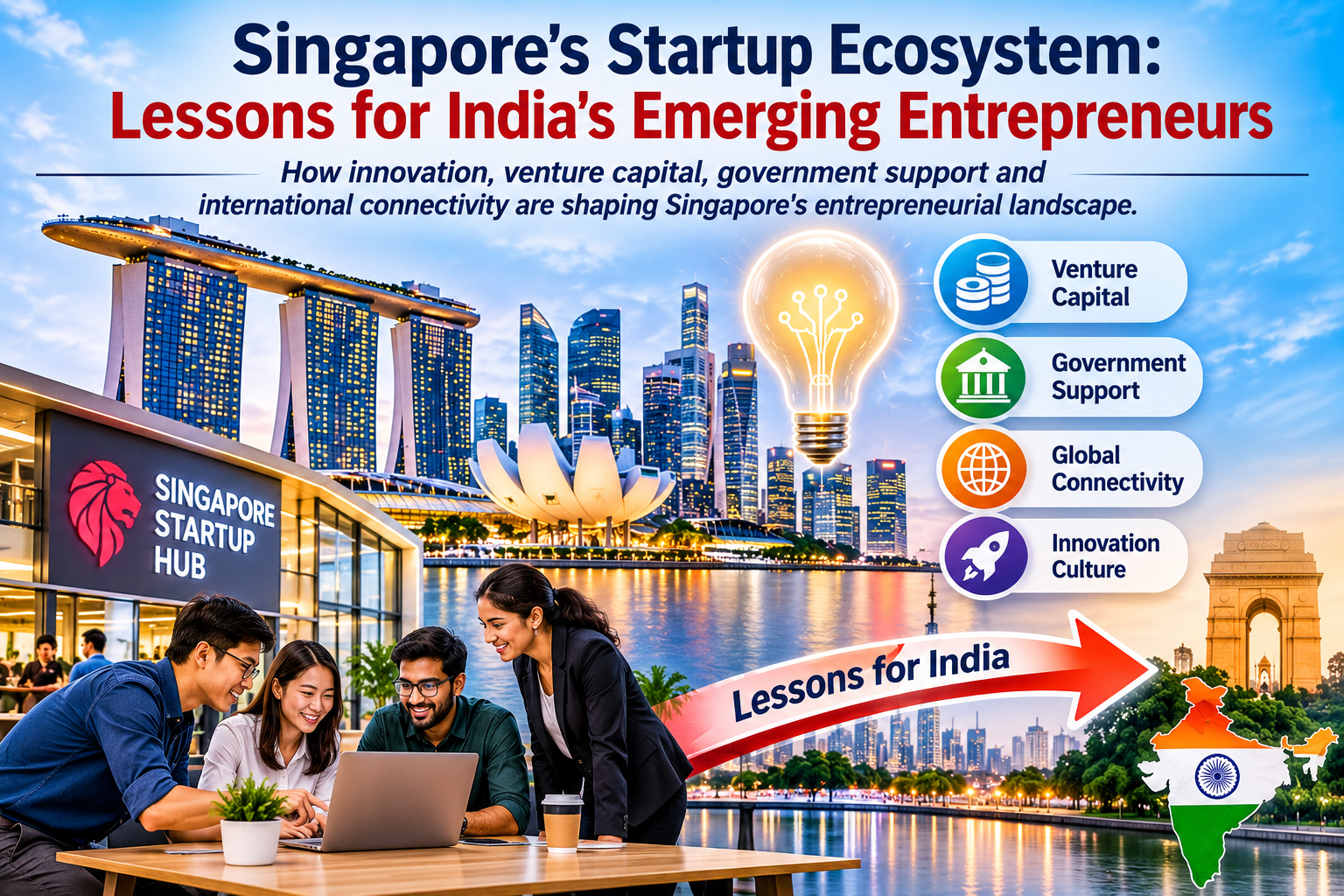
How innovation, venture capital, government support and international connectivity are shaping Singapore’s entrepreneurial landscape.
Introduction
Startups have become important drivers of innovation, employment and economic transformation. They introduce new technologies, challenge traditional business models and create solutions to emerging market requirements.
Singapore has developed one of Southeast Asia’s prominent startup ecosystems by combining government support, venture capital, research institutions, technology infrastructure and international business connectivity.
Its experience provides valuable lessons for India, where entrepreneurship is increasingly contributing to economic development.
Building an innovation-driven economy
Singapore’s startup ecosystem has developed alongside its broader economic transformation.
The government has focused on attracting technology companies, supporting research and development, encouraging entrepreneurship and connecting startups with international investors.
Organisations such as Enterprise Singapore support businesses through capability development, internationalisation programmes and innovation initiatives.
Singapore’s strategic position also allows startups to access regional markets without immediately establishing operations in multiple countries.
The role of venture capital
Venture capital is an important source of funding for startups that have high growth potential but may not qualify for conventional bank financing.
Unlike traditional lending, venture capital generally involves investors acquiring an ownership interest in a company.
Funding can be used for product development, recruitment, marketing, technology infrastructure and international expansion.
Singapore has developed an active venture capital ecosystem, connecting entrepreneurs with regional and international investors.
According to Enterprise Singapore’s May 2026 release, Singapore-based firms raised approximately S$5.9 billion across 472 venture funding deals in 2025. AI and deep technology continued to attract investor attention. Enterprise Singapore
This demonstrates the continued importance of Singapore as a funding and innovation centre, even during periods of greater investor caution.
Government support and entrepreneurship
Government support can help address some of the difficulties faced by early-stage companies.
Startups frequently face challenges such as:
- Limited access to capital.
- High research and development costs.
- Difficulty attracting specialised talent.
- Limited international market access.
- Uncertainty regarding regulations.
- Lack of established business networks.
Singapore’s innovation programmes and business support infrastructure help companies address these challenges.
However, government support cannot replace a commercially viable business model. A startup must ultimately demonstrate that customers are willing to pay for its products or services.
Technology as a growth driver
Singapore’s startup ecosystem includes companies working in several important areas.
Financial technology: Digital payments, lending platforms, wealth management and financial compliance.
Artificial intelligence: Enterprise automation, data analytics and intelligent business applications.
Deep technology: Advanced engineering, biotechnology and specialised technology solutions.
Climate technology: Renewable energy, carbon management and sustainable infrastructure.
Enterprise software: Cloud-based accounting, inventory management, cybersecurity and business intelligence.
These industries have the potential to create scalable products for regional and international markets.
Why Singapore attracts international entrepreneurs
Singapore offers several advantages to entrepreneurs.
First, its international business environment makes it easier to connect with customers, investors and business partners.
Second, its financial services industry supports fundraising and financial management.
Third, its professional services sector provides access to legal, accounting, taxation and corporate advisory expertise.
Fourth, its geographical location offers access to Southeast Asian markets.
Together, these factors make Singapore an attractive location for entrepreneurs seeking regional expansion.
Financial discipline: The foundation of startup survival
One of the most important lessons from Singapore’s startup environment is the importance of financial discipline.
Many startups fail not because their ideas lack potential but because they cannot manage cash flow, operating costs and funding requirements effectively.
A startup should regularly monitor:
- Cash burn rate.
- Monthly recurring revenue.
- Customer acquisition cost.
- Gross profit margin.
- Working-capital requirements.
- Break-even point.
- Runway and future funding requirements.
These indicators help founders understand whether their business is financially sustainable.
Cost and management accountants can play a significant role by preparing budgets, analysing unit economics, monitoring expenditure and developing financial forecasts.
Corporate governance in startups
Startups often focus on product development and fundraising while treating corporate governance as an administrative responsibility.
This can create problems when institutional investors undertake due diligence.
Investors generally examine ownership structures, statutory records, intellectual property rights, financial statements, related-party transactions, employment agreements and internal controls.
Therefore, governance should be established from the early stages of a business.
Good documentation and transparent financial reporting improve investor confidence and reduce the risk of disputes.
Lessons for Indian entrepreneurs
India has a large entrepreneurial base, a growing digital economy and a substantial domestic consumer market.
However, Indian startups can learn from Singapore in several areas.
1. Financial planning: Founders should maintain realistic budgets and cash-flow projections.
2. Governance: Companies should maintain proper records, statutory compliance and transparent ownership structures.
3. Internationalisation: Startups should consider regional markets when designing scalable products.
4. Investor readiness: Financial statements, business plans and due diligence documentation should be prepared professionally.
5. Innovation: Research, technology and customer-focused solutions should remain central to business strategy.
Challenges and limitations
Singapore’s startup ecosystem also faces challenges.
Operating costs and talent competition can be significant. Startups may also face difficulties expanding into different markets because of differences in consumer behaviour, regulations and business practices.
Venture capital funding is not guaranteed, and investors can become cautious during economic uncertainty.
Therefore, entrepreneurs must balance ambitious growth plans with realistic financial management.
Conclusion
Singapore’s startup ecosystem demonstrates how government support, financial infrastructure, technology and international connectivity can contribute to entrepreneurship.
Its venture funding activity in 2025 highlights the importance of innovation, particularly in AI and deep technology.
For Indian entrepreneurs, the most valuable lesson is that a successful startup requires more than a promising idea. It needs a viable business model, financial discipline, effective governance and a clear expansion strategy.
About Author:-
CMA Vivek Kumar (ACMA), an Associate Member of ICMAI and B.Com (Accounting Honours) graduate, is an author, finance professional, and Founder of VK Chartered Academy (www.cacmacstestseries.com). He specializes in statutory and tax audits, taxation, financial reporting, GST advisory, and corporate compliance. He also mentors CA, CMA, and CS aspirants through structured academic guidance and exam-oriented test series, bridging practical industry expertise with professional education. Email: cmavivek2026@gmail.com