Think about your morning: you check messages, pay a bill, order groceries or book a cab. You share details with several digital services, often without pausing to ask what happens after you press “submit”. Who can access that information, and why?
These questions affect anyone who uses a bank app, shops online, studies through a digital platform, works for an organisation or runs a business. They are also why India’s Digital Personal Data Protection Act, 2023 (DPDP Act) matters.
What does the Act protect?
The Act deals with digital personal data: information about an individual who is identifiable by, or in relation to, that information. A name linked to a mobile number, an email address connected to a customer account or an identifiable photograph can be personal data.
The law also covers information first collected offline but later digitised, such as a paper form entered into a database. It excludes personal or domestic processing by an individual and certain information made publicly available by the individual or under law. It can also reach processing outside India connected with offering goods or services to individuals in India.
Why did India need a data protection law?
Think of how many organisations hold fragments of information about one person. A bank has account details; an employer has recruitment and payroll records; a hospital has patient information; an online retailer has order and delivery details; a school may hold student and parent records.
Each organisation may have a valid reason to use some of that information. The problem arises when people cannot see what is collected, why it is needed, how long it is kept or with whom it is shared.
The risks are real: a spreadsheet may go to the wrong recipient, customer documents may sit in an open folder, or information collected for one purpose may continue circulating after that purpose ends. Organisations also understand their systems better than individuals do. A legal framework sets expectations, encourages responsible handling and gives people rights and ways to raise concerns. As digital payments, e-commerce, online education and health technology expand, trust becomes essential.
Three terms worth understanding
The Act identifies three roles: the Data Principal is the individual the data relates to; the Data Fiduciary decides why and how it is processed; and the Data Processor handles it on the Fiduciary’s behalf, for example by hosting a customer database. The roles depend on what parties actually do, not just their contract labels.
What is the law trying to achieve?
The Act recognises both an individual’s interest in protecting personal data and the need to process it for lawful purposes. It does not prohibit data use. It sets a framework for it.
Processing may be based on consent or specified legitimate uses. Consent must be free, specific, informed, unconditional and unambiguous, expressed through clear affirmative action. The Act also addresses notices, withdrawal, individual rights, security, breach intimation, erasure subject to legal retention and grievance redressal. The Data Fiduciary remains responsible when a processor handles data for it.
Consider a small online retailer. It may need a customer’s name, delivery address and phone number to complete an order. That does not automatically explain why it needs access to the customer’s entire contact list. The practical question is whether the information requested is connected to a lawful and clearly explained purpose.
Where does implementation stand on 16 November 2026?
The Act received Presidential assent on 11 August 2023, but its provisions were to commence on dates appointed by the Central Government. Notification G.S.R. 843(E), dated 13 November 2025, set out a phased timetable.
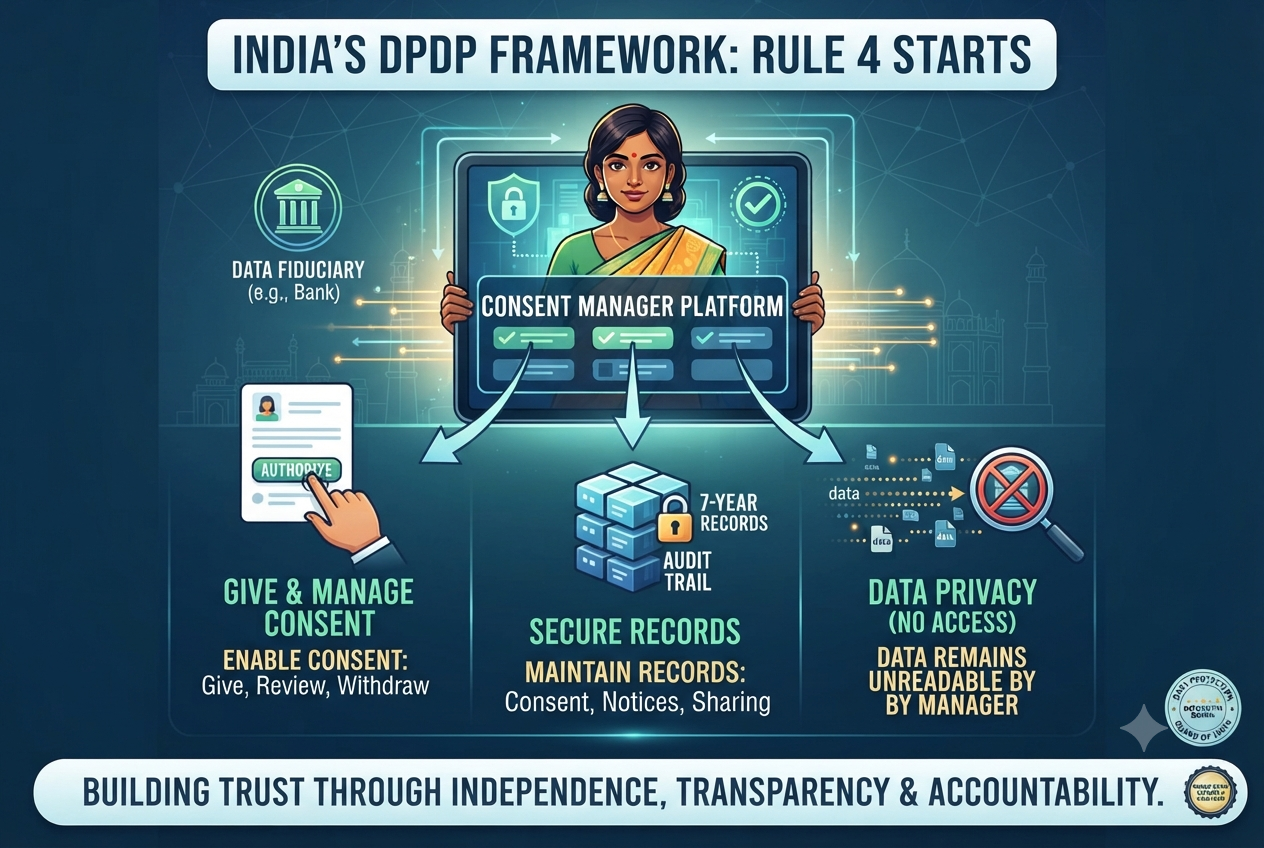
The first group of provisions has been in force since 13 November 2025. The one-year phase began on 13 November 2026: section 6(9), on registration of Consent Managers, and section 27(1)(d), on the Board’s function concerning breaches of Consent Manager registration conditions, have commenced. Rule 4 of the DPDP Rules, 2025, dealing with Consent Manager registration and obligations, also commenced in this phase.
Most principal operational provisions—including sections 3 to 17, subject to the notification’s specified exclusions—are scheduled to commence on 13 May 2027. The corresponding later-phase Rules are scheduled for that date. Organisations should prepare now, but should not describe every substantive obligation as already enforceable.
The Removal of Difficulties Order, 2026, published on 6 October 2026, corrected wording concerning children and persons with disabilities and data audits by Significant Data Fiduciaries. It did not change the commencement dates.
What can we do now?
Businesses can map the personal data they hold, record why each category is needed, identify who can access it, review service-provider arrangements and check retention and security practices. They should also examine how employees receive, store and share customer and staff documents.
Individuals can check app permissions, avoid sending identity documents through unverified channels, use strong authentication and pause before sharing information that does not appear necessary.
The DPDP Act is ultimately about accountability. Organisations need information to provide services and innovate. Individuals need confidence that their information will not be handled casually. A healthy digital economy must make room for both.
Think About It: If your organisation had to explain, in plain language, why it holds every category of personal data in its systems, could it do so today?
This article is for general awareness. Refer to the Act, Rules and applicable notifications for the legal position; organisations should assess their own facts and obligations.
CA Vrinda Aggarwal