Introduction
When purchasing a smartphone, refrigerator, car or laptop, customers often compare prices, features and performance. But there is another factor that influences purchasing decisions: the warranty.
A warranty is generally viewed as a promise by a company to repair or replace a defective product within a specified period. However, from a business perspective, it represents much more than customer protection.
Behind every warranty lies a financial strategy involving risk assessment, accounting provisions, customer retention, repair networks and long-term profitability.
The Business Economics of a Warranty
For companies, offering a warranty creates both an obligation and an opportunity.
On one hand, businesses must bear the potential cost of repairing or replacing defective products. On the other hand, a strong warranty policy can improve customer confidence and differentiate a brand from competitors.
For example, two companies may sell smartphones with similar specifications and prices. However, a customer may prefer the brand offering better after-sales support.
In this way, warranties can become an important competitive advantage.
The Hidden Financial Liability
A warranty is not necessarily a cost that arises only when a customer approaches a service centre.
Companies must estimate the future cost of warranty claims arising from products already sold.
Under Ind AS 37, where the recognition criteria are satisfied, businesses recognise a provision for warranty obligations.
This requires management to estimate expected repair costs, replacement expenses, historical claim patterns and other relevant factors.
Such estimates directly influence reported expenses, liabilities and profitability.
An increase in expected warranty claims can affect a company’s financial performance even before the actual repair expenditure occurs.
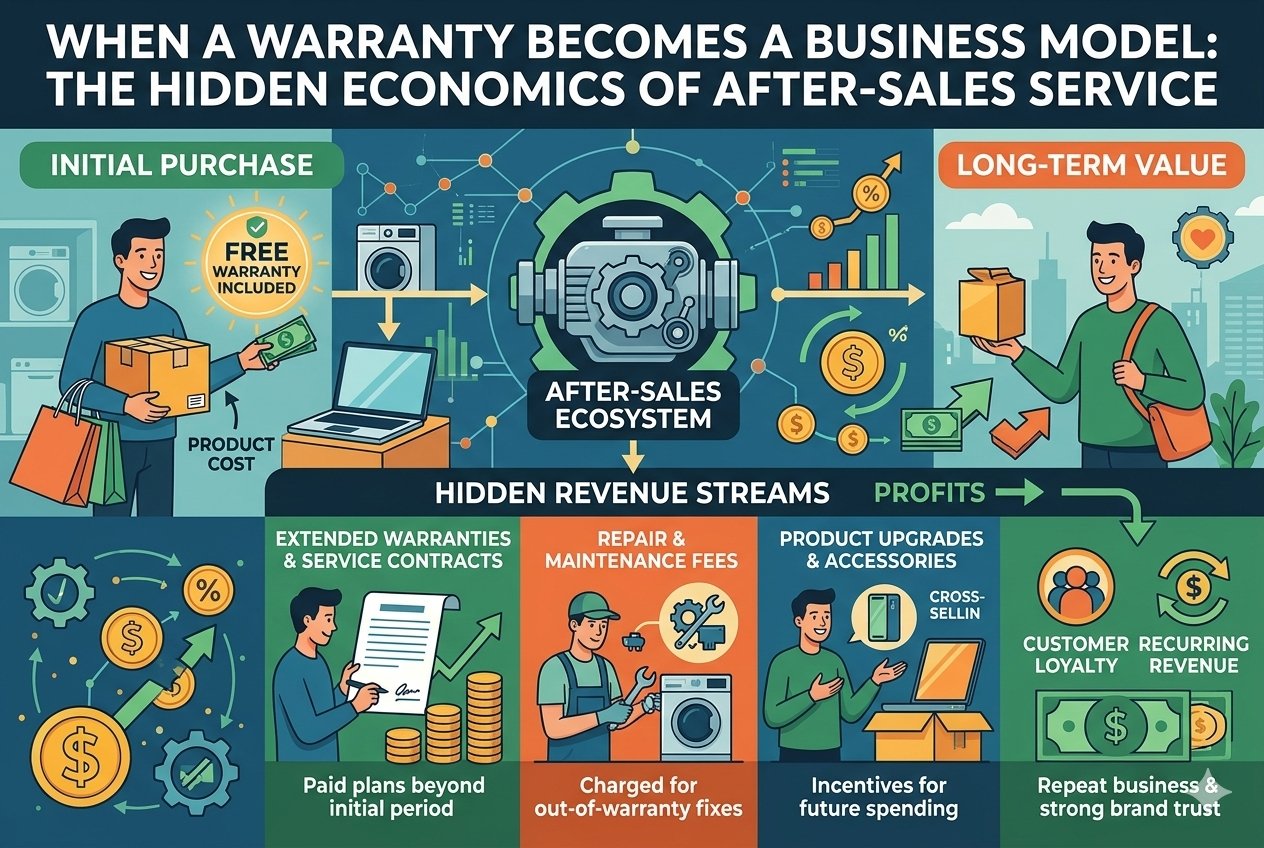
Extended Warranties: From Protection to Revenue Opportunity
Many businesses offer customers the option to purchase extended warranties beyond the standard coverage period.
These products create an additional commercial opportunity through after-sales services.
Extended warranties can generate additional revenue, strengthen customer relationships and create opportunities for service-related business models.
However, companies must also consider the future cost of providing the promised services.
The accounting treatment depends on the nature of the warranty and whether it represents assurance of product quality or an additional service under the applicable accounting standards.
Why After-Sales Service Matters for Brand Profitability
A company’s relationship with customers does not necessarily end when a product is sold.
After-sales service can influence repeat purchases, customer loyalty and brand reputation.
A business that provides reliable repairs, accessible service centres and genuine spare parts may enjoy stronger customer retention.
For automobile manufacturers, electronics companies and appliance brands, the service ecosystem can become an important part of the overall business strategy.
The Rise of the Repair Economy
Warranty obligations also support a wider economic ecosystem.
Repair centres, spare-parts manufacturers, authorised service providers and skilled technicians all participate in the after-sales value chain.
As sustainability becomes increasingly important, repair and refurbishment may also help extend product life and reduce unnecessary electronic and industrial waste.
This creates opportunities for businesses that can combine affordable repairs with efficient service delivery.
The Risks Companies Must Manage
A poorly designed warranty strategy can damage profitability.
Some major challenges include:
- Higher-than-expected product failure rates.
- Rising spare-parts and repair costs.
- Fraudulent or excessive warranty claims.
- Inefficient service networks.
- Delays in repair and replacement.
- Inaccurate estimation of warranty provisions.
Companies must balance customer satisfaction with financial sustainability.
What Investors Should Look For
Warranty-related information can provide useful insights into a company’s product quality and operational efficiency.
Investors and financial analysts may examine warranty provisions, actual claims, changes in estimated liabilities and after-sales service costs.
A rising warranty expense does not automatically indicate poor product quality, but significant changes deserve attention.
The relationship between warranty costs, sales growth and product reliability can help analysts understand the quality of a company’s earnings.
Conclusion: The Sale Is Only the Beginning
In a competitive marketplace, businesses cannot rely solely on selling products at attractive prices.
Customer trust, product reliability and after-sales support increasingly influence long-term business success.
A warranty may begin as a promise to the customer, but it eventually becomes a financial commitment, an operational responsibility and a strategic business decision.
Because in modern business, profitability is not determined only by what a company sells, but also by what it promises after the sale.