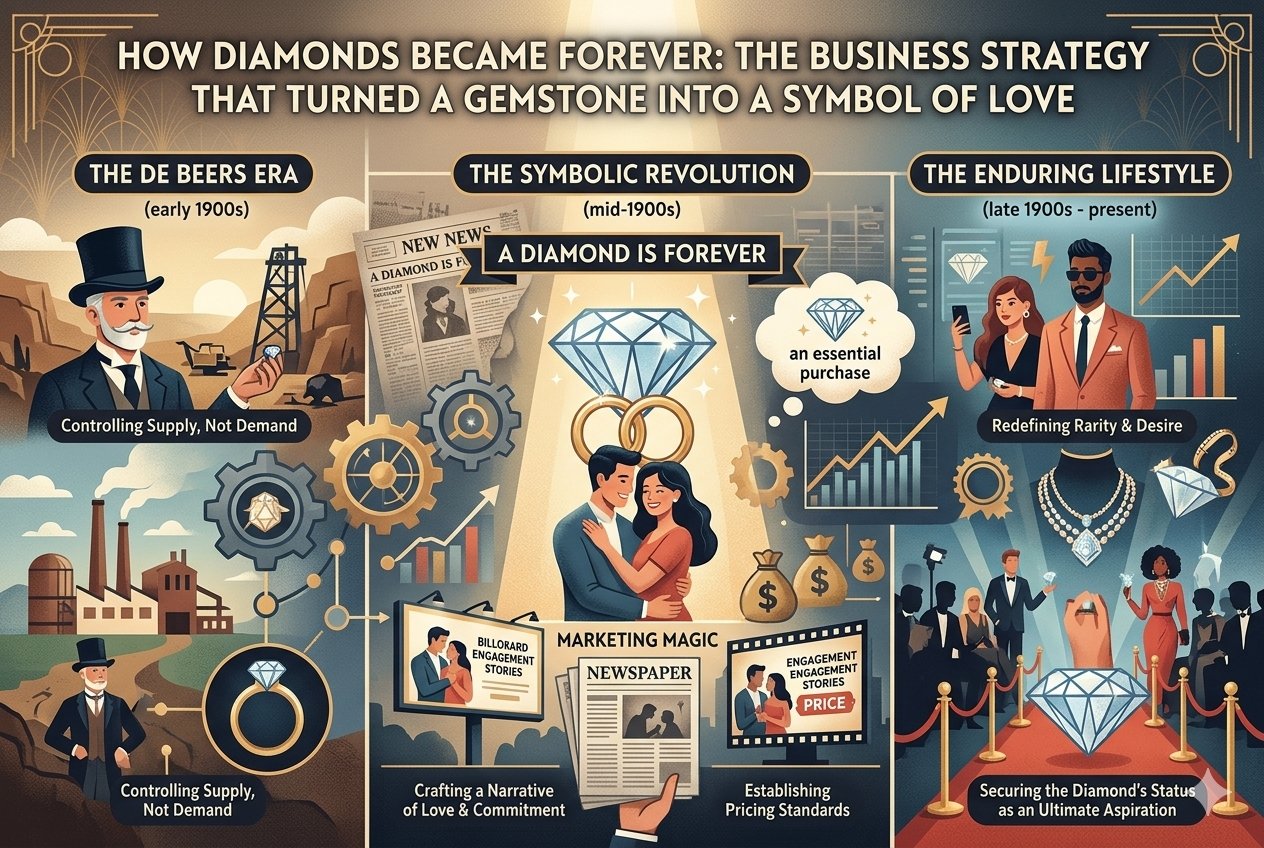
The fascinating story of how marketing, market control and consumer psychology transformed diamonds into one of the world’s most powerful luxury industries.
Imagine two people shopping for an engagement ring. One asks about the design, the other about the price, but almost everyone understands the symbolism attached to the diamond.
It represents love, commitment, status and something supposedly everlasting.
But have we ever wondered how a gemstone became so deeply connected with marriage that millions of people across the world began considering it an essential part of a proposal?
The answer is not found in geology alone. It is a fascinating story of business strategy, advertising, market economics and the power of creating consumer expectations.
1. The Company That Changed the Diamond Business
In the late nineteenth century, the discovery of diamond deposits in South Africa transformed the global diamond industry.
As production expanded, a major business challenge emerged: increasing supply could put downward pressure on prices.
Enter De Beers.
Established in 1888, De Beers became one of the most influential players in the international diamond trade. Under the leadership of Cecil Rhodes and later Ernest Oppenheimer, the company developed a powerful position in diamond mining and distribution.
Its historical strategy was not simply about extracting more diamonds. It was also about managing supply and influencing how diamonds reached the market.
The company understood something important: controlling production was only one part of the business. Creating sustained demand was equally essential.
2. Four Words That Changed Consumer Behaviour
The most remarkable chapter began in 1947.
Following the economic difficulties of the Great Depression and the disruptions of the Second World War, the diamond industry needed stronger consumer demand.
De Beers worked with the American advertising agency N. W. Ayer & Son to promote diamonds in the United States.
Then came four unforgettable words:
“A Diamond Is Forever.”
The slogan was created by copywriter Frances Gerety in 1947.
It was more than an advertising line. It connected the physical durability of diamonds with the emotional idea of everlasting love.
Advertising campaigns, celebrity associations, popular culture and changing marriage traditions gradually strengthened the relationship between diamonds and engagement rings.
The company was not merely selling a gemstone. It was helping establish a social expectation around a purchase.
This became one of the most remarkable examples of marketing influencing consumer behaviour.
3. The Economics of Creating Perceived Value
One of the most important lessons from the diamond industry is the difference between intrinsic characteristics and perceived value.
A diamond has physical properties such as hardness, brilliance, size and quality.
However, its commercial value is also influenced by several other factors:
- Brand positioning and consumer perception.
- Rarity and availability of particular stones.
- Marketing and emotional associations.
- Certification, quality and provenance.
- Consumer willingness to pay.
This illustrates an important economic principle: people do not always purchase products solely for their functional utility. They also purchase identity, status, emotion and social recognition.
A diamond engagement ring is therefore not just jewellery. It is also a product with significant symbolic value.
4. The Power of Supply Management
The diamond industry’s history also offers an interesting lesson in supply-side economics.
For decades, De Beers developed mechanisms to influence the availability of rough diamonds in the market.
By purchasing and stockpiling stones and coordinating distribution, it helped manage supply and reduce the risk of uncontrolled market flooding.
This contributed to its historical dominance.
However, the industry gradually changed as new producers, new mining locations and alternative distribution channels emerged.
De Beers could no longer exercise the same degree of influence over the global market.
The lesson is significant: a business advantage built around controlling supply can become vulnerable when competitors, technology and market structures change.
5. The New Challenge: Lab-Grown Diamonds
Today, the diamond industry is facing another major transformation.
Lab-grown diamonds have introduced a new competitive dimension.
These diamonds have essentially the same chemical composition and crystal structure as natural diamonds, but are created through technological processes rather than geological formation over millions of years.
Their growing availability and substantially lower prices are challenging traditional consumer perceptions.
This raises an interesting question:
If two diamonds can look identical and share the same essential physical properties, why should one command a significantly higher price?
The answer increasingly depends on what consumers value.
Some prefer natural diamonds because of their geological origin, rarity and heritage. Others prioritise affordability, appearance and technological innovation.
The competition is therefore no longer only about the product. It is about the meaning attached to the product.
6. What the Diamond Industry Teaches Modern Businesses
The diamond industry’s journey provides several lessons for entrepreneurs, marketers and business leaders.
First, create an identity, not just a product. Customers often remember what a product represents more than its technical specifications.
Second, understand consumer psychology. Purchasing decisions are influenced by emotions, traditions, social expectations and personal aspirations.
Third, supply management matters. Businesses must understand how availability, distribution and competition influence market prices.
Fourth, adapt before the market changes permanently. New technology and changing consumer preferences can challenge even established industries.
Finally, brand value takes time to build. A strong brand is created through consistent messaging, customer experience and credibility.
Conclusion: When Marketing Becomes an Economic Force
The story of diamonds is a reminder that some of the world’s most successful businesses do not simply sell products. They shape how people perceive, value and use those products.
A gemstone became a symbol of eternal love through a combination of natural characteristics, commercial strategy, cultural influence and decades of marketing.
But the industry’s future may depend on a different question: can natural diamonds maintain their emotional and commercial appeal in a world where technology can recreate much of their physical beauty?
Perhaps the greatest business lesson is this:
A company may sell a product, but a powerful brand sells a meaning.