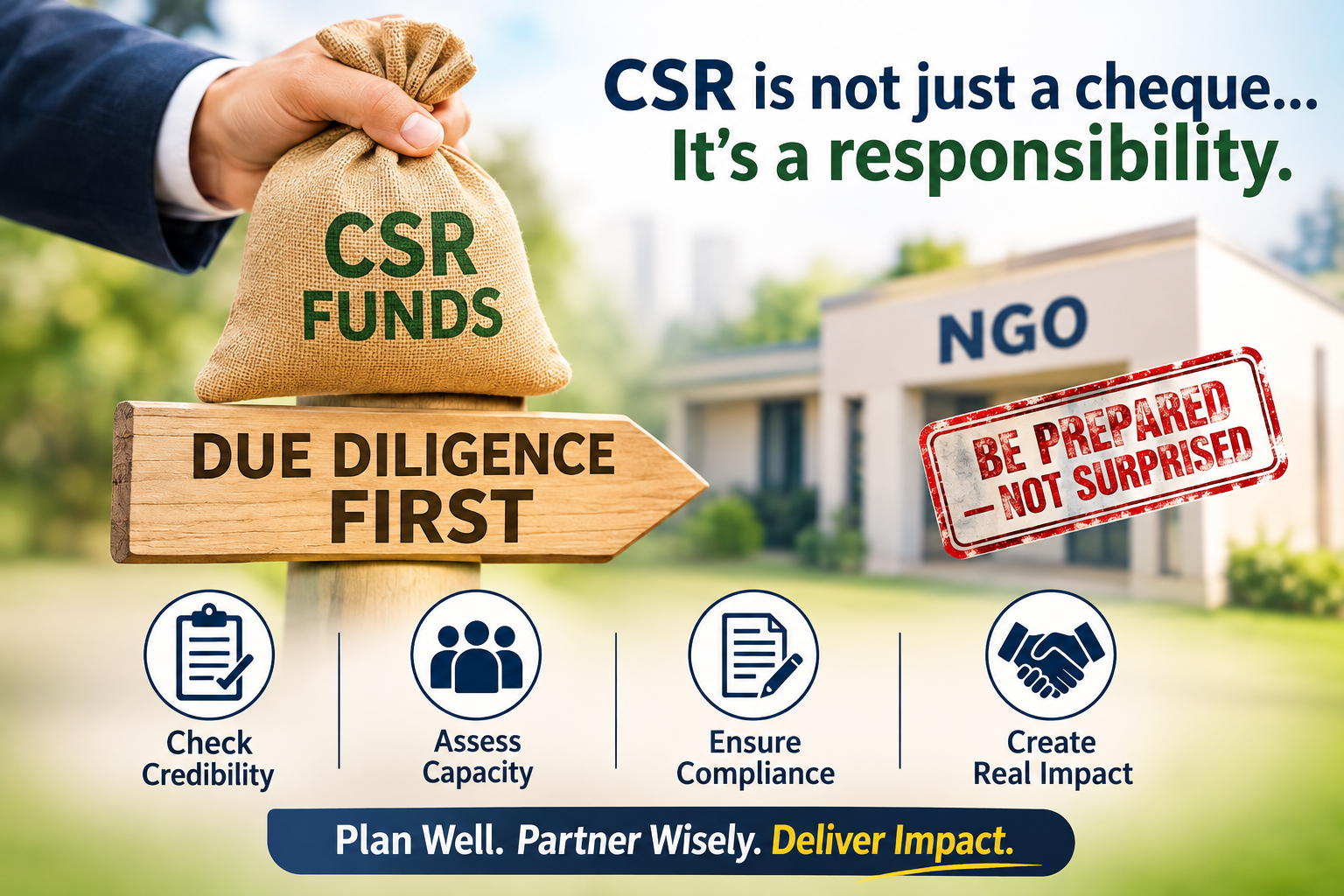
When CSR Funds Reach the Wrong Hands: A Lesson in Due Diligence, Accountability and Professional CSR Management
Everything looked perfectly fine in the beginning.
A company had identified an NGO through a reference received from its business network. There was a CSR agenda to be implemented, an organisation willing to undertake the project and, most importantly, a genuine intention to contribute towards social development.
The CSR funds were transferred, and the company expected the project to commence smoothly.
But a few months later, things started taking an unexpected turn.
The NGO did not appear to have a proper project implementation plan, adequate infrastructure, manpower or resources to execute the proposed activity. Follow-ups for project updates and utilisation proofs started becoming increasingly difficult. Calls went unanswered, emails remained unattended, and every conversation ended with another assurance that the required documents would be shared the following month.
The company, which had initially released the funds with confidence, was now concerned about project execution, fund utilisation and its statutory CSR responsibilities.
Eventually, the company approached me through its Auditor, seeking professional assistance and an opinion on the situation.
After understanding the entire sequence of events, I realised that this was not merely a case of delayed documentation. It highlighted a much larger issue in CSR implementation: the absence of proper due diligence before releasing CSR funds.
Due diligence must happen before fund transfer
During my discussion with the client, I explained the applicable legal compliances, documentation requirements, reporting obligations and statutory timelines under Section 135 of the Companies Act, 2013, read with the Companies (CSR Policy) Rules, 2014.
However, my advice was not limited to resolving the immediate concern.
I highlighted that identifying an NGO through a business reference or personal network cannot replace professional due diligence. A good introduction, an impressive presentation or a registered legal entity does not automatically establish an organisation’s capacity to execute a CSR project.
Before associating with an implementing agency, companies should carefully evaluate:
- Legal eligibility: Registration details, CSR-1, applicable statutory registrations and eligibility under Rule 4 of the CSR Rules.
- Financial credibility: Previous years’ financial statements, turnover, funding sources, expenditure patterns and audit reports.
- Project experience: Previously executed projects, ongoing activities, beneficiary details and verifiable implementation records.
- Infrastructure and manpower: Availability of qualified staff, operational facilities, equipment and resources required for the proposed project.
- Governance and policies: Management structure, financial controls, procurement policies and other relevant governance mechanisms.
- Implementation capacity: Whether the NGO can realistically deliver the proposed project within the approved budget and timelines.
A project proposal may look excellent on paper, but does the implementing agency actually have the capacity to deliver it? That is the question every corporate donor must ask.
CSR compliance does not end with fund transfer
Another important aspect I discussed was that transferring funds to an implementing agency does not automatically discharge all CSR responsibilities of the company.
Proper project approval, execution agreements, defined deliverables, fund-release mechanisms, periodic monitoring, utilisation documentation and statutory reporting are equally important.
Companies must also remain conscious of the provisions relating to ongoing projects and unspent CSR amounts under Section 135(5) and 135(6).
For instance, unspent amounts relating to ongoing projects are required to be transferred to a special Unspent CSR Account within 30 days from the end of the financial year and utilised within the prescribed three financial years. Amounts remaining unspent thereafter must be transferred to a fund specified in Schedule VII within the prescribed timeline.
Similarly, amounts not relating to ongoing projects are subject to the six-month transfer timeline prescribed under Section 135(5).
These are statutory obligations, not optional administrative formalities. Therefore, poor coordination or non-responsiveness of an implementing agency should never be allowed to create avoidable compliance exposure.
Why professional CSR management matters
One thing I have increasingly observed while working in the CSR sector is that companies often have genuine intentions and adequate CSR budgets, while several NGOs have the grassroots presence and social-sector experience required to execute meaningful projects.
Yet, the two do not always connect effectively.
This is where professional CSR consulting becomes valuable.
A CSR consultant should not merely introduce a company to an NGO or prepare a project proposal. The role should extend to project conceptualisation, implementing-agency due diligence, documentation, MoUs, compliance management, fund-utilisation monitoring, coordination and impact reporting.
A professional consultant can act as a bridge between the corporate donor and implementing agency, ensuring that responsibilities, deliverables, communication and reporting mechanisms are clearly defined.
Of course, the statutory responsibility of the company and its Board remains with them. Professional support strengthens the process; it does not replace that responsibility.
From an uncomfortable experience to a positive association
Coming back to my recent client interaction, what I found encouraging was the client’s willingness to understand the problem and seek professional guidance rather than simply look for a quick solution.
After listening to their concerns, I shared my professional opinion, explained the applicable compliance framework and outlined the immediate areas requiring attention.
We also discussed how future CSR collaborations could be structured with better due diligence, transparent communication and defined responsibilities.
What began as an uncomfortable experience eventually opened the doors to new professional collaborations.
The client left with clarity, assurance and confidence in having a professional partner to guide them through the process.
For me, that is one of the most satisfying aspects of consulting: not merely identifying what went wrong, but helping organisations build a better and more accountable approach for the future.
The larger lesson
India’s CSR framework has created significant opportunities for social development across education, healthcare, skill development, environmental sustainability and several other areas.
However, the success of CSR cannot be measured merely by the amount of money spent or transferred.
The real question is whether the funds have reached the intended beneficiaries and created the impact for which they were allocated.
My advice to companies is simple:
Verify before you trust. Document before you execute. Monitor before problems arise.
CSR is not charity with a cheque, nor is it merely a statutory compliance exercise. It is a responsibility that demands planning, accountability, transparency and professional execution.
Because a CSR fund transferred is not necessarily a CSR project delivered. The real success lies in the impact created.
CA Neha Sedhara is a CSR Consultant and Chartered Accountant, providing professional support in CSR project conceptualisation, implementing-agency due diligence, project documentation, execution coordination, statutory compliance and reporting across India.