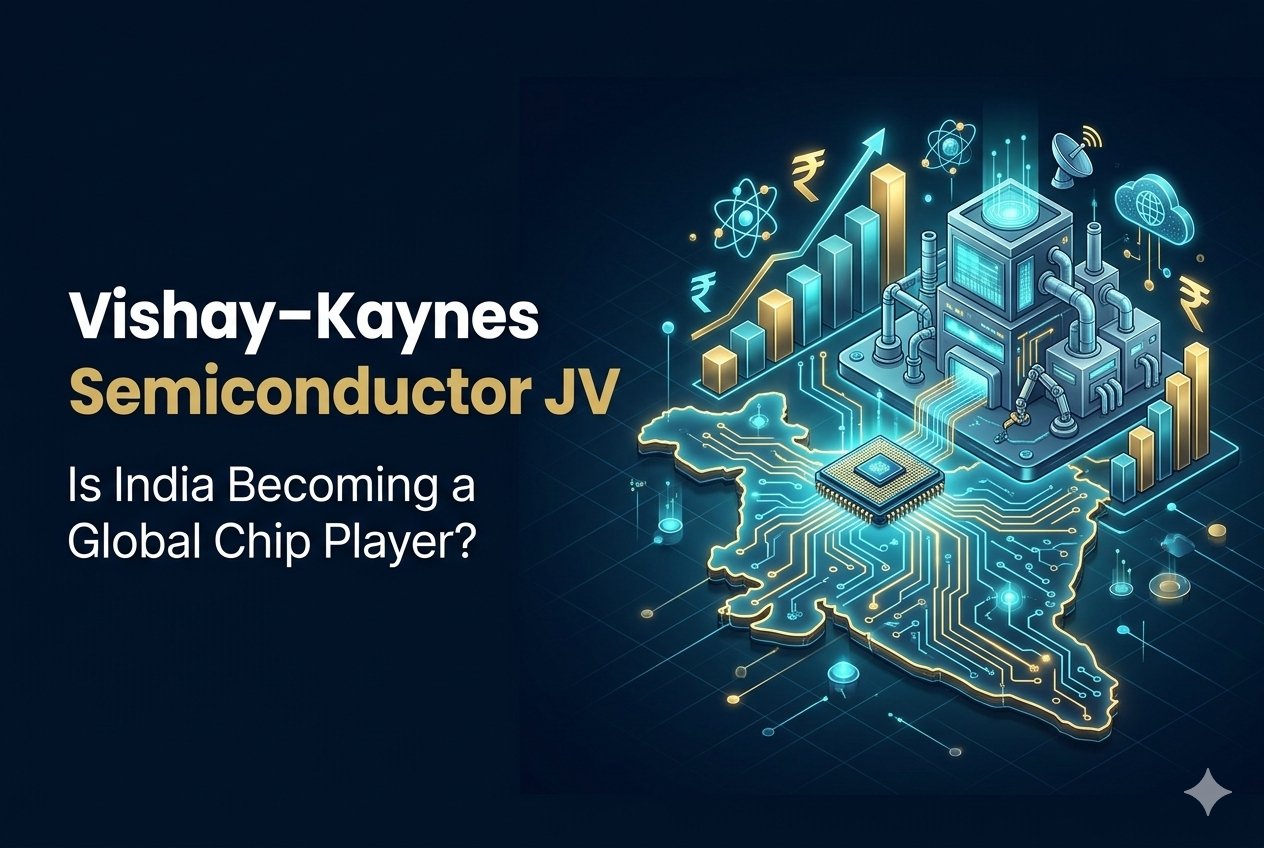
India’s ambition to become a global semiconductor manufacturing destination is gaining momentum. A new partnership between US-based Vishay Intertechnology and India’s Kaynes Technology highlights how international companies are increasingly looking at India as a strategic manufacturing destination.
On November 12, 2026, Vishay Intertechnology entered into a binding term sheet with Kaynes Technology to establish a semiconductor manufacturing joint venture in India. Under the proposed arrangement, Vishay will invest US$56.4 million for a 49% stake, while Kaynes Technology will retain 51% ownership.
The development is significant not merely because of the investment amount, but because it reflects a growing shift towards building semiconductor manufacturing capabilities within India.
1. Understanding the Deal
The proposed joint venture will operate through Kaynes Semicon, a subsidiary of Kaynes Technology.
Its planned activities will include:
- Post-fabrication wafer processing.
- Semiconductor assembly.
- Testing and packaging.
- Manufacturing support for Vishay’s semiconductor requirements.
- Potential services for third-party customers.
The partnership aims to establish a captive semiconductor back-end manufacturing line for Vishay in India.
The proposed transaction remains subject to definitive agreements, regulatory approvals and customary closing conditions. Therefore, it should not yet be treated as a completed acquisition.
2. Why Is This Partnership Important?
Semiconductor manufacturing is not limited to fabricating silicon wafers. Assembly, testing and packaging are equally important stages in converting semiconductor components into usable products.
These activities are commonly known as OSAT — Outsourced Semiconductor Assembly and Test.
India has traditionally been recognised for its semiconductor design and engineering talent. However, developing domestic manufacturing and packaging capabilities is essential if the country wants to participate more deeply in the global semiconductor supply chain.
This partnership could help India strengthen its position in the semiconductor back-end manufacturing segment.
3. What Does Vishay Bring to the Table?
Vishay Intertechnology is a global manufacturer of discrete semiconductors and passive electronic components used across several industries.
Its involvement can bring international customer relationships, technical expertise and manufacturing requirements to the Indian venture.
For Kaynes, the partnership offers an opportunity to work more closely with a global semiconductor company and strengthen its manufacturing capabilities.
For Vishay, the proposed investment provides an opportunity to establish dedicated back-end manufacturing capacity in India.
This is an example of how international technology partnerships can combine global expertise with domestic manufacturing infrastructure.
4. The Role of India Semiconductor Mission 2.0
An important feature of the proposed venture is the plan by both companies to seek central and state government support under India Semiconductor Mission 2.0.
India’s semiconductor strategy is focused on developing a broader ecosystem that includes fabrication, assembly, testing, packaging, equipment and materials.
Government incentives can help reduce the initial capital burden associated with semiconductor projects. However, long-term success will depend on technology capabilities, skilled manpower, reliable infrastructure and customer demand.
The partnership therefore represents an opportunity to connect private investment with India’s wider industrial policy objectives.
5. Opportunities for the Indian Economy
The proposed joint venture could create benefits beyond the two participating companies.
Manufacturing development: It can strengthen India’s semiconductor back-end manufacturing ecosystem.
Employment generation: Semiconductor facilities require skilled engineers, technicians and quality-control professionals.
Technology capabilities: Collaboration with international players can support knowledge transfer and technical development.
Supply-chain diversification: Global companies are looking to diversify manufacturing locations and reduce excessive dependence on a limited number of markets.
Investment confidence: Partnerships involving established international companies can encourage further investment in India’s semiconductor sector.
6. Challenges That Cannot Be Ignored
Despite the opportunity, semiconductor manufacturing is a capital-intensive and technically demanding industry.
India must continue addressing challenges such as:
- Availability of highly specialised technical talent.
- Reliable power, water and supporting infrastructure.
- Access to advanced equipment and materials.
- Consistent quality and international manufacturing standards.
- Competition from established semiconductor manufacturing hubs.
Moreover, investment announcements alone cannot establish a globally competitive ecosystem. Actual production, customer qualification, capacity utilisation and financial sustainability will determine the venture’s success.
Conclusion: From Semiconductor Ambition to Manufacturing Reality
The proposed Vishay–Kaynes partnership is another important development in India’s journey towards becoming a stronger participant in the global semiconductor industry.
It demonstrates that India’s manufacturing opportunity is not restricted to attracting investments for large fabrication plants. Semiconductor assembly, testing and packaging can also become important drivers of industrial development.
The real test will be whether India can convert these strategic partnerships into sustainable manufacturing capabilities, globally competitive businesses and long-term technological progress.