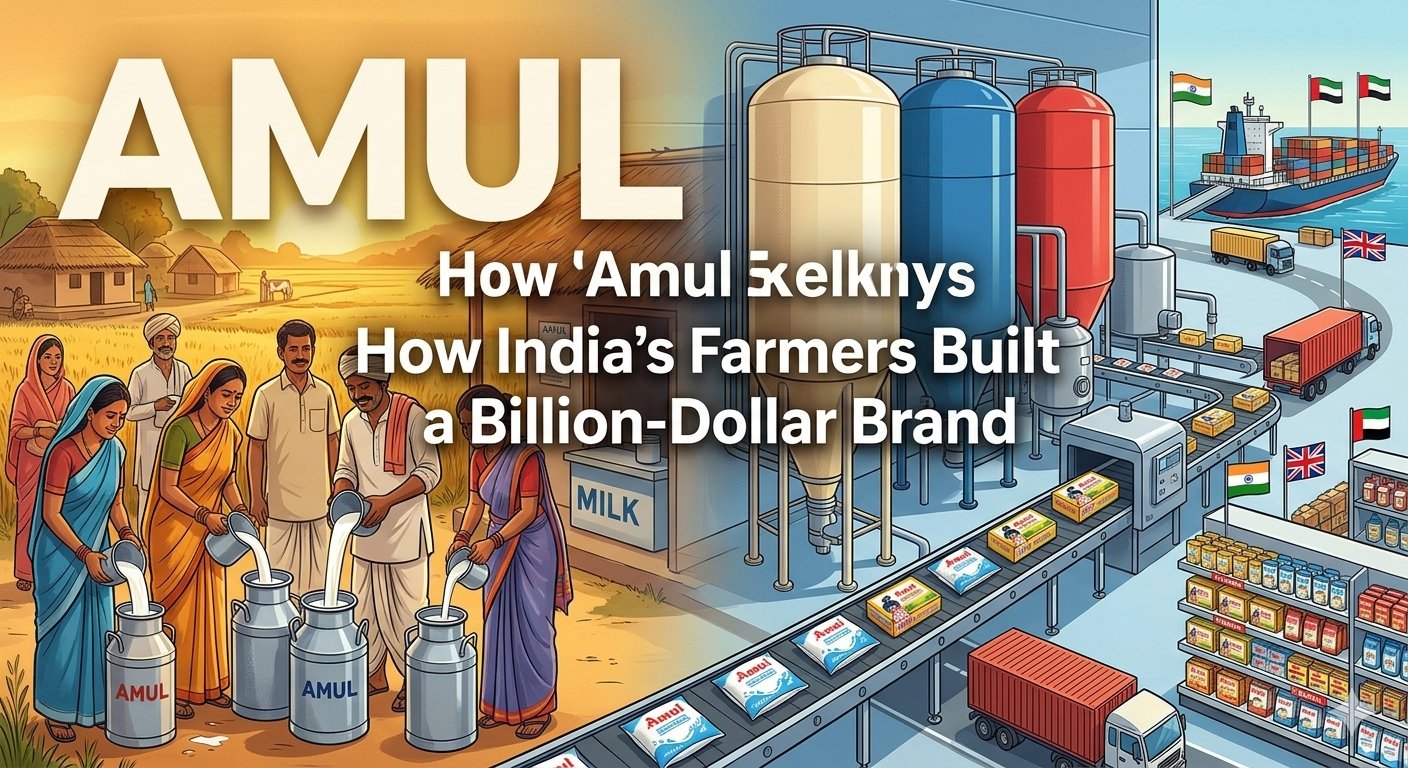
From a small farmers’ cooperative in Anand to a global dairy powerhouse — the business strategy behind the Taste of India.
What happens when thousands of small farmers decide to challenge an established business system?
The answer is Amul.
Today, Amul is one of India’s most recognisable consumer brands. Its products are found in millions of households, but its real success story goes far beyond butter, milk and cheese.
It is a story of collective ownership, supply-chain management, financial discipline and the power of rural entrepreneurship.
1. The Beginning: A Business Born Out of Protest
Amul’s journey began in 1946 in Anand, Gujarat.
At that time, dairy farmers were struggling with unfair prices and the exploitation of middlemen. Instead of accepting the existing system, they decided to organise themselves into a cooperative.
With the guidance of leaders including Sardar Vallabhbhai Patel and Tribhuvandas Patel, the Kaira District Cooperative Milk Producers’ Union was established.
The cooperative began with just two village societies and approximately 250 litres of milk per day.
What started as a movement for fair prices gradually developed into one of India’s most influential business models.
2. Dr. Verghese Kurien: The Visionary Behind the White Revolution
No discussion of Amul is complete without Dr. Verghese Kurien, widely regarded as the Father of India’s White Revolution.
He played a crucial role in transforming the cooperative into a professionally managed dairy enterprise.
His vision was not simply to increase milk production. It was to ensure that farmers received a fair share of the value created throughout the dairy supply chain.
Under his leadership, the Amul model became an inspiration for India’s Operation Flood programme, launched in 1970.
This initiative helped transform India from a milk-deficient nation into one of the world’s largest milk producers.
3. The Three-Tier Business Model: The Real Secret of Amul
One of the most interesting aspects of Amul is its cooperative structure.
Unlike conventional companies where ownership primarily rests with investors, Amul’s cooperative model places milk producers at the centre of the system.
Its structure operates through three levels:
Level 1 – Village Dairy Cooperative Societies
Farmers supply milk to village-level societies, where milk is collected and evaluated.
Level 2 – District Milk Producers’ Unions
These unions handle processing, quality control, storage and manufacturing of dairy products.
Level 3 – State Marketing Federation
The Gujarat Cooperative Milk Marketing Federation (GCMMF) manages marketing and distribution under the Amul brand.
This integrated structure connects farmers directly with the larger consumer market.
4. How Does Amul Create Economic Value?
Amul’s business model demonstrates how an efficient supply chain can create value for multiple stakeholders.
Consider its approach:
- Farmers receive payments for their milk.
- Cooperative societies organise procurement.
- District unions convert raw milk into value-added products.
- The federation develops the brand and manages marketing.
- Consumers receive products through a widespread distribution network.
The company creates value not merely by selling milk but by converting agricultural produce into a diversified portfolio of products.
Butter, cheese, ghee, ice cream, milk powder and other products help strengthen its market presence.
5. The Financial Strategy Behind the Brand
Amul offers several important financial and managerial lessons.
Economies of Scale: Collecting milk from thousands of producers allows the cooperative network to develop large-scale processing and distribution capabilities.
Value Addition: Converting raw milk into higher-value products creates additional business opportunities.
Working Capital Management: Dairy is a business where procurement, processing, storage and payments must be carefully coordinated because milk is highly perishable.
Supply Chain Efficiency: A strong collection and distribution network helps connect rural producers with urban consumers.
Brand Strength: Consistent product quality and customer trust have helped Amul establish a strong market identity.
6. What Can Businesses Learn from Amul?
Amul challenges the conventional belief that business success must always be driven by individual ownership and investor capital.
Its journey demonstrates that collective ownership, professional management and a common commercial objective can create a powerful enterprise.
For entrepreneurs and finance professionals, the lessons are significant:
- A business model should solve a genuine economic problem.
- Supply-chain efficiency can become a competitive advantage.
- Scale must be supported by strong operational management.
- Value addition is essential for sustainable growth.
- Inclusive business models can create both economic and social value.
7. Beyond Dairy: A Model for the Future
Amul’s cooperative model offers an important lesson for India’s agricultural economy.
The same principles of collective procurement, processing, professional management and organised marketing can inspire businesses in food processing, agriculture, handicrafts and other rural industries.
Its story also demonstrates that social impact and commercial success do not necessarily have to operate separately.
Conclusion: More Than a Brand, A Business Revolution
Amul did not begin with an ambition to become a household name.
It began with a simple objective: ensuring that farmers received fair value for their hard work.
Over time, that objective evolved into a business model capable of transforming an entire industry.
From a few hundred litres of milk to a nationally recognised brand, Amul’s journey proves that powerful businesses can emerge when the right economic structure meets the right vision.
The biggest lesson from Amul is simple: Sometimes, the most successful business strategy is not to compete against people, but to build a system in which everyone grows together.
— Ankita Nag