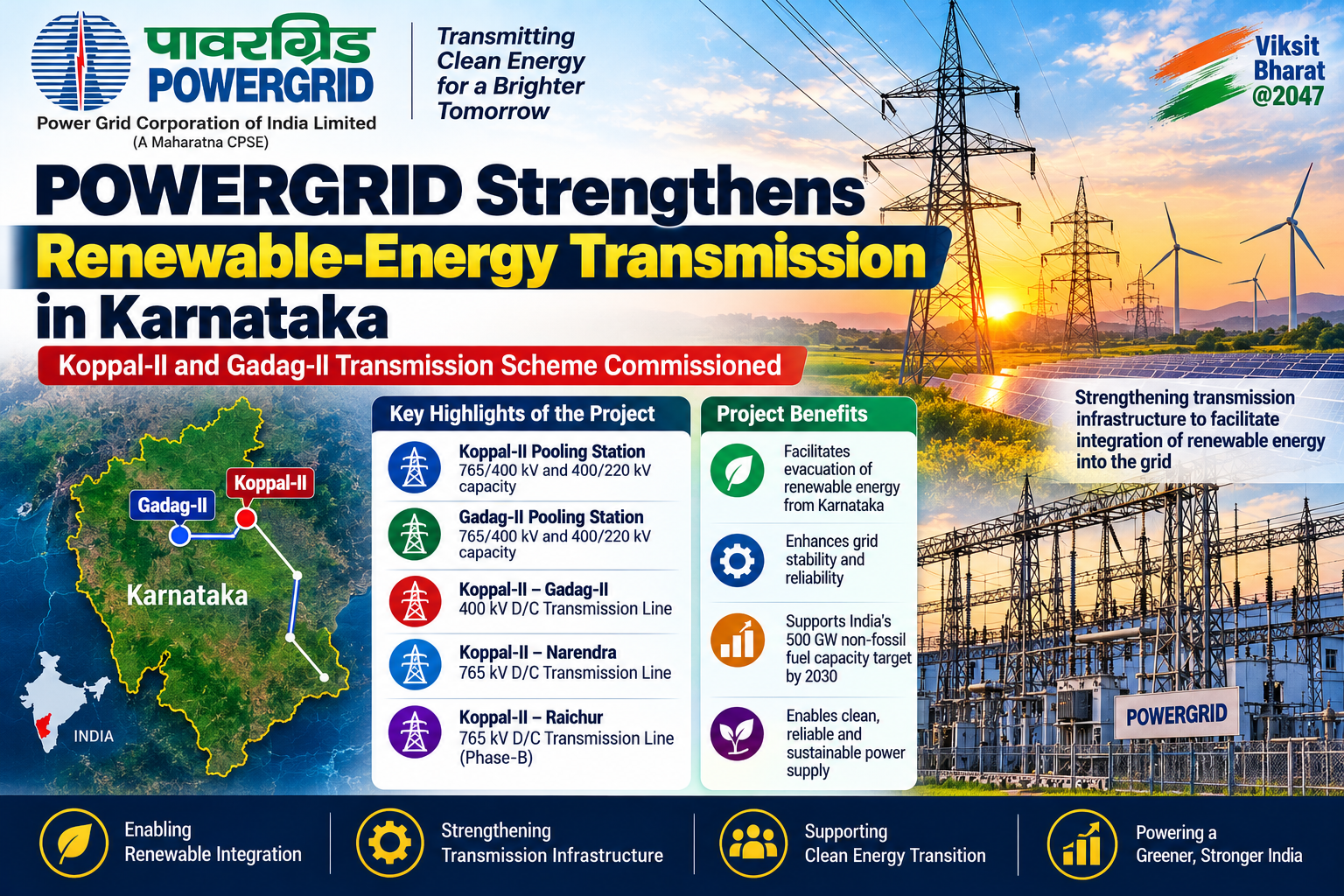
Koppal-II and Gadag-II Transmission Scheme Commissioned to Support Renewable-Energy Integration
New Delhi, October 26, 2026: Power Grid Corporation of India Limited (POWERGRID) has strengthened Karnataka’s renewable-energy transmission infrastructure with the commissioning of a major transmission scheme designed to facilitate the integration and evacuation of renewable power from the state’s high-potential renewable-energy zones.
The “Transmission Scheme for Integration of Renewable Energy Zone (Phase-II) in Koppal-II (Phase-A & B) and Gadag-II (Phase-A), Karnataka” was completely commissioned with effect from October 23, 2026, with the Date of Commercial Operation (DOCO) notification received on the same day. The project forms part of the wider effort to build transmission capacity capable of carrying electricity generated from renewable-energy projects to demand centres across the grid.
Major Transmission Infrastructure Commissioned
The project was originally entrusted to POWERGRID Koppal Gadag Transmission Limited (PKGTL), a wholly owned subsidiary of POWERGRID acquired through the tariff-based competitive bidding route. PKGTL was subsequently amalgamated with POWERGRID Khavda II-C Transmission Limited, effective March 1, 2026, pursuant to an order issued by the Ministry of Corporate Affairs.
The transmission scheme encompasses substantial high-voltage infrastructure around Koppal and Gadag. The planned system includes 765/400 kV and 400/220 kV pooling-station capacity, high-voltage transmission lines and reactive-power compensation equipment.
Among the key components are the Koppal-II Pooling Station, the Koppal-II–Narendra 765 kV double-circuit line, the Gadag-II Pooling Station, and the Gadag-II–Koppal-II 400 kV double-circuit line. The Phase-B component also includes the Koppal-II–Raichur 765 kV double-circuit line and augmentation of transformer capacity at Koppal-II.
Enabling Renewable-Energy Evacuation
Karnataka has emerged as an important renewable-energy state, particularly in solar and wind generation. However, the growth of renewable generation requires corresponding investment in transmission infrastructure to ensure that electricity generated in resource-rich areas can be evacuated reliably.
Renewable-energy projects are often concentrated in areas where solar radiation or wind resources are favourable, while major electricity demand centres can be located hundreds of kilometres away. This creates the need for high-capacity transmission corridors and pooling stations.
The Koppal-II and Gadag-II scheme is therefore significant because it strengthens the network required to connect renewable-generation zones with the wider transmission system.
According to industry reporting, the project was developed as part of broader plans to integrate renewable-energy capacity in Karnataka and support India’s long-term renewable-energy expansion.
Karnataka Emerging as a Renewable-Energy Transmission Hub
The latest commissioning is not an isolated development. POWERGRID has been undertaking multiple transmission projects across Karnataka to accommodate rising renewable-energy potential.
Earlier in October, POWERGRID commissioned the Transmission Scheme for Solar Energy Zone in Bidar (2,500 MW), Karnataka, effective October 5, 2026. That project includes a 765 kV double-circuit transmission line between Bidar and Maheshwaram and significant transformation capacity at the Bidar pooling station.
The company has also been working on transmission infrastructure associated with additional renewable-energy potential at Davanagere and Bellary, including systems designed to integrate several gigawatts of additional renewable generation.
The concentration of such projects demonstrates the growing importance of Karnataka in India’s clean-energy transition and the corresponding requirement for grid infrastructure.
Importance for Grid Stability
The expansion of renewable energy presents a different operational challenge compared with conventional power generation. Solar generation varies with daylight and weather conditions, while wind generation can fluctuate depending on wind conditions.
A strong transmission network allows renewable electricity to be moved efficiently across regions, improving the ability of the national grid to balance generation and demand.
High-voltage transmission systems also help reduce congestion and provide greater flexibility in power flows. For renewable-rich states such as Karnataka, strengthening the transmission backbone is therefore essential for ensuring that generation capacity translates into usable electricity.
The latest POWERGRID commissioning contributes to this broader objective by adding transmission infrastructure at the pooling and interconnection levels.
Tariff-Based Competitive Bidding Model
The Koppal-Gadag project was developed through the Tariff-Based Competitive Bidding (TBCB) route.
Under the TBCB model, transmission developers compete to provide transmission services at the lowest viable tariff, with projects generally developed under a Build, Own, Operate and Transfer framework.
The model has become an important mechanism for expanding India’s interstate transmission infrastructure while encouraging competition and efficient project execution.
POWERGRID remains one of the country’s principal transmission infrastructure developers and has continued to secure and execute projects through both regulated and competitive-bidding routes.
Supporting India’s 500 GW Renewable-Energy Ambition
The expansion of renewable-energy transmission is closely linked to India’s national objective of substantially increasing renewable-energy capacity.
The country has set an ambitious goal of achieving 500 GW of non-fossil-fuel-based electricity capacity by 2030. Meeting that objective requires not only solar and wind generation capacity but also large-scale investment in transmission corridors, substations, transformers, grid-management systems and energy-storage infrastructure.
POWERGRID’s projects across renewable-energy zones form an important part of this enabling infrastructure.
The company’s latest Karnataka commissioning demonstrates that the energy transition involves much more than adding generation capacity. Transmission infrastructure is equally critical in connecting renewable resources with India’s rapidly growing electricity demand.
Strategic Significance for POWERGRID
For POWERGRID, commissioning renewable-energy transmission assets strengthens its position as a key infrastructure partner in India’s energy transition.
Every successfully commissioned project adds to the company’s operational transmission network and enhances its ability to manage large-scale electricity flows. At the same time, timely completion of transmission projects helps renewable-energy developers secure reliable connectivity to the grid.
The commissioning also reflects the company’s continuing focus on developing infrastructure ahead of the country’s changing generation mix.
Looking Ahead
India’s renewable-energy expansion is expected to generate continued demand for interstate and inter-regional transmission infrastructure. Karnataka, with its significant solar and wind potential, is likely to remain an important area for such investments.
The commissioning of the Koppal-II and Gadag-II transmission scheme therefore represents more than the completion of an individual infrastructure project. It is part of a larger transformation of India’s power system—from a grid historically designed around conventional generation towards a more flexible network capable of integrating large volumes of renewable electricity.
As renewable-energy capacity expands, the strength and flexibility of the transmission network will increasingly determine how effectively clean power can be delivered to consumers.
For POWERGRID, the Karnataka commissioning reinforces its role at the centre of this transformation, helping build the infrastructure required for reliable power supply, renewable-energy integration and India’s long-term clean-energy ambitions.
The Worldonomics Times | PSU & Energy Desk