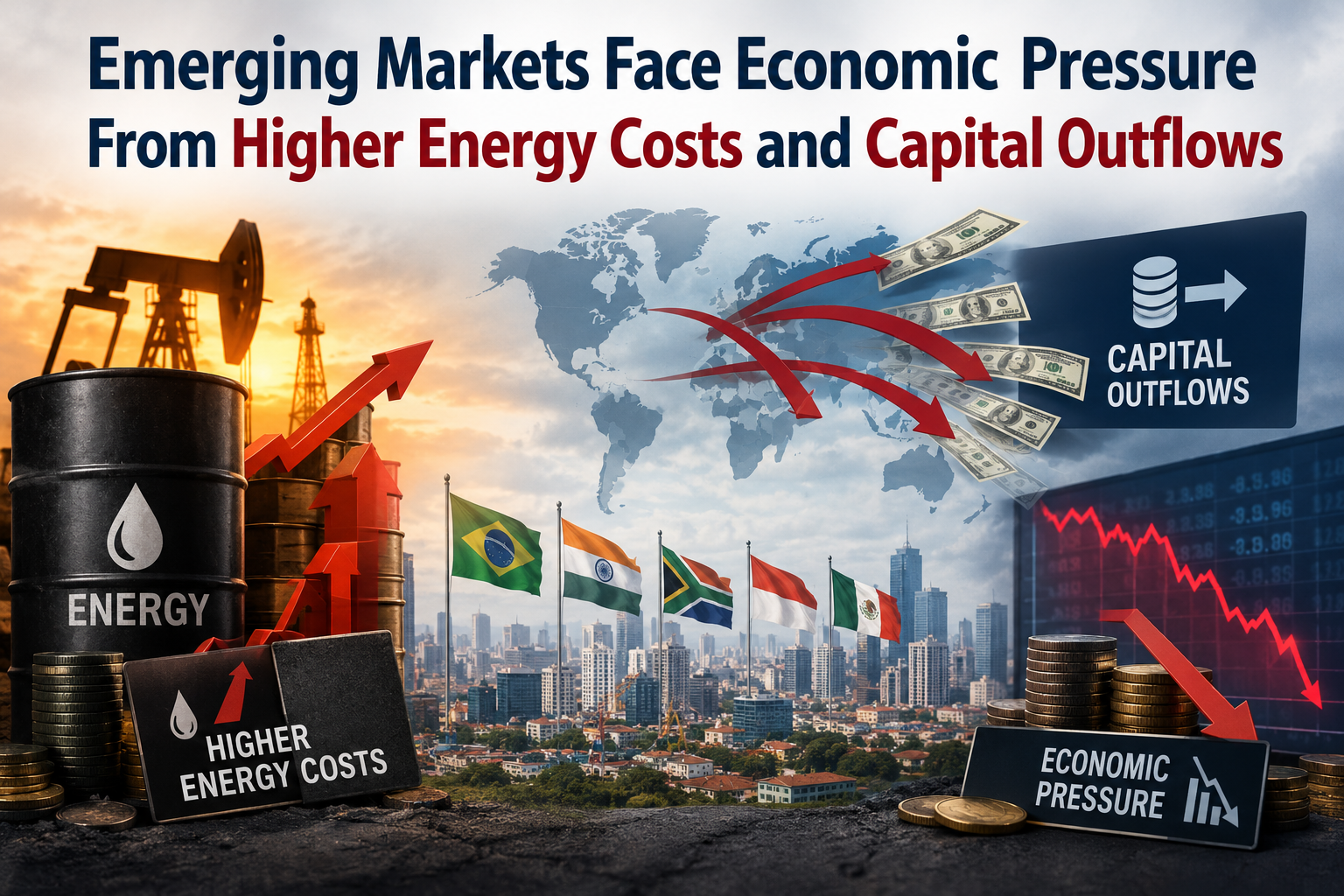
Higher energy prices, tight financial conditions and limited gains from the artificial intelligence boom are clouding the region’s outlook, raising concerns over investment, inflation and long-term development.
The Worldonomics Times | 28 October 2026
Growth Outlook Weakens Across the Region
The International Monetary Fund (IMF) has lowered its economic growth forecasts for Latin America and the Caribbean, warning that external shocks and persistent domestic challenges are likely to restrain the region’s economic momentum. Although the region continues to benefit from trade, tourism, remittances and commodity exports, these supports are proving insufficient to offset growing uncertainty.
In its October 2026 World Economic Outlook, the IMF projected regional growth of 2.3% in 2026, down from its July forecast of 2.4%. The forecast for 2027 was also reduced, from 2.7% to 2.5%. The region’s expected expansion is therefore below the global growth forecast of 3.1% for 2026.
The downward revisions highlight the difficulties facing economies that are still working to strengthen productivity, attract investment and improve living standards. While growth remains positive across much of the region, its modest pace could limit job creation and slow progress in reducing poverty and inequality.
Rising Energy Costs Add to Inflation Risks
Higher international energy prices have emerged as a major concern for policymakers. Geopolitical conflict in the Middle East has disrupted energy markets and pushed up fuel costs, increasing pressure on businesses and households.
The impact varies across Latin America and the Caribbean. Countries that export oil, gas and other commodities may benefit from higher international prices through increased export revenues. However, energy-importing economies face higher costs for fuel, transportation and electricity.
Even commodity exporters can experience domestic inflation when higher international prices feed through to local markets. Rising fuel and freight expenses may also increase the cost of food and other essential goods, putting pressure on household budgets.
For central banks, the challenge is to prevent temporary external shocks from turning into persistent inflation. If price pressures remain elevated, policymakers may need to maintain higher interest rates for longer, limiting access to credit and slowing investment.
Major Economies Face Different Challenges
The IMF’s latest projections show that the region’s largest economies are experiencing different combinations of domestic and external pressures.
Brazil, Latin America’s largest economy, is expected to grow by 2.2% in 2026 and 1.9% in 2027. The Fund attributes the weaker outlook partly to restrictive monetary policy, the withdrawal of fiscal support and uncertainty in the global economy. Higher borrowing costs may help control inflation but can also restrain consumer demand and business investment.
Argentina has received a particularly sharp downward revision. Its 2026 growth forecast was reduced to 2.1%, compared with the earlier estimate of 3.5%. The adjustment reflects weaker economic activity and subdued domestic demand amid tight financial conditions and ongoing structural changes. Inflation remains a significant challenge, despite expectations that it will ease from its 2025 level.
Mexico has followed a somewhat different path. The IMF raised its 2026 growth forecast to 1.5%, supported by exports and participation in technology-related supply chains. However, its 2027 projection was trimmed to 1.8%, reflecting continuing trade and economic uncertainty.
These contrasting performances demonstrate why a regional forecast cannot fully capture the differences in national economic conditions, policy choices and exposure to international markets.
Limited Benefits from the AI Investment Boom
Another factor influencing the outlook is the uneven distribution of gains from artificial intelligence investment. In several economies, AI-related spending has supported demand for semiconductors, digital infrastructure and advanced manufacturing.
However, the IMF has noted that most Latin American and Caribbean economies are receiving relatively little direct benefit from this technology-driven investment surge. As a result, the region has fewer opportunities to offset the negative effects of higher energy costs through expanding technology exports.
The challenge is not simply a lack of access to advanced technology. Many economies also face obstacles involving digital infrastructure, workforce skills, research funding and the ability of smaller businesses to adopt new systems.
Greater investment in digital connectivity, technical education and innovation could help the region participate more fully in emerging industries. The development of clean energy, critical minerals and technology-related supply chains may also create opportunities, provided countries can attract investment and build stronger domestic capabilities.
Debt and Borrowing Costs Limit Policy Options
Public finances represent another important concern. Many governments across the region face high debt burdens and substantial spending requirements, limiting their capacity to respond to economic shocks.
The IMF has warned that favourable global financing conditions may not last. If international borrowing costs rise or investor confidence weakens, governments could face more expensive debt refinancing, pressure on their currencies and tighter domestic financial conditions.
Higher debt-servicing costs can leave less money available for infrastructure, education, healthcare and social protection. Yet abrupt spending cuts may also weaken demand and disproportionately affect vulnerable households.
The challenge is to improve fiscal sustainability without undermining the foundations of future growth. More efficient public spending, stronger tax administration and transparent budget management can help governments preserve financial flexibility.
Employment and Long-Term Productivity Remain Key Priorities
Sustained economic growth is essential for expanding employment opportunities and raising living standards. When growth remains modest, businesses may be less willing to hire, invest in training or expand operations.
The region also faces structural productivity challenges. Limited investment, infrastructure gaps, informality and unequal access to education can prevent workers and businesses from reaching their full potential.
Governments can address these constraints by improving education and vocational training, strengthening institutions, expanding infrastructure and making it easier for businesses to grow. Stable economic policies and predictable regulations can also help attract foreign direct investment.
Regional cooperation could further improve trade links, reduce unnecessary barriers and strengthen supply chains, allowing countries to benefit more effectively from international demand.
The Worldonomics Times View
The IMF’s downgrade is a reminder that Latin America and the Caribbean cannot rely solely on favourable commodity prices, tourism or temporary improvements in global financial conditions. These factors can support growth, but they cannot resolve the deeper challenges of weak productivity, limited fiscal space and uneven technological development.
Policymakers should prioritise responsible debt management, credible monetary frameworks and targeted assistance for households most affected by rising living costs. At the same time, long-term investment in education, infrastructure, digital technology and clean energy will be essential to improve competitiveness.
The region also needs to strengthen its ability to convert natural resources and foreign investment into broader economic benefits, including better jobs and stronger domestic industries.
Ultimately, the lower growth forecasts do not eliminate Latin America and the Caribbean’s economic potential. They underline the urgency of building more resilient economies that can withstand external shocks and generate sustained improvements in living standards. Turning current opportunities into lasting gains will require consistent policies, productive investment and reforms that allow businesses and workers to participate more fully in the region’s future growth.