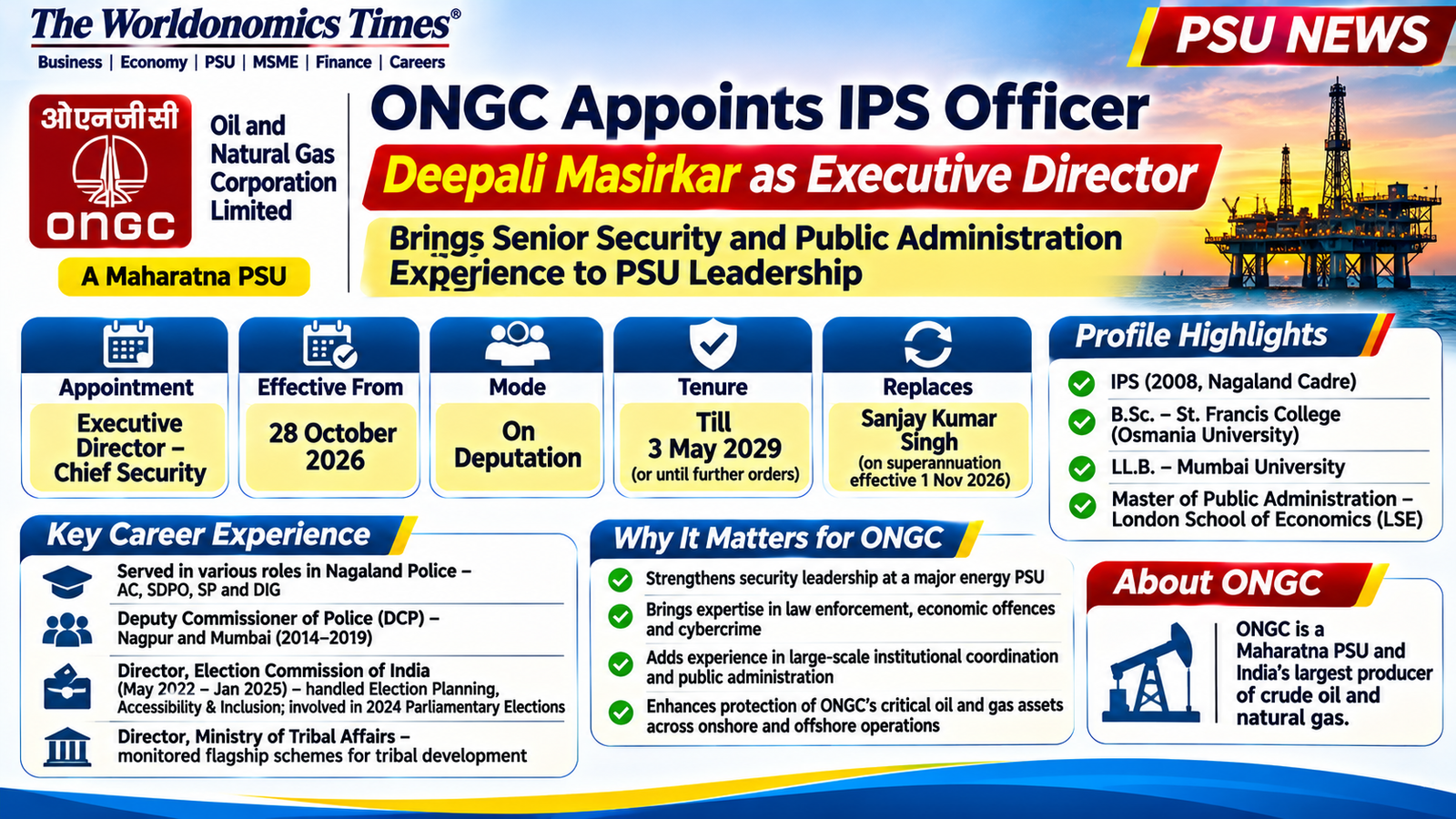
New Delhi | November 2, 2026: Oil and Natural Gas Corporation Limited (ONGC) has strengthened its senior management and security leadership with the appointment of Ms. Deepali Masirkar, IPS (2008, Nagaland cadre), as Executive Director–Chief Security.
According to ONGC’s regulatory disclosure, Masirkar’s appointment is on deputation and became effective on October 28, 2026. The position is part of ONGC’s senior management, one level below the Board. Her appointment follows the superannuation of Executive Director Sanjay Kumar Singh, effective November 1, 2026.
The appointment brings an unusual but strategically relevant combination of policing, public administration, election management, economic-offence investigation and government-programme experience into the leadership structure of one of India’s largest energy PSUs.
From IPS Leadership to ONGC’s Security Function
Deepali Masirkar is a 2008-batch Indian Police Service officer of the Nagaland cadre. During her career in the state, she served in several supervisory positions, including Assistant Commandant, Sub-Divisional Police Officer, Superintendent of Police and Deputy Inspector General.
Her experience also extends beyond conventional policing. During her inter-cadre deputation to the Maharashtra Police between 2014 and 2019, she served as Deputy Commissioner of Police in Nagpur and Mumbai, handling responsibilities related to law and order, crime, economic offences and cybercrime.
These areas of experience are particularly relevant to the security requirements of a large energy organisation operating critical national infrastructure.
Strong Academic and Public Administration Background
Masirkar holds a B.Sc. degree from St. Francis College, affiliated with Osmania University, Hyderabad, and an LL.B. from Mumbai University.
She also holds a Master of Public Administration in International Political Economy from the London School of Economics and Political Science (LSE).
The combination of law, public administration and policing experience gives her a multidisciplinary profile that extends beyond traditional security operations.
For an energy PSU, such a background can be relevant to areas including institutional security, risk assessment, crisis management, coordination with government agencies and protection of critical assets.
Experience at the Election Commission of India
One of the notable phases of Masirkar’s career was her tenure as Director at the Election Commission of India from May 2022 to January 2025.
During this period, she was associated with the Election Planning, Accessibility & Inclusion Division and territorial divisions covering Uttar Pradesh and Manipur. ONGC’s disclosure also notes her role in the conduct of the 2024 Parliamentary Elections.
This experience involved large-scale institutional coordination, planning and execution—skills that can have relevance in the management of security and operational risks within a major public-sector enterprise.
Most Recent Role: Ministry of Tribal Affairs
Before joining ONGC, Masirkar was serving as Director in the Ministry of Tribal Affairs.
Her tenure there involved monitoring flagship government schemes aimed at the development of tribal communities. The appointment to ONGC resulted in the curtailment of her central deputation to the ministry.
Her transition from a policy and government-programme role to a major energy PSU demonstrates the increasingly cross-functional nature of senior government leadership.
Why Security Leadership Matters for ONGC
ONGC operates critical oil and gas infrastructure across exploration, production, offshore installations, pipelines, processing facilities and other strategic assets.
Security risks for an energy company are therefore considerably broader than conventional physical security. They can include protection of installations, emergency response, cyber-related risks, industrial security, personnel safety and coordination with multiple government and law-enforcement agencies.
The company’s operations also involve offshore and remote locations where effective security planning and emergency preparedness are particularly important.
Masirkar’s experience in policing, economic offences, cybercrime, public administration and large-scale institutional coordination could therefore provide a different perspective to ONGC’s security function.
Leadership Change Comes at an Important Time
The appointment comes during a period when ONGC is pursuing growth in domestic oil and gas production while also investing in new exploration and development opportunities.
ONGC’s own website describes the company as a Maharatna PSU and India’s largest producer of crude oil and natural gas.
As India’s energy requirements continue to grow, protecting energy infrastructure is becoming an increasingly important part of national energy security.
The presence of experienced senior leadership in the security function can help organisations prepare for a wide range of operational and strategic risks.
What the Appointment Means for PSU Leadership
Masirkar’s appointment also highlights a broader trend in India’s public-sector ecosystem—the movement of experienced civil and police-service officers into specialised leadership roles within major PSUs.
Traditional PSU leadership has often been associated primarily with engineering, finance, commercial and operational expertise. However, modern infrastructure companies increasingly require expertise in security, cyber risk, governance, public administration, regulatory coordination and crisis management.
The appointment of an IPS officer with experience across policing, election management and government administration reflects this changing requirement.
For professionals watching India’s PSU sector, the development is therefore noteworthy not simply as a personnel change but as an example of how public-sector organisations are bringing specialised government expertise into strategic corporate functions.
A New Chapter for ONGC’s Security Leadership
Deepali Masirkar’s appointment as Executive Director–Chief Security adds a distinctive leadership profile to ONGC’s senior management.
With experience spanning the police service, Maharashtra Police, Election Commission of India and Ministry of Tribal Affairs, she brings exposure to security operations, law enforcement, institutional coordination and public administration.
Her tenure at ONGC is expected to continue until May 3, 2029, or until further orders, whichever is earlier, according to the appointment details reported following the ACC approval.
For India’s energy sector, the appointment reinforces an important message: energy security is not only about producing more oil and gas—it also requires protecting the infrastructure, people and systems that keep the energy ecosystem running.
Source: ONGC regulatory disclosure under Regulation 30 of SEBI (LODR) Regulations, 2015, and related government appointment information.