Expanding Professional Horizons Through Risk Management, Governance and Business Assurance
By CMA Madhuri Kashyap
The Worldonomics Times | CMA Perspective
Introduction
The business environment is changing rapidly, with organisations facing increasing challenges involving financial risks, regulatory compliance, operational efficiency, cybersecurity and corporate governance. In this environment, internal audit has emerged as an important function for strengthening organisational performance and accountability.
Traditionally, internal audit was often viewed as a process of checking financial transactions and verifying compliance. Today, its scope has expanded considerably. Modern internal audit examines not only financial records but also business processes, risk management systems, internal controls, technology and operational performance.
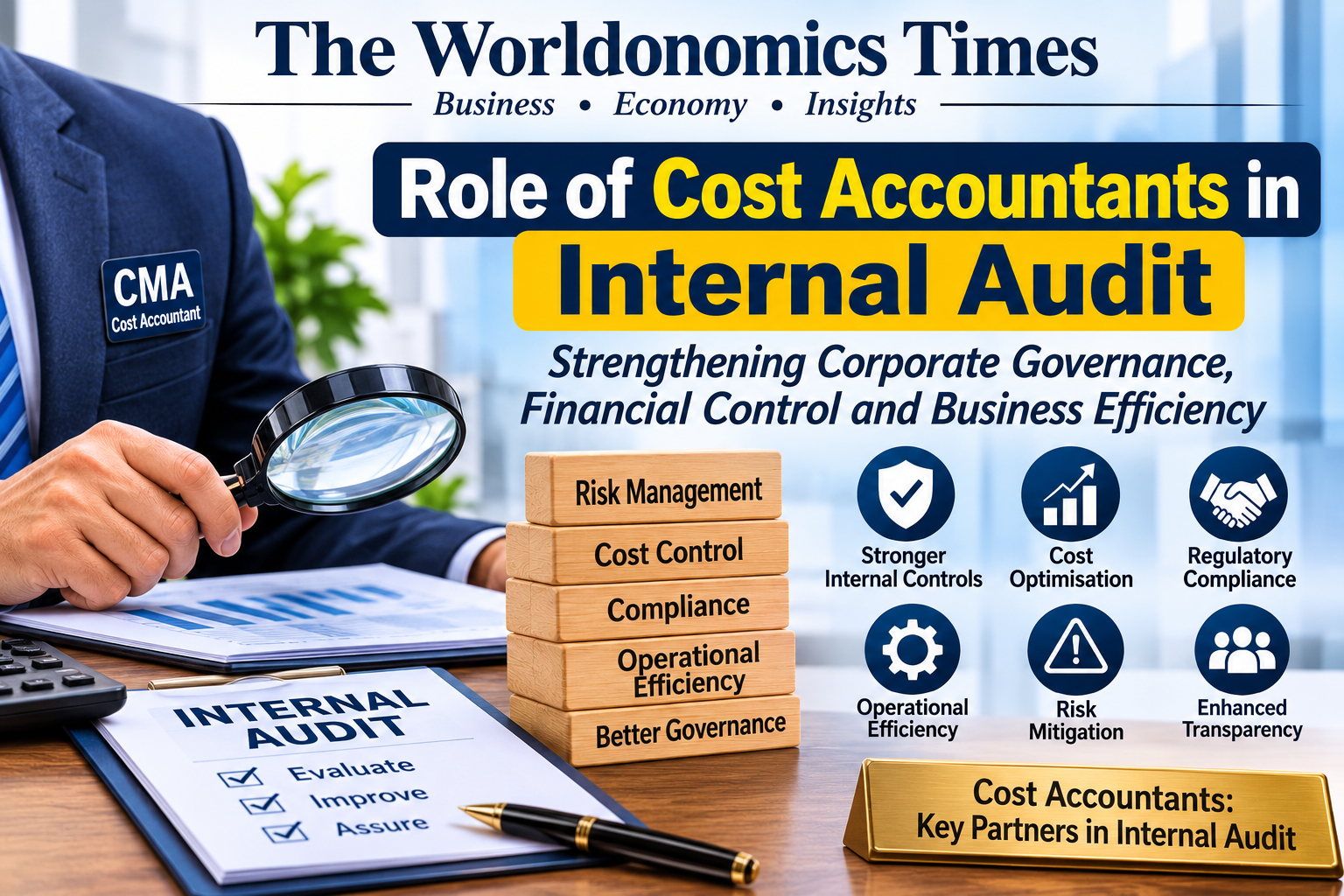
This transformation has created significant professional opportunities for Cost and Management Accountants (CMAs). Their expertise in cost management, financial analysis, budgeting and business operations makes them well-positioned to contribute to modern internal audit functions.
1. Understanding the Changing Scope of Internal Audit
Internal audit is an independent and objective assurance and advisory activity designed to add value and improve an organisation’s operations.
It evaluates whether risk management, internal controls and governance processes are functioning effectively.
The modern internal audit function may cover:
- Financial and accounting processes.
- Procurement and vendor management.
- Inventory and production systems.
- Revenue and expenditure controls.
- Regulatory and statutory compliance.
- Information technology and data security.
- Operational efficiency and performance.
This wider scope has created opportunities for professionals who understand both financial systems and business operations.
2. Legal Framework and Opportunities in India
In India, Section 138 of the Companies Act, 2013, read with the Companies (Accounts) Rules, 2014, prescribes internal audit requirements for specified classes of companies.
The applicability depends on the prescribed categories and thresholds, including relevant paid-up capital, turnover, outstanding loans or borrowings and deposits, as applicable.
The law permits the internal auditor to be a Chartered Accountant, Cost Accountant or other professional as prescribed by the Central Government. The internal auditor may be an individual or a firm.
This statutory framework creates opportunities for eligible CMA professionals to undertake internal audit assignments, subject to applicable legal requirements, professional standards and independence considerations.
3. Internal Audit in Cost and Operational Management
One of the major strengths of CMA professionals is their understanding of cost structures and operational processes.
In manufacturing organisations, internal audit can examine material consumption, labour productivity, machine utilisation, production losses, overhead allocation and inventory management.
For example, if a manufacturing unit experiences increasing production costs despite stable output, an internal audit can examine whether the increase is caused by excessive material consumption, inefficient processes, avoidable wastage or inadequate controls.
CMAs can provide practical recommendations to improve cost efficiency, productivity and resource utilisation.
4. Risk-Based Internal Audit
Modern internal audit increasingly follows a risk-based approach. Instead of examining every activity with equal intensity, auditors identify areas with higher exposure to financial, operational, compliance or reputational risks.
CMAs can contribute by understanding business processes, identifying control weaknesses and assessing the potential financial impact of risks.
Important areas include:
- Procurement and vendor-related risks.
- Inventory loss and stock mismanagement.
- Revenue leakage.
- Cash flow and working capital risks.
- Budgetary control failures.
- Regulatory non-compliance.
- Fraud and financial irregularities.
A risk-based approach helps management prioritise corrective action and use audit resources more effectively.
5. Opportunities in Corporate Governance and Compliance
Good corporate governance depends on transparency, accountability and effective internal controls.
Internal audit supports these objectives by examining whether organisational policies are being followed and whether business processes are adequately controlled.
CMA professionals can assist organisations in reviewing financial procedures, approval systems, documentation, cost records and compliance processes.
Their work can help management and audit committees understand control weaknesses and monitor the implementation of corrective measures.
Internal audit also supports a culture of accountability by encouraging departments to take responsibility for their processes and performance.
6. Digital Audit and Data Analytics
Technology is transforming the internal audit profession. Organisations increasingly use ERP systems, cloud platforms, automated accounting systems and digital procurement processes.
These systems generate large volumes of information that can be analysed to identify unusual transactions and control exceptions.
CMAs with digital skills can use tools such as advanced Excel, Power BI, data analytics platforms and ERP reporting systems to:
- Identify duplicate payments and invoices.
- Analyse unusual expenditure patterns.
- Monitor inventory movements.
- Review vendor transactions.
- Examine budget variances.
- Develop continuous monitoring dashboards.
Artificial intelligence and automation are also creating new possibilities for audit planning, data analysis and risk identification.
However, technology supports professional judgement; it does not replace the need for verification, evidence and independent assessment.
7. Internal Audit Opportunities in MSMEs and Startups
Internal audit is not relevant only to large corporations. MSMEs and startups also need reliable financial systems, proper documentation and effective business controls.
Many growing enterprises face challenges involving inventory management, cash flow, procurement, customer credit, expenditure monitoring and financial reporting.
CMA professionals can provide internal audit and process review services that help these businesses establish sound financial practices.
For smaller organisations, a well-designed internal audit framework can identify inefficiencies early, strengthen financial discipline and support business expansion.
This creates opportunities for CMAs in consultancy and professional practice, subject to applicable eligibility and regulatory requirements.
8. New Career Opportunities for CMA Professionals
The expanding scope of internal audit offers several career pathways.
CMA professionals can explore roles such as:
- Internal Audit Manager.
- Internal Auditor.
- Risk and Compliance Professional.
- Cost and Operational Auditor.
- Internal Controls Specialist.
- Enterprise Risk Management Professional.
- Audit and Process Improvement Consultant.
- Forensic and Fraud Risk Analyst.
Opportunities are available across manufacturing, infrastructure, banking and financial services, healthcare, retail, information technology, logistics and professional consulting.
Professionals can also develop specialised expertise in areas such as IT audit, supply chain audit, ESG-related assurance and enterprise risk management.
9. Skills Required to Succeed in Modern Internal Audit
Technical accounting knowledge is important, but modern internal auditors also need broader business and technology skills.
Key capabilities include:
- Risk assessment and internal control evaluation.
- Financial and operational analysis.
- Knowledge of corporate laws and compliance.
- Data analytics and digital audit tools.
- ERP systems and process understanding.
- Professional ethics and independence.
- Report writing and communication.
- Critical thinking and problem-solving.
Continuous learning and practical exposure can help CMAs remain competitive in this evolving professional field.
Conclusion
Internal audit has evolved from a traditional checking function into a strategic activity that supports risk management, corporate governance, operational efficiency and business improvement.
For CMA professionals, this evolution presents significant opportunities to apply their expertise beyond conventional cost accounting and financial reporting.
Their understanding of costs, processes, financial controls and business performance makes them valuable contributors to modern internal audit functions.
As Indian organisations become more technology-driven and governance-focused, the demand for skilled internal audit professionals is likely to grow.
Internal audit is no longer merely about identifying what went wrong; it is about helping organisations understand risks, improve processes and build a stronger foundation for sustainable growth.