Introduction
“Free Delivery” has become one of the most powerful marketing tools in modern e-commerce. From online shopping platforms to food delivery applications, customers are increasingly attracted by the promise of receiving products at their doorstep without paying a delivery charge.
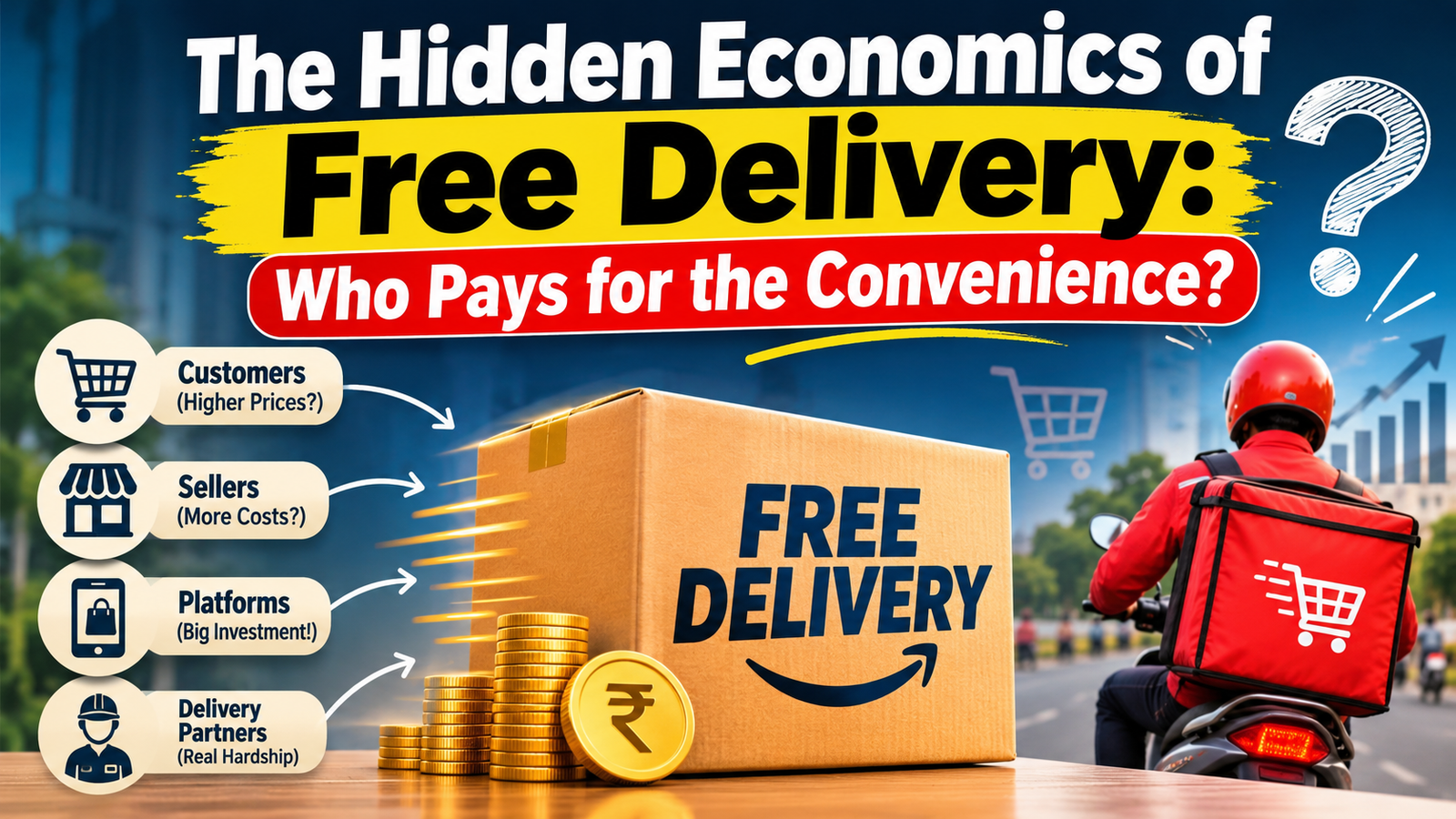
But delivery is never truly free. Fuel, logistics, packaging, warehouses, technology and delivery personnel all involve real costs. The interesting economic question is not whether delivery is free, but who ultimately bears its cost?
1. The Cost Does Not Disappear; It Changes Hands
Free delivery is primarily a pricing strategy rather than the elimination of expenses. Its cost can be absorbed by the platform, shared with sellers, recovered through product prices or supported by membership subscriptions.
In many cases, customers indirectly pay through higher product prices, platform fees or minimum-order requirements. Retailers may also incorporate logistics expenses into their overall pricing structure.
According to DHL’s 2025 E-Commerce Trends Report, 42% of surveyed retailers included delivery costs within their product offering, while another 20% offered a mix of free and paid delivery depending on order value. This illustrates how the apparent benefit of free delivery can be financed through different pricing arrangements.
2. The Seller Also Pays a Price
For sellers and restaurants, joining a delivery platform provides access to a wider customer base. However, this convenience comes with commercial costs.
Platforms may earn through commissions, advertising fees, promotional contributions and other charges. Sellers may also offer discounts to attract customers or qualify for promotional campaigns.
Consequently, a business can experience higher order volumes without necessarily achieving higher profitability. More sales do not automatically translate into more earnings.
3. Platforms Use Free Delivery to Buy Customer Loyalty
For e-commerce companies, free delivery is often an investment in customer acquisition and retention.
Discounted or waived delivery charges encourage customers to place more frequent orders, explore new products and remain loyal to a particular platform.
Membership programmes further strengthen this strategy by offering delivery benefits in exchange for recurring subscription revenue.
Eternal Limited’s FY2024–25 annual report, covering Zomato and Blinkit, illustrates this diversified revenue model. Its food delivery business generated revenue through commissions, advertising, platform fees and subscriptions. Food delivery revenue reached ₹8,080 crore in FY25, growing 27% year-on-year.
The strategy is clear: a platform may sacrifice some revenue on an individual delivery to build a larger and more valuable customer base.
4. The Hidden Burden on Delivery Workers
Behind every convenient doorstep delivery is a person responsible for completing the journey.
Delivery partners face expenses such as fuel, vehicle maintenance, mobile data and other operating costs. Their earnings can also depend on order volumes, distance, incentives and working hours.
A January 2026 Moneycontrol analysis reported that a full-time delivery partner working around 10 hours daily for 26 days could earn approximately ₹26,500–₹27,700 gross per month, with net earnings estimated at around ₹21,000 after fuel and maintenance costs.
This highlights an important distinction: while customers enjoy the convenience of faster and cheaper deliveries, the economics of the system must also account for the people who make it possible.
5. The Real Economics of Last-Mile Delivery
Delivery is often the most challenging part of the supply chain because it involves moving individual orders across different locations within limited timeframes.
A July 2026 report by the Centre for Social and Economic Progress (CSEP) estimates that last-mile delivery accounts for roughly 60% of total logistics costs per parcel in India’s merchandise e-commerce sector.
Low order values, geographically dispersed customers and product returns further complicate profitability. For platforms, the challenge is to balance delivery speed, affordability and operational efficiency.
Conclusion: Is Free Delivery Really Free?
Free delivery is not a free economic service; it is a carefully designed business strategy in which costs are distributed across customers, sellers, platforms and the wider delivery ecosystem.
It creates value by improving convenience, expanding market access and increasing consumption. However, its long-term sustainability depends on transparent pricing, efficient logistics, viable seller margins and fair working conditions for delivery partners.
The next time an order arrives with zero delivery charges, remember: the delivery may be free on the screen, but someone, somewhere, is paying for the journey.