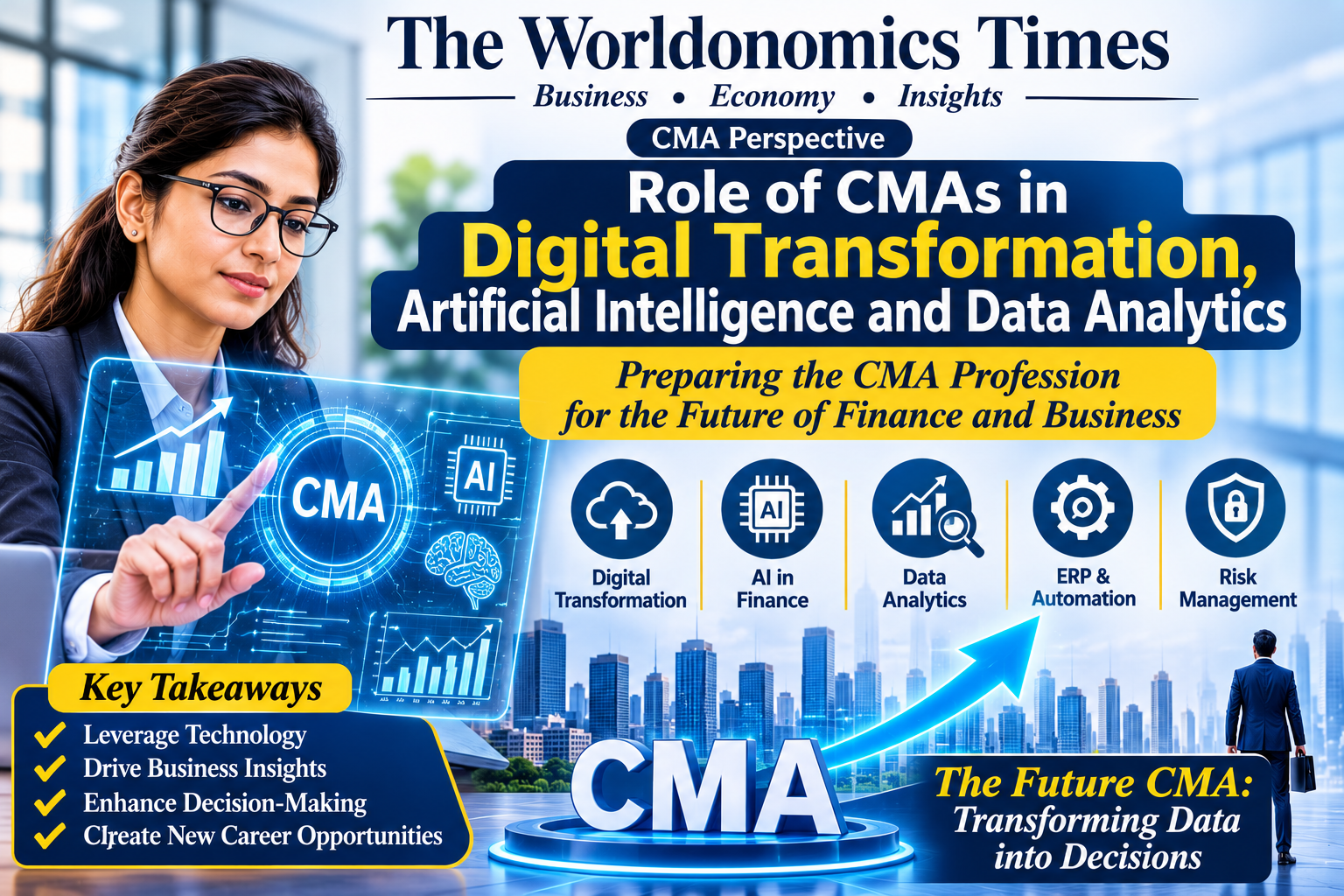
Preparing the CMA Profession for the Future of Finance and Business
By CMA Madhuri Kashyap
The Worldonomics Times | CMA Perspective
Introduction
Digital transformation is changing the way businesses operate, manage finances and make strategic decisions. Artificial Intelligence (AI), automation, cloud computing, Enterprise Resource Planning (ERP) systems and data analytics are transforming traditional accounting and finance functions.
For Cost and Management Accountants (CMAs), these developments represent both an opportunity and a challenge. Traditional responsibilities such as cost calculation, budgeting, financial reporting and variance analysis are increasingly supported by automated systems. At the same time, organisations need professionals who can interpret digital information, identify business trends and convert data into meaningful decisions.
The modern CMA is therefore expected to combine professional accounting knowledge with technology, analytical thinking and strategic business understanding.
1. Digital Transformation in the Finance Function
Digital transformation involves adopting technology to improve business processes, efficiency and decision-making.
In finance departments, digital systems are being used for accounting, budgeting, expense management, financial reporting, procurement and inventory control.
CMAs can contribute to this transformation by helping organisations design effective cost information systems, improve financial reporting processes and monitor business performance.
Their understanding of management accounting enables them to ensure that technology investments support actual business requirements.
2. Artificial Intelligence in Cost and Management Accounting
Artificial Intelligence is creating new possibilities in financial analysis and management accounting.
AI-enabled systems can process large volumes of financial information, identify unusual patterns and support forecasting.
For CMA professionals, potential applications include:
- Automated expense classification.
- Cost trend analysis.
- Financial forecasting.
- Identification of unusual transactions.
- Budget variance monitoring.
- Inventory demand analysis.
- Management reporting.
AI can reduce repetitive work and provide faster insights. However, professional judgement remains essential. CMAs must verify information, understand the assumptions behind automated outputs and ensure that decisions are based on reliable data.
3. Data Analytics for Better Business Decisions
Data analytics is becoming an important capability in modern finance and management accounting.
Businesses generate information through sales transactions, production systems, procurement platforms, inventory records and customer interactions.
CMAs can analyse this information to understand profitability, identify cost inefficiencies and evaluate operational performance.
For example, product-wise data analysis can help identify which products generate higher contribution margins. Customer-wise profitability analysis can reveal the financial value of different customer segments.
Tools such as Microsoft Excel, Power BI and other business intelligence platforms help professionals convert complex datasets into understandable dashboards and reports.
4. Transformation of Budgeting and Financial Planning
Traditional budgeting often involves lengthy manual processes and periodic reporting. Digital tools can make budgeting more flexible and responsive.
Modern organisations increasingly use automated budgeting systems, rolling forecasts and scenario analysis.
CMAs can use these systems to evaluate alternative business situations, estimate financial requirements and assess the impact of changing market conditions.
For example, a manufacturing company can use scenario analysis to understand how an increase in raw material prices may affect production costs and profitability.
This allows management to prepare corrective strategies before financial pressure becomes significant.
5. ERP Systems and Integrated Business Management
Enterprise Resource Planning systems integrate different business functions through a common information platform.
ERP systems can connect finance, procurement, inventory, production, sales and human resources.
For CMAs, understanding ERP systems is valuable because cost information depends on accurate data from multiple departments.
A well-designed ERP environment can help professionals monitor material consumption, production costs, inventory levels, overheads and financial performance.
CMAs can contribute to ERP implementation by identifying reporting requirements, evaluating cost information flows and helping management develop useful performance indicators.
6. Digital Transformation in Internal Audit and Risk Management
Technology is also changing internal audit and risk management.
Digital audit tools can examine large volumes of transactions and identify unusual patterns that may require further investigation.
CMAs can use data analytics to review procurement transactions, inventory movements, expenditure patterns and budget deviations.
Automation can support continuous monitoring of selected controls and help identify exceptions more quickly.
However, digital audit requires proper data governance, cybersecurity awareness and careful verification of findings. Technology-generated alerts should be treated as indicators for review rather than conclusive evidence of irregularities.
7. Opportunities for CMAs in the Digital Economy
Digital transformation is creating new professional opportunities for CMA professionals across industries.
Emerging career areas include:
- Financial Data Analyst.
- Business Intelligence Analyst.
- Digital Finance Consultant.
- ERP and Management Accounting Specialist.
- Cost Analytics Professional.
- Technology Risk and Controls Analyst.
- Financial Planning and Analysis Professional.
- Digital Transformation Consultant.
These opportunities are available in manufacturing, banking, consulting, infrastructure, technology, retail and other business sectors.
CMAs who combine finance expertise with digital capabilities can position themselves for more strategic responsibilities.
8. Skills Required for the Future CMA
The future of the CMA profession will depend on continuous learning and adaptation.
Important skills include:
- Advanced Excel and financial modelling.
- Power BI and data visualisation.
- ERP systems and digital finance platforms.
- Understanding of AI and automation.
- Data interpretation and analytical thinking.
- Cybersecurity and data privacy awareness.
- Strategic communication and problem-solving.
- Knowledge of business processes and risk management.
Professionals do not necessarily need to become software developers. However, they should understand how digital tools work, where they can add value and what risks they may create.
9. Challenges and Professional Responsibility
Digital transformation also brings challenges. Data quality, system integration, cybersecurity, privacy and the reliability of AI-generated information require careful attention.
CMAs must maintain professional ethics, confidentiality and independence while working with digital systems.
They should also understand the limitations of automated analysis and ensure that important financial decisions receive appropriate human review.
Technology should strengthen professional judgement, not replace accountability.
Conclusion
Digital transformation is reshaping the finance profession and expanding the role of Cost and Management Accountants. AI, automation, ERP systems and data analytics are creating new ways to manage costs, improve financial planning and support strategic decisions.
The CMA of the future will be more than a traditional accounting professional. The profession will increasingly require individuals who can combine financial expertise, technological awareness and business intelligence.
As Indian businesses adopt digital systems and compete in a technology-driven economy, CMAs have an important opportunity to lead financial transformation and improve organisational performance.
The future CMA will not simply work with numbers; the future CMA will transform data into decisions, technology into efficiency and financial insight into business growth.