New Delhi, November 2026:
Government departments, Public Sector Undertakings (PSUs), Central Public Sector Enterprises (CPSEs) and other public organisations represent one of the largest institutional markets available to India’s Micro, Small and Medium Enterprises (MSMEs).
However, many entrepreneurs hesitate to participate in government tenders because they consider the process complicated. In reality, the tender process becomes considerably easier when an MSME understands the stages involved, prepares the required documents and carefully follows the conditions specified in the tender.
For MSMEs, tendering should not be viewed simply as submitting the lowest quotation. It is a structured process involving eligibility, technical compliance, financial competitiveness, documentation and timely execution.
Understanding the Government Tender Process
A government or PSU tender generally begins when a buyer identifies a requirement for a product, service or project.
The organisation publishes a Notice Inviting Tender (NIT), Request for Quotation (RFQ), Request for Proposal (RFP) or online bid containing details such as specifications, quantity, eligibility criteria, delivery schedule, technical requirements, bid validity, payment terms and other conditions.
MSMEs should never submit a bid merely because the product appears similar to what they manufacture or supply.
The first step is to carefully read the complete tender document and determine whether the enterprise meets every mandatory eligibility requirement.
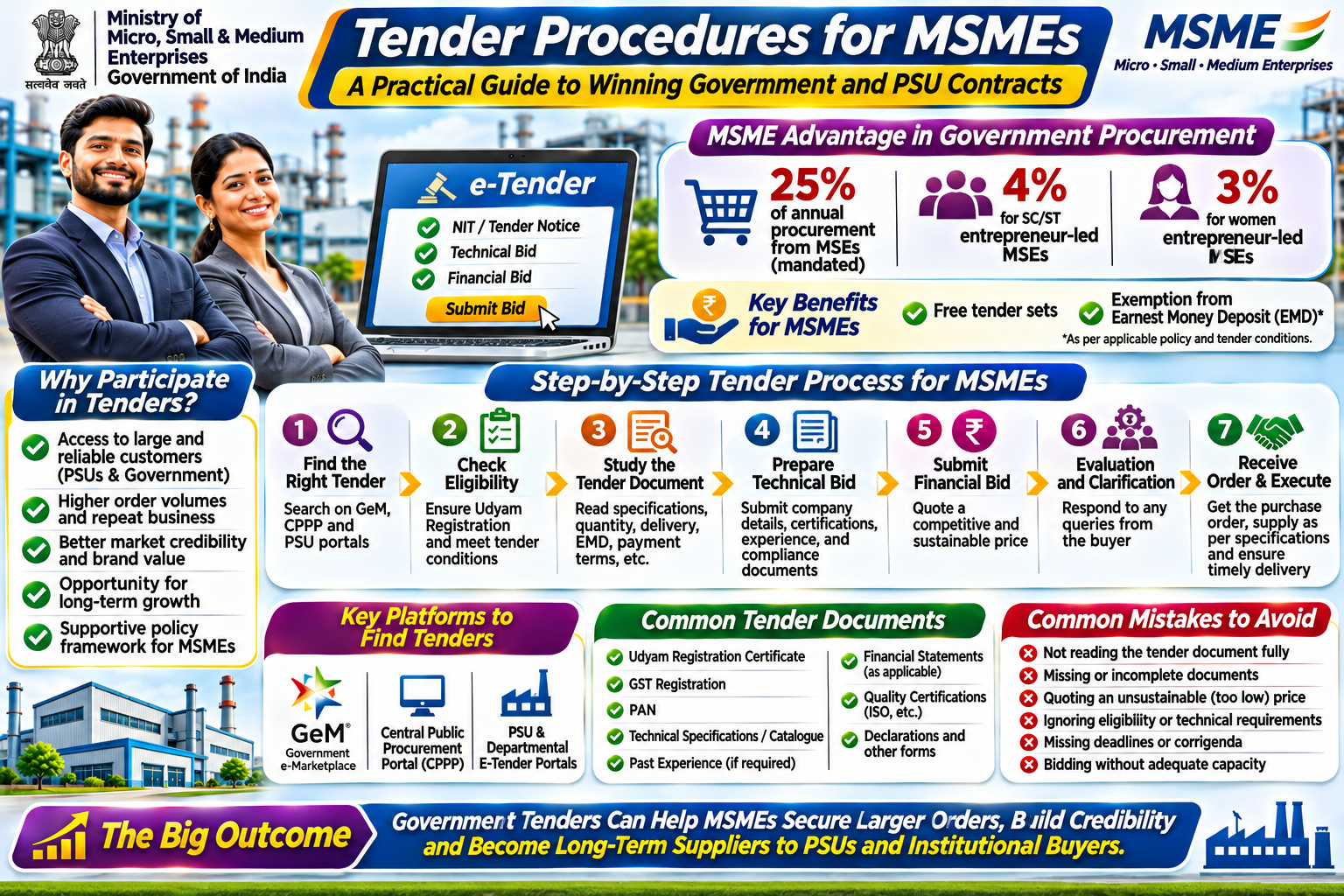
Step 1: Find the Right Tender
The tender journey begins with identifying relevant opportunities.
MSMEs can monitor platforms such as the Government e-Marketplace (GeM), Central Public Procurement Portal and individual PSU procurement portals.
The enterprise should search using product names, technical specifications, industry categories and keywords relevant to its business.
The objective should be quality rather than quantity.
Submitting bids for hundreds of unrelated tenders can waste management time and increase the risk of errors. An MSME should focus on tenders where it has the required product capability, capacity, certifications and delivery infrastructure.
Step 2: Check MSME Eligibility and Benefits
Before participating, an enterprise should ensure that its Udyam Registration and other relevant registrations are current.
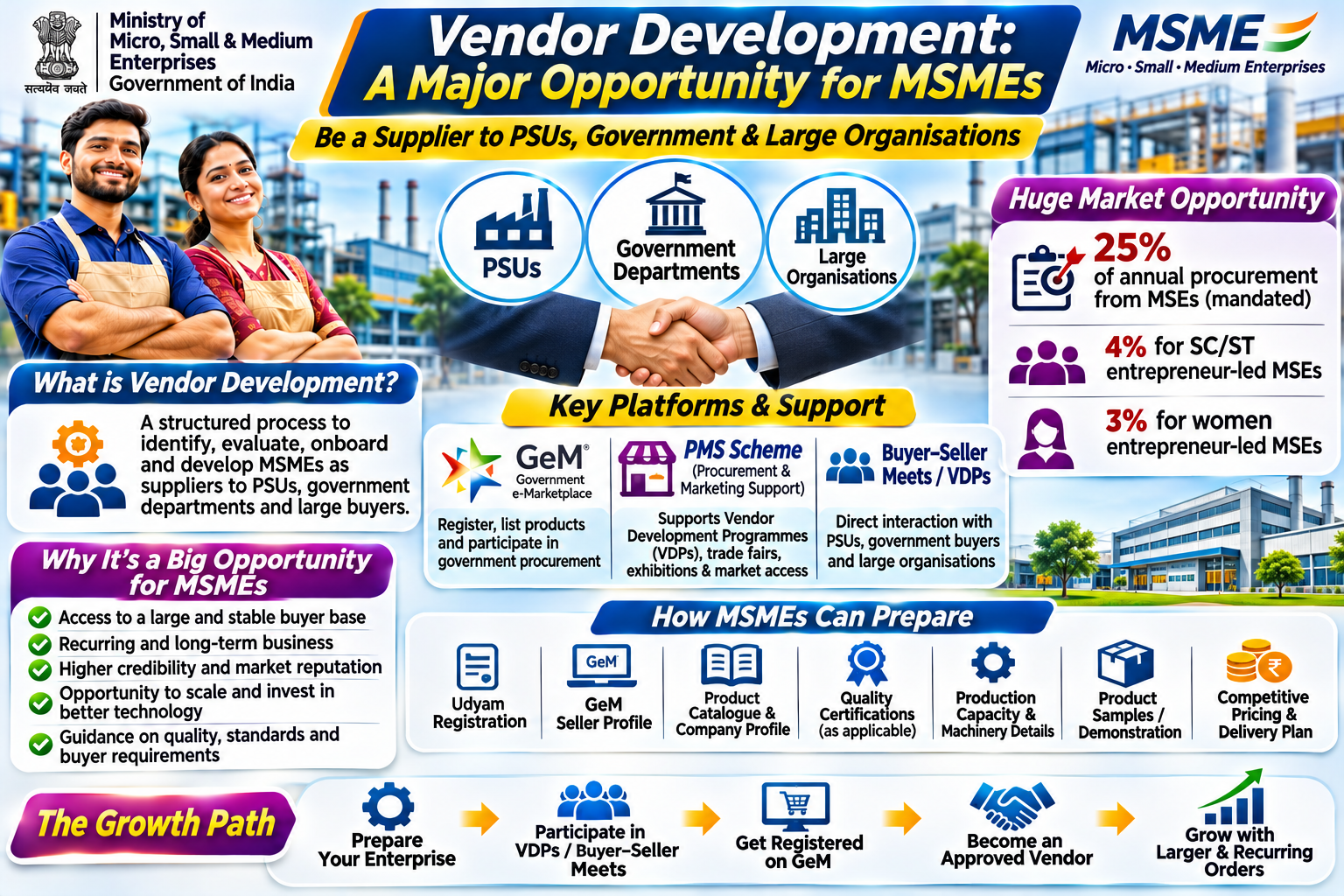
The Public Procurement Policy for Micro and Small Enterprises provides important procurement support. Central Ministries, Departments and CPSEs are mandated to target 25% of annual procurement from MSEs, including sub-targets of 4% for MSEs owned by SC/ST entrepreneurs and 3% for women-owned MSEs.
The policy also provides certain benefits to eligible MSEs, including free tender sets and exemption from Earnest Money Deposit (EMD). However, MSMEs should carefully check the specific tender because eligibility conditions and documentary requirements must be satisfied.
Importantly, MSMEs should not assume that every government tender automatically provides every MSME benefit.
Step 3: Study the Tender Document Carefully
This is one of the most important stages.
The entrepreneur should identify:
- Scope of supply or work
- Technical specifications
- Quantity
- Delivery location
- Delivery period
- Eligibility criteria
- Prior experience requirements
- Turnover requirements
- Quality certifications
- EMD requirements
- Tender fee
- Performance security
- Payment terms
- Warranty requirements
- Bid validity
- Evaluation methodology
- Important dates
A useful practice is to create a Tender Compliance Checklist before preparing the bid.
Every mandatory condition should be marked as either “Complied”, “Not Applicable” or “Clarification Required”.
Step 4: Prepare the Technical Bid
Many tenders have separate technical and financial components.
The technical bid generally demonstrates whether the bidder is capable of supplying the required product or service.
It may include company information, Udyam certificate, GST registration, PAN, product specifications, technical literature, certifications, experience documents, declarations, financial information and other supporting documents.
A common mistake is to focus heavily on price while overlooking technical compliance.
A competitively priced bid can still be rejected if a mandatory technical document or specification is missing.
Step 5: Understand EMD and Tender Fee Requirements
Earnest Money Deposit is designed to provide bid security to the buyer.
Eligible MSEs may receive EMD exemption under the applicable procurement policy, but the bidder normally needs to provide the required registration or exemption documentation in the manner prescribed in the tender.
Government procurement guidance specifically notes that MSEs may receive exemption from EMD, while performance security is not automatically covered by the MSME procurement policy.
Therefore, an MSME should read the tender’s EMD and performance-security clauses carefully rather than relying solely on its MSME status.
Step 6: Submit the Financial Bid
The financial bid is where the enterprise quotes its price.
However, the lowest price should not automatically be the objective.
Before quoting, the MSME should calculate:
Raw material + Labour + Power + Overheads + Finance Cost + Logistics + Taxes + Warranty/Service Cost + Profit Margin = Sustainable Bid Price
A manufacturer that quotes below its actual cost simply to win an order may create a cash-flow problem later.
The financial quotation should therefore be competitive but commercially sustainable.
Step 7: Participate in Evaluation
After submission, the buyer evaluates bids according to the tender conditions.
The process may include technical evaluation, commercial evaluation, price comparison, clarification, negotiation where permitted under applicable rules, and identification of the successful bidder.
MSMEs should regularly monitor the procurement portal after submission.
Missing a clarification request or failing to provide information within the specified period can negatively affect the bid.
Step 8: Understand MSE Purchase Preference
The Public Procurement Policy provides an important mechanism for eligible MSEs.
Under the policy framework, participating MSEs quoting within the prescribed L1 + 15% price band may, subject to applicable conditions, be allowed to supply a portion of the requirement by matching the L1 price.
This makes it particularly important for MSMEs to understand the purchase-preference provisions applicable to a particular tender.
Such benefits should be treated as an opportunity—not as a substitute for competitive pricing and strong technical capability.
Step 9: Contract, Supply and Payment
Winning the tender is only the beginning.
After receiving the purchase order or contract, the MSME must focus on:
- Timely production
- Quality compliance
- Correct packaging
- Documentation
- Delivery schedules
- Inspection requirements
- Invoice submission
- Warranty obligations
- After-sales support
Government and PSU customers place significant importance on contractual compliance.
A successful first order can become the foundation for future business if the supplier consistently performs well.
GeM and Digital Tendering
Digital procurement has significantly changed government purchasing.
GeM provides an online marketplace for government procurement, while many organisations also operate dedicated e-tendering systems.
GeM has introduced measures to simplify MSME participation, including integration with the Udyam database for seller onboarding and functionality supporting applicable MSME-related procurement benefits.
MSMEs should therefore develop internal capabilities for online tender search, document preparation, digital signatures, bid submission and portal monitoring.
Common Mistakes MSMEs Should Avoid
Several avoidable mistakes can result in bid rejection:
Ignoring eligibility conditions: Product capability alone is not enough.
Submitting incomplete documents: One missing mandatory document can make a bid non-responsive.
Quoting an unsustainable price: Winning an order at a loss is not success.
Missing deadlines: Government portals generally operate according to specified closing times.
Failing to read corrigenda: Tender conditions can change through official amendments.
Using incorrect certificates: MSME benefits must be supported by valid and relevant documentation.
Participating without capacity: An MSME should ensure that it can actually fulfil the order.
From Tender Participant to Long-Term Supplier
The ultimate objective of tender participation should not be winning one contract.
MSMEs should aim to build a track record of successful government and PSU execution.
That means delivering on time, maintaining quality, resolving complaints quickly and maintaining proper documentation.
Over time, a strong track record can help an MSME approach larger tenders, new PSUs, major private companies and export markets.
A Strategic Opportunity for MSMEs
Government tendering can appear complicated at first, but the process becomes manageable when divided into clear stages:
Identify → Check Eligibility → Study Tender → Prepare Documents → Submit Technical Bid → Quote Financial Bid → Monitor Evaluation → Receive Order → Execute Contract → Build Track Record.
India’s public procurement ecosystem provides MSMEs with significant opportunities to access institutional customers. The Public Procurement Policy, GeM, Vendor Development Programmes and digital tendering platforms are creating multiple pathways for smaller enterprises to participate in government procurement.
For an MSME entrepreneur, the key is preparation.
A successful tender is not won only by quoting the lowest price. It is won by understanding the requirement, demonstrating capability, submitting a compliant bid and delivering exactly what was promised.
With professional tender management, India’s MSMEs can turn government procurement from an unfamiliar process into a powerful channel for business growth, credibility and long-term institutional customers.