New Delhi, November 2026:
For India’s Micro, Small and Medium Enterprises (MSMEs), becoming a vendor to a large corporate, Public Sector Undertaking (PSU) or government organisation can be a major turning point. A single successful institutional buyer can provide recurring orders, stronger credibility, improved production capacity and a pathway towards long-term business growth.
This is where Vendor Development Programmes (VDPs) are becoming increasingly important.
Vendor development is not simply about finding a buyer. It is about connecting capable MSMEs with organisations that require products, components, services and specialised solutions. India’s public procurement framework, the Procurement and Marketing Support (PMS) Scheme, GeM and various MSME initiatives are creating an ecosystem in which smaller enterprises can increasingly participate in institutional supply chains.
What Is Vendor Development?
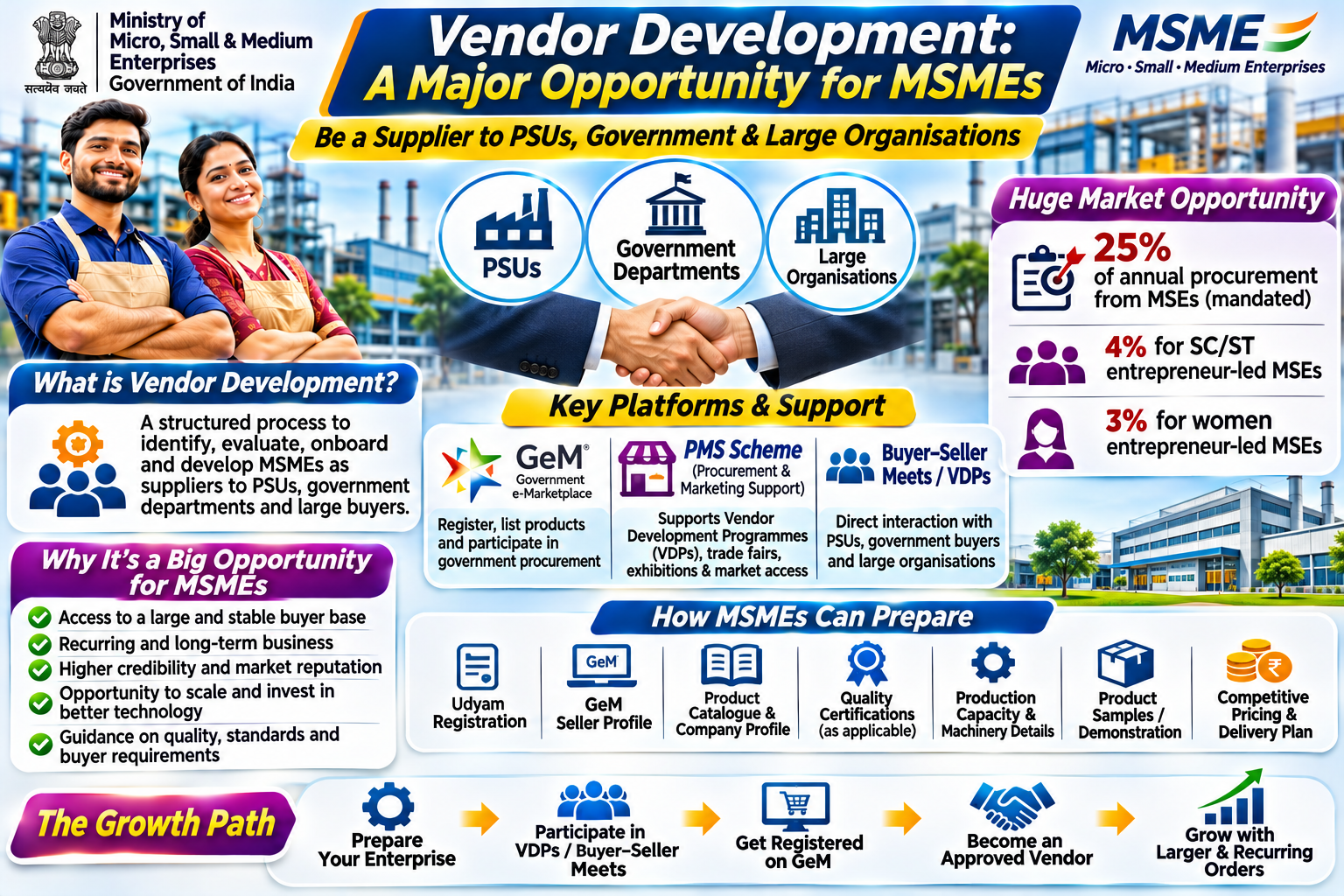
Vendor development is the process through which large organisations identify, evaluate, onboard and develop smaller businesses as potential suppliers.
For an MSME, a Vendor Development Programme can provide an opportunity to meet procurement officials, understand buyer requirements, display products, learn about tender procedures and explore vendor-registration opportunities.
The Ministry of MSME describes VDPs as a mechanism to facilitate market linkages and support implementation of the Public Procurement Policy for MSEs. Such programmes also help MSMEs understand GeM registration and public procurement requirements.
In practical terms, a VDP can bring the buyer and seller into the same room.
A Significant Government Procurement Market
The opportunity is substantial.
The Public Procurement Policy for Micro and Small Enterprises mandates Central Ministries, Departments and Central Public Sector Enterprises (CPSEs) to target 25% of annual procurement from MSEs. Within this target, 4% is earmarked for MSEs owned by SC/ST entrepreneurs and 3% for MSEs owned by women entrepreneurs.
The scale of actual procurement has also grown.
During FY 2024-25, Central Ministries, Departments and CPSEs procured ₹93,017.08 crore, or 43.58% of their total procurement, from MSEs as reported in the government’s year-end review.
This demonstrates that government procurement is not merely a policy concept. It represents a substantial commercial opportunity for eligible MSEs.
VDPs Help MSMEs Understand What Buyers Actually Need
One of the biggest challenges for MSMEs is the gap between what they manufacture and what institutional buyers actually require.
A vendor development programme can help bridge this gap.
PSUs and large organisations can communicate their procurement requirements, technical specifications, quality standards, annual demand, vendor-registration procedures and outsourcing opportunities.
For MSMEs, this information can be extremely valuable.
Instead of developing products based only on assumptions about the market, an entrepreneur can understand the actual requirements of potential buyers and modify production, quality systems, packaging, certifications or capacity accordingly.
GeM and Vendor Development Go Together
The Government e-Marketplace (GeM) has become an important part of India’s government procurement ecosystem.
MSMEs seeking government business should therefore treat GeM readiness as a strategic requirement.
A vendor development programme can help enterprises understand:
- GeM seller registration;
- Product and service catalogue creation;
- Tender discovery;
- Bid submission;
- Technical specifications;
- Pricing and competitiveness;
- Documentation and compliance;
- Order fulfilment and delivery;
- Government buyer expectations.
The government’s procurement manual specifically calls upon Central Ministries, Departments and PSUs to take steps to develop appropriate MSE vendors through VDPs and Buyer-Seller Meets, including for procurement through GeM.
What MSMEs Can Gain
Vendor development can create several advantages.
First, market access. MSMEs can directly interact with large institutional buyers.
Second, credibility. Supplying a reputed PSU or government organisation can strengthen an enterprise’s market reputation.
Third, recurring business. Successful vendor relationships can potentially generate repeat orders.
Fourth, product improvement. Buyer feedback can help MSMEs improve quality, specifications and production processes.
Fifth, scale. Institutional orders can encourage enterprises to invest in machinery, manpower, technology and quality systems.
Vendor development can therefore become a bridge between a small local enterprise and a much larger supply chain.
PMS Scheme Supports Vendor Development
The Ministry of MSME’s Procurement and Marketing Support (PMS) Scheme specifically includes Vendor Development Programmes as a market-access component.
The scheme also supports participation in trade fairs and exhibitions, while its capacity-building components cover modern packaging, barcode adoption, e-commerce platforms and workshops.
The PMS framework therefore creates an integrated market-development approach:
Product → Packaging → Barcode → Exhibition → Vendor Development → GeM → Institutional Orders.
The Ministry’s PMS programme continues to be actively implemented in 2026, with multiple sanctions and circulars issued during the year for exhibitions, market-access activities and related interventions.
Vendor Development Is Not Only for Manufacturers
A common misconception is that only manufacturing companies can become institutional vendors.
In reality, government and large organisations require a wide range of goods and services. Depending on procurement requirements, opportunities can exist in areas such as engineering components, electrical products, IT services, professional services, maintenance, logistics, packaging, food products, textiles, safety equipment and other specialised categories.
The key requirement is to identify a genuine buyer requirement and demonstrate the capability to meet it consistently.
How MSMEs Can Prepare
MSMEs should prepare before attending a VDP or Buyer-Seller Meet.
A professional vendor-development kit should include:
- Udyam Registration
- Company profile
- Product catalogue
- GeM seller profile
- GST and PAN details
- Relevant licences and certifications
- Quality certificates, where applicable
- Manufacturing/service capacity details
- Existing client references
- Product samples or demonstrations
- Price and delivery capability
- Details of machinery and technology
Most importantly, entrepreneurs should research the participating PSUs and identify the products or services they may require.
From Vendor to Strategic Supplier
The real objective should not be simply obtaining one purchase order.
An MSME should aim to become a reliable, quality-focused and scalable supplier.
That requires timely delivery, consistent quality, competitive pricing, documentation discipline, after-sales support and the ability to respond to changing buyer requirements.
Successful vendor development can also open doors to other large buyers because institutional procurement experience becomes an important business credential.
The Opportunity Ahead
India’s growing public procurement ecosystem provides MSMEs with an important route to larger markets.
With the 25% MSE procurement target, expanding GeM adoption, PMS support and structured Vendor Development Programmes, the ecosystem is increasingly designed to connect smaller enterprises with institutional demand.
For entrepreneurs, the message is simple: do not wait for a large buyer to discover your business. Prepare your enterprise, understand procurement requirements, participate in VDPs and actively approach institutional markets.
Vendor development can transform an MSME from a local supplier into a PSU vendor, government supplier and long-term strategic partner.
For India’s MSMEs, this is not merely a procurement opportunity—it can be a pathway to larger orders, stronger credibility, higher capacity and sustainable growth.