New Delhi, November 2026:
India’s manufacturing ambitions are increasingly being shaped not only by large corporations but also by thousands of Micro, Small and Medium Enterprises (MSMEs) operating across engineering, auto components, electronics, textiles, food processing, chemicals, pharmaceuticals, machinery, electrical equipment, defence components and other industrial segments.
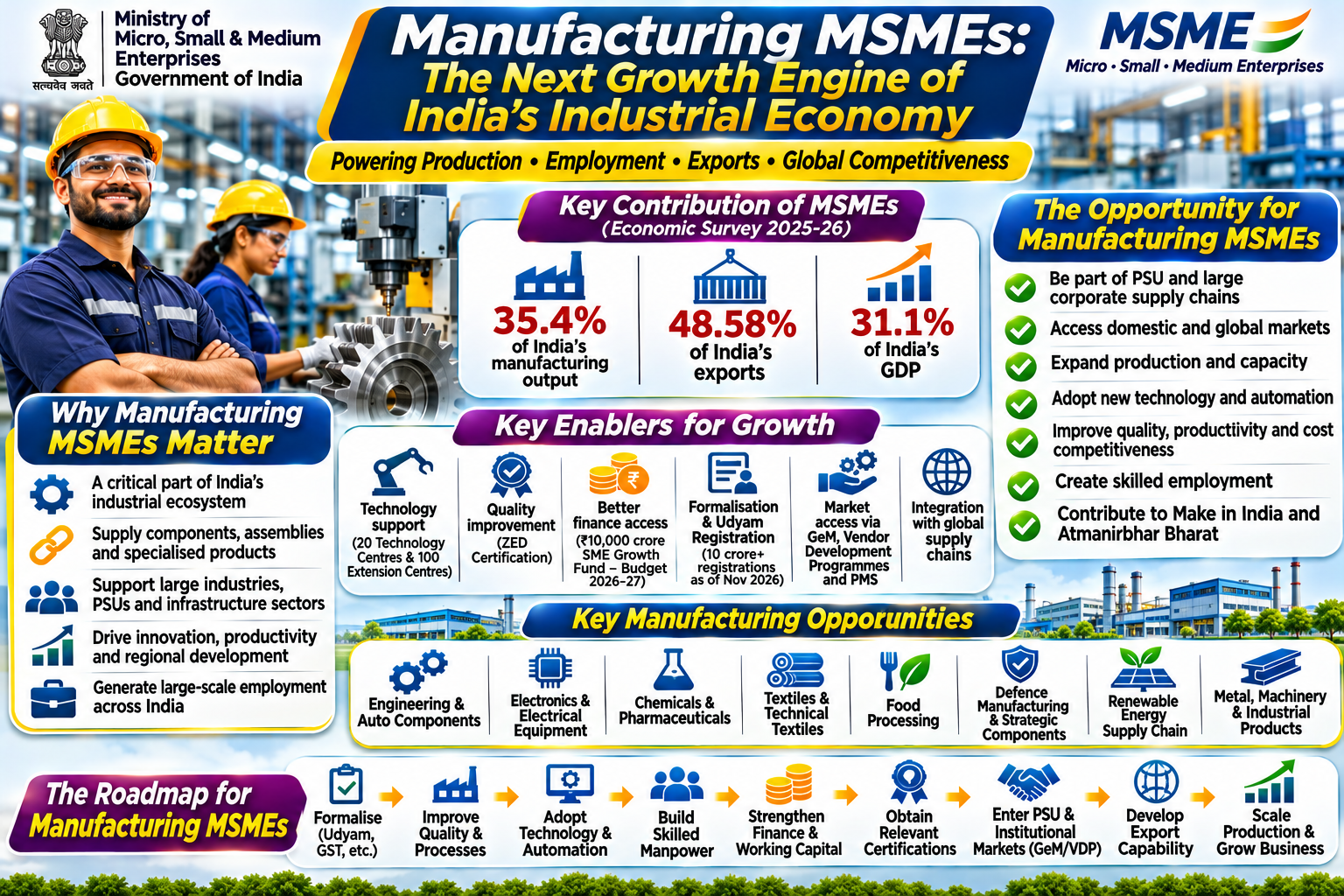
MSMEs already account for around 35.4% of India’s manufacturing output, 48.58% of exports and 31.1% of GDP, according to the Economic Survey 2025-26. This makes manufacturing MSMEs a critical part of India’s industrial ecosystem and an important pillar of the country’s ambition to become a globally competitive manufacturing economy.
Manufacturing MSMEs at the Heart of Industrial Growth
Manufacturing MSMEs occupy a unique position in India’s economy. Large industries depend on smaller enterprises for components, assemblies, packaging, maintenance, specialised services, tooling and other inputs.
An automobile manufacturer, for example, may have hundreds of MSME suppliers producing components. Similarly, infrastructure companies, power utilities, railways, defence manufacturers and engineering companies require a wide network of smaller suppliers.
This creates an opportunity for MSMEs to move beyond local markets and become part of national and global supply chains.
The Government’s manufacturing strategy is also increasingly focused on creating integrated industrial ecosystems, clusters and manufacturing hubs. The government’s April 2026 manufacturing backgrounder highlighted initiatives including MSME clusters, PM MITRA parks and other integrated infrastructure aimed at improving scale and competitiveness.
From Small Factory to Strategic Supplier
For many manufacturing MSMEs, the next stage of growth should not simply be increasing production capacity. The bigger objective should be becoming a reliable and preferred supplier.
This requires improvements across several areas:
- Consistent product quality
- Modern production technology
- Competitive costing
- On-time delivery
- Quality certifications
- Strong financial controls
- Professional documentation
- Digital systems
- Skilled manpower
- Research and product development
A manufacturer that can demonstrate these capabilities has a much greater chance of securing institutional customers, including PSUs and large private-sector companies.
Technology Will Determine Competitiveness
Technology adoption is becoming increasingly important for manufacturing MSMEs.
Automation, enterprise software, digital inventory management, computer-aided design, machine monitoring, quality-control systems and data-based production planning can help enterprises reduce wastage and improve productivity.
The Ministry of MSME’s technology ecosystem includes Technology Centres and Extension Centres that support enterprises with technology, training and technical services. The MSME dashboard reported 20 Technology Centres and 100 Extension Centres as of November 2026.
Manufacturing MSMEs should therefore consider technology expenditure not merely as a cost, but as an investment in competitiveness.
Quality Can Become a Market Advantage
In the past, many MSMEs competed primarily on price. The market is increasingly moving towards a different model—price plus quality plus reliability.
Large companies and institutional buyers want suppliers capable of maintaining consistent specifications over repeated orders.
Quality certifications, testing facilities, process documentation, traceability and quality-control systems can therefore become important differentiators.
Programmes such as Zero Defect Zero Effect (ZED) are designed to encourage MSMEs to improve quality, productivity and environmental performance. Government data shows significant participation in ZED certification, reflecting growing interest in structured quality improvement.
Access to Finance Remains Critical
Manufacturing requires capital. Entrepreneurs need funds not only for machinery but also for inventory, raw materials, wages, technology upgrades and expansion.
The Government has increasingly focused on improving access to institutional finance and growth capital.
The Union Budget 2026-27 proposed a ₹10,000 crore SME Growth Fund aimed at providing patient equity capital to high-potential SMEs with viable and scalable business models. The initiative is intended to support the emergence of future champion enterprises across manufacturing, technology and strategic value chains.
For manufacturing MSMEs, the availability of appropriate growth capital can make the difference between remaining a small workshop and developing into a larger industrial supplier.
Formalisation Opens More Opportunities
Formalisation is another major advantage for manufacturing enterprises.
Udyam Registration provides enterprises with formal recognition and access to various government support mechanisms. The official Udyam portal states that MSME classification is based on investment and turnover, with the current limits set at ₹2.5 crore/₹10 crore for micro enterprises, ₹25 crore/₹100 crore for small enterprises and ₹125 crore/₹500 crore for medium enterprises.
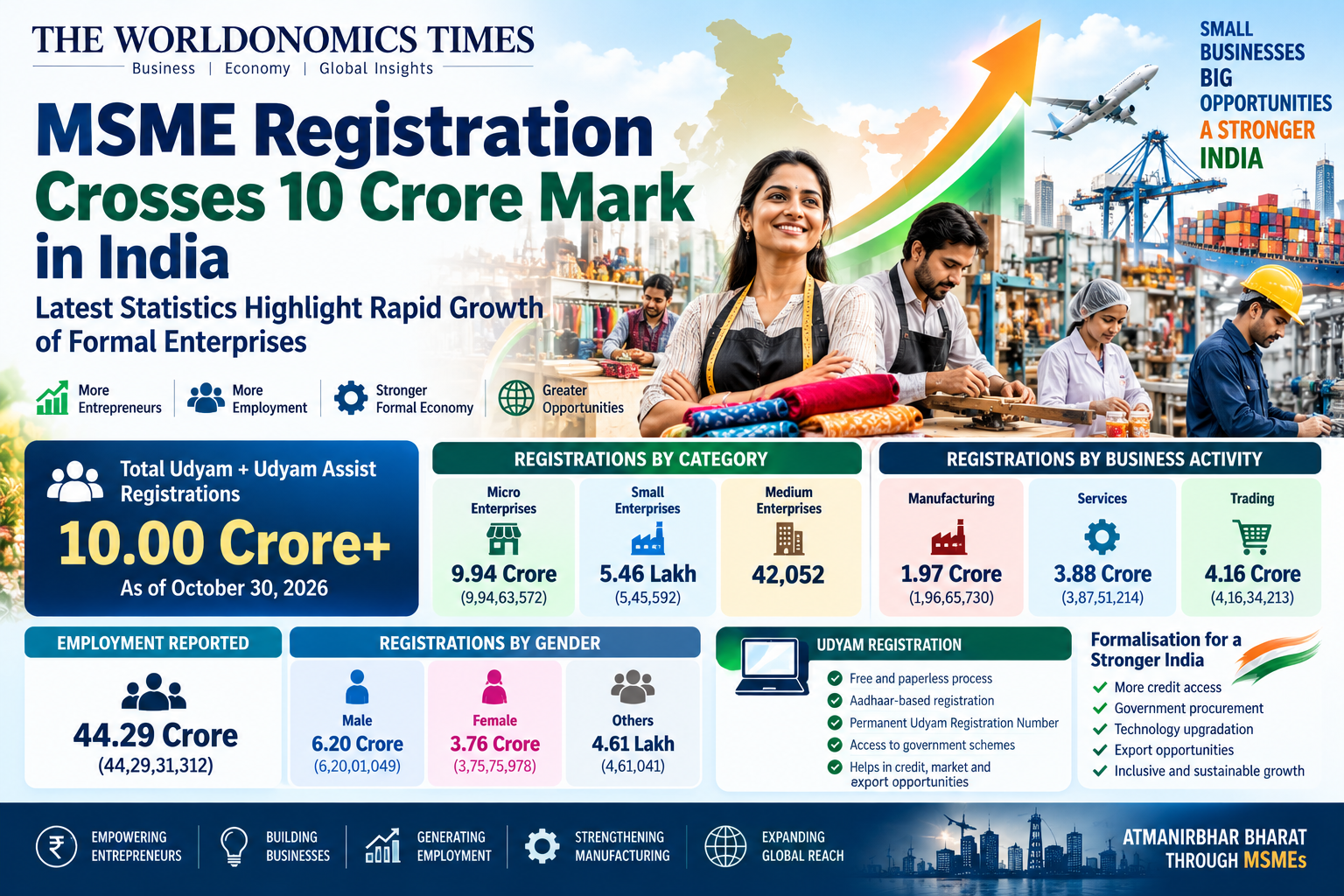
As of 2 November 2026, the Udyam and Udyam Assist ecosystem had crossed 10 crore registrations, according to the Ministry of MSME dashboard.
For manufacturers, formalisation can improve access to credit, government programmes, procurement opportunities and larger corporate customers.
Manufacturing MSMEs and Global Supply Chains
One of India’s biggest opportunities is integration into global value chains.
Global companies are diversifying supply chains, while India is seeking to increase domestic value addition and manufacturing capacity.
The Economic Survey 2025-26 specifically highlighted deeper participation in global supply chains as an opportunity for job-rich industrialisation.
Manufacturing MSMEs can benefit by developing products that meet international specifications, obtaining relevant certifications, improving packaging, adopting traceability systems and developing export capabilities.
The opportunity is particularly significant in areas such as engineering components, electronics, automotive parts, textiles, pharmaceuticals, food processing, defence manufacturing and renewable-energy supply chains.
The PSU and Institutional Market
Another major opportunity is the public-sector and institutional procurement market.
Manufacturing MSMEs can become suppliers to PSUs by identifying products purchased by government organisations, participating in Vendor Development Programmes, registering on GeM where applicable and developing professional tendering capabilities.
The objective should not be to win only one government order. A successful MSME should aim to develop a long-term institutional customer base.
A PSU order can provide revenue, credibility, technical exposure and the opportunity to demonstrate capability to other large buyers.
Building the Manufacturing MSME of Tomorrow
The successful manufacturing MSME of the future will need to combine entrepreneurial flexibility with professional systems.
The roadmap is straightforward:
Formalise → Improve quality → Adopt technology → Build skilled manpower → Strengthen finance → Obtain certifications → Enter institutional markets → Develop export capability → Scale production.
Manufacturers should also continuously measure productivity, rejection rates, delivery performance, working-capital cycles and customer satisfaction.
India’s Manufacturing Opportunity
India’s manufacturing transformation cannot be achieved by large companies alone. A strong manufacturing ecosystem requires thousands of competitive MSMEs operating as component manufacturers, specialised suppliers, technology partners and exporters.
With MSMEs already contributing more than one-third of manufacturing output, their future growth will have a direct impact on India’s industrial competitiveness.
The opportunity before manufacturing MSMEs is therefore much larger than simply producing more goods.
It is about producing better, adopting technology faster, meeting global standards, entering institutional supply chains and building globally competitive businesses.
For India’s entrepreneurs, the next decade could be the period in which a small manufacturing unit evolves into a national supplier—and potentially a global manufacturing partner.
Manufacturing MSMEs can become one of the strongest engines of India’s journey towards a more competitive, self-reliant and globally integrated industrial economy.