New Delhi, November 2026:
India’s startup ecosystem is entering a new phase. The focus is gradually moving beyond creating ideas and prototypes towards building businesses that can deliver market-ready products, generate revenues, create jobs and scale sustainably.
For startups that have already developed a working product, the most important question is no longer simply, “Can we build it?” The question is, “Can we sell it repeatedly, profitably and at scale?”
This transition from innovation to commercialisation is particularly important for startups operating in manufacturing, technology, engineering, electronics, healthcare, agriculture, clean energy, financial technology and other emerging sectors.
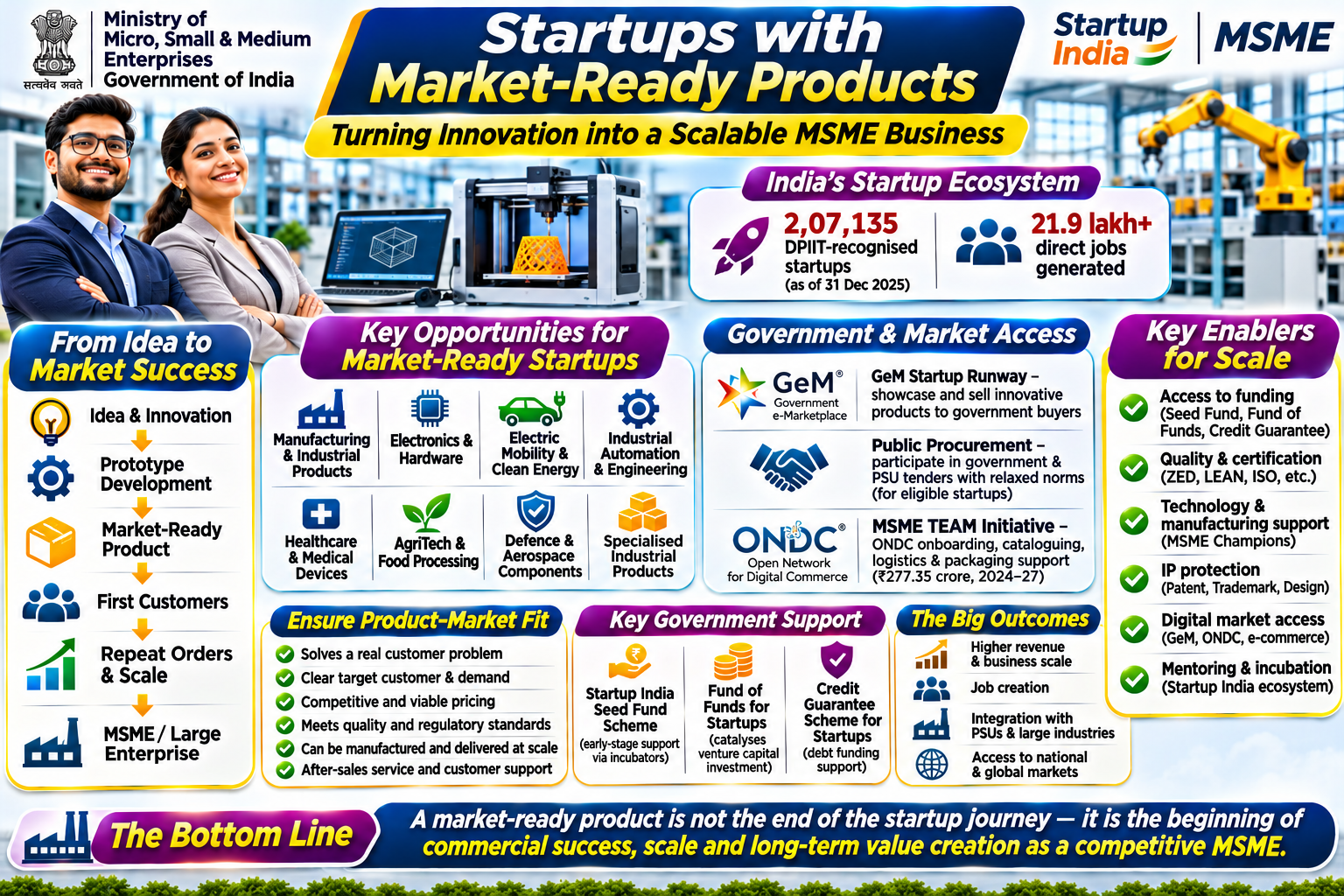
As of 31 December 2025, India had 2,07,135 DPIIT-recognised startups, which had generated more than 21.9 lakh direct jobs. The Government’s Startup India ecosystem provides funding, credit support and market-access mechanisms at different stages of the startup journey.
From Prototype to Market-Ready Product
A startup with a market-ready product has crossed an important milestone.
However, a working prototype does not automatically mean that the product is commercially ready.
Before entering the market, founders should evaluate:
- Is there a clearly identified customer?
- Does the product solve a real problem?
- Is the customer willing to pay?
- Can the product be manufactured or delivered consistently?
- Is the pricing commercially viable?
- Are quality and regulatory requirements satisfied?
- Can production be scaled without losing quality?
- Can the startup provide after-sales support?
These questions help transform a technology project into a business proposition.
Product-Market Fit Is the First Priority
Many startups focus heavily on technology but underestimate customer requirements.
A market-ready product should have a clearly defined target customer and a strong value proposition.
Instead of saying that a product uses advanced technology, the startup should explain the measurable benefit—such as lower operating cost, higher productivity, reduced energy consumption, improved safety, faster processing or better quality.
The ability to communicate this value clearly is essential when approaching customers, investors, distributors, large companies or government buyers.
Manufacturing Startups Have a Major Opportunity
India’s manufacturing transformation provides a significant opportunity for startups developing physical products.
Electronics, electric mobility, industrial automation, defence technology, renewable energy equipment, medical devices, machinery, agricultural technology and specialised industrial components are among the areas where innovative products can potentially enter large supply chains.
However, startups must move from small-batch production to repeatable manufacturing.
This requires reliable suppliers, quality-control systems, production planning, inventory management, testing procedures and appropriate certifications.
The MSME Champions framework also supports competitiveness, quality enhancement and innovation. Its Innovative component covers incubation, design and intellectual property support, while ZED and LEAN initiatives focus on quality and competitiveness, particularly for manufacturing MSMEs.
Government Procurement Can Become a First Major Customer
One of the most important opportunities for market-ready startups is public procurement.
Government departments and PSUs can become significant customers for innovative products, particularly when the product addresses an identified operational requirement.
The Startup India public-procurement framework states that DPIIT-recognised startups can participate on GeM and that GeM Startup Runway provides a route for innovative products to reach government buyers. Eligible startups can also receive exemptions from certain prior-experience, turnover and EMD requirements, subject to applicable conditions.
This is particularly valuable for startups because lack of historical turnover or experience can otherwise make it difficult to compete with established companies.
GeM Startup Runway and Market Access
For a startup with a market-ready product, getting listed where institutional buyers can discover it is extremely important.
GeM Startup Runway is designed to help startups present innovative products to government buyers. The platform allows recognised startups to showcase products that may be new or different in design, process or functionality.
Startups should therefore prepare professional product descriptions, technical specifications, photographs, certifications, pricing information and demonstration material.
The objective should be to make it easy for a procurement officer to understand what the product does, why it is useful and how it meets the requirement.
Funding Should Follow Commercial Validation
Once a product has achieved market acceptance, the startup may require additional capital for manufacturing capacity, inventory, marketing, technology and expansion.
Government-backed startup programmes operate at different stages.
The Startup India Seed Fund Scheme supports seed-stage startups through incubators, while the Fund of Funds for Startups helps catalyse venture capital investment. The Credit Guarantee Scheme for Startups supports debt funding through eligible financial institutions.
This means founders should select financing according to their stage rather than raising capital simply because funding is available.
Digital Market Access Is Increasingly Important
A market-ready product should not depend entirely on personal networks.
Digital commerce can help startups expand their customer base beyond their immediate geography.
The MSME TEAM initiative under the RAMP programme was launched to improve digital market access for Micro and Small Enterprises through ONDC. The initiative has an outlay of ₹277.35 crore for 2024-27 and targets approximately five lakh MSEs, with 50% intended to be women-owned enterprises. Support includes ONDC onboarding, catalogue creation, account management, logistics and packaging-related assistance.
For product-based startups, digital catalogues, online marketplaces and direct-to-business channels can become important components of a scalable sales strategy.
Protect Intellectual Property
A startup’s product may represent years of research and investment.
Founders should therefore consider intellectual property protection before aggressively entering the market.
Depending on the product, this could include patents, trademarks, industrial designs, copyrights or other forms of protection.
The MSME Innovative scheme specifically includes support related to intellectual property and commercialisation.
From Startup to Scalable Enterprise
The biggest challenge for a market-ready startup is often not product development but execution.
The company must build systems for procurement, production, quality, finance, sales, customer service and compliance.
The journey can be visualised as:
Idea → Prototype → Product Validation → Market-Ready Product → First Customer → Repeat Orders → Institutional Customers → Scale → National and Global Markets
Each stage requires different capabilities.
A founder who remains focused only on product development may struggle to build a sustainable enterprise. Commercial discipline becomes increasingly important as the organisation grows.
The Next Opportunity Is Commercialisation
India has created a large ecosystem for entrepreneurship and innovation. The next challenge is ensuring that innovative products become successful businesses.
For startups with market-ready products, the opportunity is significant. They can target consumers, MSMEs, large corporations, PSUs, government departments and export markets.
The most successful ventures will be those that combine innovation with quality, customer understanding, cost competitiveness, intellectual property, professional management and scalable distribution.
A market-ready product is not the end of the startup journey. It is the beginning of the commercial journey.
The real success of an innovation is measured not only by whether it can be built, but by whether customers are willing to buy it, use it, recommend it and buy it again.
For India’s startups and emerging MSMEs, converting market-ready products into repeatable revenue can be the foundation for creating the next generation of globally competitive Indian enterprises.