New Delhi | 4 November 2026
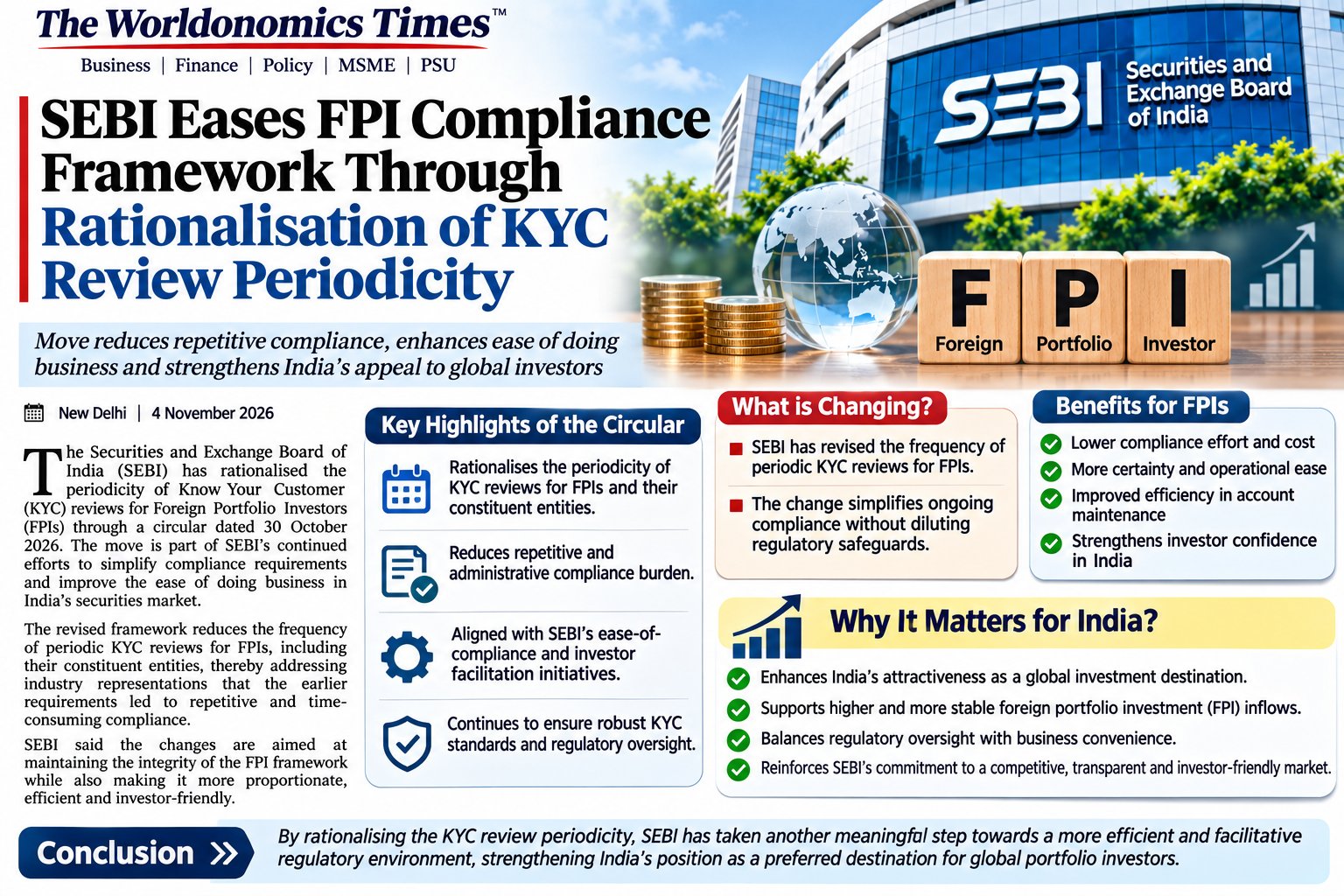
The Securities and Exchange Board of India (SEBI) has introduced significant changes to the Know Your Customer (KYC) review requirements for Foreign Portfolio Investors (FPIs), extending the review periodicity from one year to two years and from three years to eight years for specified categories of investors. The revised framework will come into effect from December 1, 2026.
Through its circular dated October 30, 2026, titled Rationalisation of Periodicity of KYC Review for FPIs, SEBI has taken steps to reduce repetitive compliance requirements and simplify the regulatory framework governing foreign investors participating in India’s securities market.
The decision is part of the regulator’s broader efforts to promote Ease of Doing Business, reduce administrative requirements and make India’s investment environment more efficient and accessible to global investors.
The changes also include discontinuation of the separate requirement for FPIs to intimate changes in previously submitted information or provide a no-change declaration at the time of continuation of registration.
KYC Review Periodicity Extended to Two and Eight Years
Under the earlier framework, FPIs were subject to periodic KYC reviews annually or once every three years, depending on their category, jurisdiction and regulatory status.
SEBI has now revised the review schedule based on the investor’s FPI category, the risk classification of its jurisdiction and whether the investor is a regulated entity.
The revised framework provides for KYC reviews every two years or eight years for the specified categories.
The revised periodicity is summarised below:
| Jurisdiction | Category I FPI | Category II FPI |
|---|---|---|
| High-risk | Every 8 years for entities registered under Regulation 5(a)(i); others every 2 years | Every 2 years |
| Non-high-risk | Every 8 years | Regulated entities: every 8 years; others: every 2 years |
The revised arrangement introduces a differentiated approach to KYC reviews, allowing certain regulated foreign investors and investors from non-high-risk jurisdictions to benefit from longer review cycles.
For other specified categories, the review requirement will remain every two years.
Separate Change-Intimation Requirement Discontinued
Another important feature of the revised framework is the removal of the separate requirement to intimate changes in previously furnished information or submit a no-change declaration at the time of continuance of registration.
Earlier, FPIs, other than those investing exclusively in government securities, were required to intimate changes in information submitted earlier or provide a no-change declaration when continuing their registration.
SEBI has now dispensed with this additional requirement as part of its efforts to rationalise overlapping compliance obligations.
The move is expected to reduce repetitive documentation and administrative work for foreign investors and their designated depository participants.
However, this change should not be interpreted as a general exemption from applicable disclosure and information-update obligations under the FPI regulatory framework.
Registration Continuation: Fee Payment Requirement
While simplifying the KYC and information-confirmation requirements, SEBI has retained the registration continuation fee mechanism.
FPIs wishing to continue their registration for the subsequent block of three years must pay the applicable fee to their Designated Depository Participant (DDP).
For investors registered under the SWAGAT-FI framework, the subsequent registration block remains ten years.
The circular further requires FPIs to pay the continuation fee at least 15 days before the expiry of their existing registration validity. This requirement is intended to facilitate a smooth continuation process and minimise the possibility of delays.
Special Treatment for Government Securities and SWAGAT-FI Investors
SEBI has retained the existing KYC review arrangements for two specific categories.
Government Securities-only FPIs (GS-FPIs): Their KYC review periodicity will continue to follow the requirements applicable to their respective bank accounts, as prescribed by the Reserve Bank of India (RBI).
SWAGAT-FI FPIs: The existing ten-year KYC review periodicity will remain unchanged.
These provisions ensure that the revised framework does not disturb the existing special arrangements applicable to these investor categories.
Responsibilities of Depositories, Custodians and DDPs
The revised framework will also require operational changes by market infrastructure institutions and intermediaries.
SEBI has advised depositories, custodians and Designated Depository Participants to make the necessary changes in their systems and processes to implement the revised requirements.
They are also required to communicate the changes to the concerned FPIs.
DDPs play an important role in the registration, documentation and regulatory compliance processes of foreign portfolio investors. Consequently, updating internal systems, compliance calendars and KYC monitoring mechanisms will be essential for the smooth implementation of the revised framework.
The corresponding KYC review timelines in the Investor Charter for Designated Depository Participants have also been revised.
Why the Decision Matters for Foreign Investors
Foreign Portfolio Investors play an important role in India’s capital markets by contributing to equity and debt investments, supporting market liquidity and participating in the country’s financial growth.
However, frequent documentation requirements and repetitive compliance procedures can increase operational costs for global investment institutions.
By extending the KYC review intervals for specified categories, SEBI aims to make the compliance process more proportionate and efficient.
The revised framework may offer several practical benefits:
- Reduced compliance costs: Longer review intervals can reduce repetitive documentation and verification exercises.
- Improved operational efficiency: Foreign investors and intermediaries can allocate fewer resources to recurring KYC reviews.
- Greater regulatory clarity: A category-based framework provides a more structured approach to compliance.
- Ease of doing business: Simplified procedures can make participation in India’s securities market more convenient.
- Improved investor experience: Reduced administrative requirements can support smoother interactions between FPIs, custodians and DDPs.
The changes are particularly relevant for global institutional investors managing investments across multiple jurisdictions, where different documentation and verification requirements can create operational complexities.
Balancing Ease of Compliance with Regulatory Oversight
While the revised framework provides longer KYC review intervals, maintaining transparency and regulatory oversight remains essential.
Foreign investments involve cross-border transactions, multiple ownership structures and different regulatory jurisdictions. Regulators must therefore maintain appropriate mechanisms to identify beneficial ownership, monitor compliance and address potential risks.
SEBI’s revised approach seeks to balance these objectives by differentiating review requirements according to investor classification and jurisdictional risk.
The longer review period for specified categories does not remove the need to comply with other applicable regulatory requirements.
Effective Date: December 1, 2026
The provisions of SEBI Circular No. HO/19/34/14(10)2026-AFD-POD3/I/24814/2026, dated October 30, 2026, will become effective from December 1, 2026.
Depositories, custodians and DDPs will need to complete the necessary system and process modifications before implementation.
FPIs should also review their existing registration validity, applicable KYC review timelines and continuation fee obligations to ensure a smooth transition.
A Step Towards a More Investor-Friendly Capital Market
SEBI’s decision to rationalise KYC review periodicity represents another step towards simplifying India’s foreign investment compliance framework.
By reducing repetitive verification requirements and discontinuing a separate information-confirmation requirement at the time of registration continuation, the regulator has sought to improve operational convenience for global investors.
For India, attracting foreign capital requires not only strong economic opportunities but also a predictable, transparent and efficient regulatory environment.
The revised FPI KYC framework reflects an effort to achieve this balance while retaining the essential safeguards of the securities market.
As India continues to strengthen its position as an international investment destination, regulatory simplification and efficient compliance mechanisms will remain important factors in encouraging long-term foreign investor participation.
The Worldonomics Times | Banking, Finance & Capital Markets