New Delhi | 4 November 2026
The Securities and Exchange Board of India (SEBI) has signed a Memorandum of Understanding (MoU) with the Digital India BHASHINI Division (DIBD) to strengthen access to securities-market services and information in regional Indian languages. The agreement, signed on 3 November 2026, marks an important step towards making India’s capital markets more accessible to investors across different linguistic backgrounds.
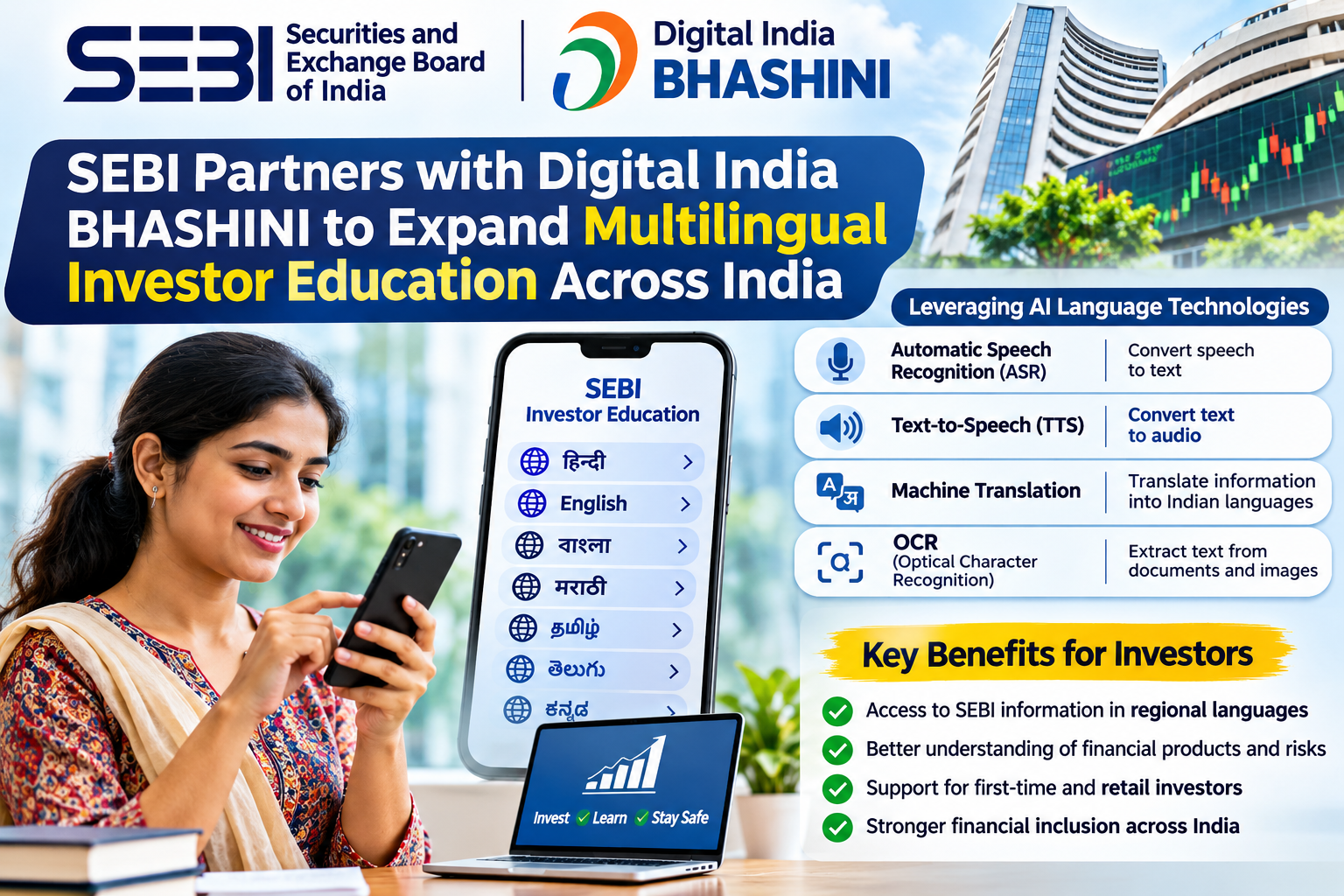
Under this collaboration, SEBI will leverage BHASHINI’s artificial intelligence-powered language technologies, including Automatic Speech Recognition (ASR), Text-to-Speech (TTS), Machine Translation and Optical Character Recognition (OCR). These technologies are expected to facilitate wider access to SEBI’s services through regional Indian languages and improve the availability of market-related information for citizens.
Technology to Bridge the Language Gap in Financial Markets
India has a large and diverse population, with investors belonging to different linguistic, educational and geographical backgrounds. While digital platforms have expanded access to financial services, understanding complex securities-market terminology, investment disclosures and regulatory information can remain challenging for individuals who are more comfortable communicating in their regional languages.
The SEBI-BHASHINI partnership seeks to address this language barrier by using advanced language technologies. Through machine translation, written information can be made available in different Indian languages, while speech recognition and text-to-speech tools can support voice-based access to information.
Optical Character Recognition can also help convert text contained in scanned documents and images into machine-readable formats, supporting digital accessibility and information processing.
The initiative could help make regulatory information, investor education resources and other SEBI-related services easier to understand and access.
Specialised Financial Terminology to Strengthen Language Models
An important aspect of the agreement is the proposed enhancement of BHASHINI’s language models with securities-market-related terminology.
Financial and investment communication involves specialised expressions such as equity shares, mutual funds, derivatives, initial public offerings, demat accounts, market risks, investment disclosures and regulatory compliance. Direct translation of these terms without appropriate financial context may create confusion among investors.
The collaboration is expected to help improve the handling of securities-market terminology within BHASHINI’s language models. This can support more contextually relevant multilingual communication and improve the quality of translated financial information.
For investors, the availability of understandable information is an important factor in making informed financial decisions.
Four Key AI Technologies Supporting the Initiative
The collaboration will enable SEBI to utilise four important categories of BHASHINI language technologies:
- Automatic Speech Recognition (ASR): Converts spoken communication into text, potentially supporting voice-based investor interaction and information access.
- Text-to-Speech (TTS): Converts written information into spoken audio, helping investors access educational and regulatory content through voice.
- Machine Translation: Enables conversion of information from one language to another, supporting multilingual access to securities-market services.
- Optical Character Recognition (OCR): Extracts text from scanned documents and images, helping make information available in digital and searchable formats.
Together, these technologies can contribute to a more accessible digital information ecosystem for India’s securities market.
Significance for Retail Investors and Financial Inclusion
The partnership has potential significance for first-time investors, individuals from smaller cities, rural communities and people who prefer receiving information in their mother tongue.
Investor participation requires more than access to trading platforms. Individuals also need to understand investment products, associated risks, regulatory safeguards and the importance of dealing with authorised market intermediaries.
Multilingual investor education can help communicate these concepts to a wider audience. It may also support awareness initiatives relating to fraudulent investment schemes, misleading stock-market recommendations and the importance of verifying information before investing.
For regulators, technology-enabled multilingual communication can provide an additional channel for reaching investors and improving public awareness.
However, machine translation of financial and regulatory information must maintain accuracy, consistency and appropriate contextual meaning. Investor-facing material will continue to require suitable verification and quality controls, particularly where technical terminology and legal disclosures are involved.
Role of Digital India BHASHINI Division
The Digital India BHASHINI Division functions under Digital India Corporation, a Section 8 not-for-profit company established under the Ministry of Electronics and Information Technology (MeitY).
BHASHINI is a national initiative focused on developing and deploying AI-powered language technologies to reduce linguistic barriers in digital services. Its technology infrastructure supports multilingual communication and the development of language resources for different sectors.
The collaboration with SEBI adds another important institutional application of multilingual AI technology in India’s financial ecosystem.
A Step Towards More Inclusive Capital Markets
India’s securities market is undergoing rapid digital transformation, with growing participation from retail investors and increasing use of online investment platforms. In this environment, accessible and understandable information is essential for building investor awareness and confidence.
The SEBI-BHASHINI MoU represents an institutional effort to combine financial-market regulation with India’s developing multilingual digital infrastructure.
The success of this initiative will depend on the practical deployment of these technologies, the quality of translations and the extent to which investors can access and understand the resulting services.
For India’s capital markets, reducing language barriers could become an important part of expanding financial awareness and encouraging more informed participation. The partnership also demonstrates how artificial intelligence can be applied beyond business automation to support public access to essential financial information.
The Worldonomics Times | Banking, Finance & Capital Markets