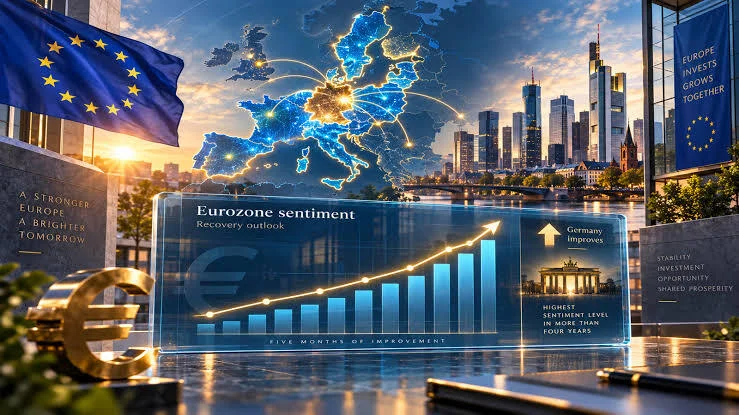
The European Central Bank is facing growing pressure to consider further interest-rate increases as inflation accelerates across the eurozone. Rising energy prices, geopolitical uncertainty and concerns about persistent price pressures are forcing policymakers to balance price stability against the risk of slowing economic growth.
The European Central Bank (ECB) is approaching another important monetary policy decision as inflation concerns return to the centre of Europe’s economic debate. After keeping interest rates unchanged at its October 29 meeting, the central bank has indicated that further tightening remains possible if incoming economic data justify action.
The renewed debate comes at a challenging time for the eurozone. Higher energy costs, geopolitical disruptions and uncertainty surrounding international trade are putting pressure on businesses and households. Policymakers must determine whether these price increases are temporary or whether they could spread into wages, services and broader economic activity.
The ECB’s decisions will have important consequences not only for European economies but also for international financial markets and emerging economies connected to European trade and investment.
Inflation Moves Further Above the ECB Target
Eurozone inflation has accelerated in recent months, increasing pressure on the central bank to maintain a restrictive monetary policy.
According to Eurostat’s November 4 flash estimate, annual inflation in the euro area reached 4.0% in October 2026, up from 3.8% in September. This represents a significant increase above the ECB’s medium-term inflation target of 2%.
Energy was the biggest contributor to the increase. Annual energy inflation reached 20.8% in October, compared with 18.9% in September. Services inflation also increased slightly to 3.3%.
These figures highlight the influence of international energy markets on Europe’s domestic economy.
Higher oil and gas prices increase transportation, electricity and manufacturing expenses. Businesses facing higher operating costs may eventually pass these increases on to consumers, creating additional inflationary pressure.
The ECB is particularly concerned about the possibility that temporary energy-related inflation could become embedded in the wider economy.
ECB Keeps Interest Rates Unchanged in October
At its October 29 meeting, the ECB’s Governing Council decided to maintain its three key interest rates unchanged.
The deposit facility rate remained at 2.50%, the main refinancing operations rate at 2.65%, and the marginal lending facility rate at 2.90%.
The decision reflected the central bank’s assessment that underlying inflation had remained broadly stable, while wage developments had not yet demonstrated a significant response to higher energy costs.
However, the ECB warned that a larger and longer-lasting energy shock could increase inflation while weakening economic growth.
The central bank also emphasised that financing conditions had tightened, which could already be weighing on economic activity.
Its approach remains data-dependent, meaning future decisions will depend on incoming inflation figures, economic performance and evidence of wider price pressures.
December Rate Hike Debate Gains Attention
Although the ECB did not raise rates in October, the possibility of another increase has become an important topic among European policymakers.
On November 5, ECB President Christine Lagarde said the central bank would examine incoming economic indicators to determine whether a rate increase could be necessary at its December meeting.
Several policymakers have also indicated that further tightening may be justified if inflation remains elevated or begins spreading through the economy.
The central concern is the possibility of second-round inflation effects. These occur when higher energy and production costs influence wage negotiations, business pricing decisions and consumer expectations.
If these effects become widespread, inflation may remain high even after the original energy shock begins to ease.
However, raising interest rates too aggressively could weaken investment, consumption and employment.
Energy Crisis Creates a Difficult Policy Choice
Europe’s inflation challenge is closely connected to geopolitical developments and disruptions in international energy supplies.
The continuing Middle East conflict has increased uncertainty surrounding oil and gas markets, creating additional pressure on European energy costs.
For energy-importing economies, higher international prices can increase import bills, weaken trade balances and reduce household purchasing power.
Manufacturing industries are particularly exposed because energy represents an important component of production expenses.
The ECB therefore faces a complicated situation: higher energy prices are pushing inflation upwards while simultaneously threatening economic growth.
Monetary policy can reduce demand and prevent inflation expectations from becoming entrenched, but it cannot directly increase energy supplies or resolve geopolitical disruptions.
This makes the timing and size of any additional rate increase especially important.
Impact on Businesses, Consumers and Financial Markets
A further ECB rate increase could have significant consequences across the European economy.
Households with variable-rate mortgages and other floating-rate loans may face higher repayment costs. New borrowers could also encounter more expensive housing and consumer finance.
Businesses may experience increased costs when borrowing to expand production, purchase equipment or finance working capital.
Small and medium-sized enterprises could be particularly affected because they often depend heavily on bank financing.
Financial markets would also respond to changes in interest-rate expectations. Bond yields, euro exchange rates, equity valuations and international investment flows could all experience adjustments.
For emerging economies, changes in European monetary policy may influence capital movements and the relative attractiveness of international investment opportunities.
Economic Growth Remains a Major Concern
The ECB must consider the wider economic consequences of tightening monetary policy.
Higher interest rates can help control inflation by reducing borrowing and spending, but excessive tightening may weaken economic activity.
European manufacturers already face challenges from international competition, expensive energy and changing global trade conditions.
A further increase in financing costs could discourage business investment and delay expansion plans.
The central bank must therefore distinguish between inflation caused by strong domestic demand and inflation driven primarily by external supply disruptions.
A carefully calibrated approach will be essential to prevent price instability without creating unnecessary economic weakness.
The Worldonomics Times View
The ECB’s growing rate-hike dilemma highlights the difficult choices facing central banks in an increasingly interconnected global economy.
In our view, the biggest challenge for European policymakers is that inflation is being driven substantially by external energy pressures rather than solely by excessive domestic demand. This limits the effectiveness of interest-rate increases as a solution.
However, allowing inflation expectations to rise unchecked could create more persistent economic problems, making timely policy action important.
We believe the ECB should maintain a cautious, data-driven approach rather than commit prematurely to a particular interest-rate path. Policymakers must carefully assess wage growth, underlying inflation, energy prices and economic activity before taking further action.
European governments also need to complement monetary policy with measures that strengthen energy security, diversify supply sources and improve industrial competitiveness.
For businesses and investors, the current environment reinforces the importance of financial planning, cost management and careful assessment of borrowing risks.
Our position is clear: price stability and sustainable economic growth must remain equally important priorities. An effective monetary policy should control inflation without unnecessarily weakening Europe’s productive capacity.
Ultimately, the ECB’s success will depend on its ability to respond to changing economic conditions while maintaining confidence in the eurozone’s financial system. The coming policy decisions will be closely watched by businesses, investors and governments around the world.