By The Worldonomics Times | Global Economy
Date: 3 November 2026
European Economic Activity Remains Resilient Amid Inflationary Pressures, Geopolitical Tensions and Uncertain Global Trade Conditions
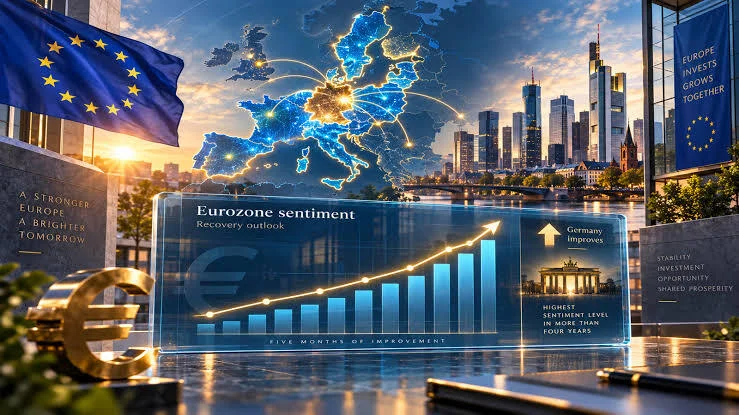
The eurozone economy recorded moderate growth of 0.4% in the third quarter of 2026, demonstrating resilience despite higher energy prices, geopolitical tensions and continuing uncertainty in international markets. According to the preliminary flash estimate released by Eurostat on October 30, economic activity across the 21-country euro area continued to expand, although at a slower pace than during the previous quarter.
The latest figures indicate that the eurozone economy grew by 0.6% in the second quarter of 2026 before moderating to 0.4% in the July–September period. Compared with the third quarter of 2025, the region’s GDP increased by 1.3%.
The European Union as a whole performed slightly better, recording quarterly growth of 0.5% and annual growth of 1.5%. The figures suggest that Europe’s economy has maintained positive momentum despite significant external challenges, although the pace of expansion remains relatively modest.
Economic Growth Continues Despite External Pressures
The eurozone’s economic performance is particularly noteworthy given the difficult international environment. Higher energy prices, disruptions to supply chains and geopolitical instability have increased operating costs for European businesses.
The ongoing conflict in the Middle East has contributed to uncertainty in international energy markets, raising concerns about the availability and affordability of oil and gas. Since many European industries depend on energy-intensive production processes, sustained increases in energy prices can affect manufacturing costs, transportation expenses and overall business profitability.
European companies are also navigating changing international trade conditions, uncertain demand and increased competition in global markets. These factors have created additional pressure on industrial production and business investment.
Despite these challenges, continued household spending, business activity and investment have helped support economic expansion across the region.
Performance Varies Across Major European Economies
The third-quarter figures reveal significant differences in economic performance among European countries.
Ireland recorded the strongest quarterly growth among the countries included in the preliminary estimate, with GDP expanding by 5.5%. However, Eurostat cautioned that Ireland’s figure is experimental and particularly affected by multinational enterprise activity, making it less representative of underlying domestic economic conditions.
Spain and the Netherlands both recorded growth of 0.6%, while Estonia also expanded by 0.6%. Germany, Europe’s largest economy, recorded moderate growth of 0.2%, indicating a gradual improvement but continuing challenges for its industrial sector.
France experienced a contraction of 0.1%, while Italy’s economy remained unchanged compared with the previous quarter. Lithuania also recorded a decline of 1.0%.
These differences demonstrate that economic recovery across Europe remains uneven. Countries with stronger domestic demand and relatively resilient service sectors have generally performed better, while economies facing industrial weakness and political or fiscal uncertainty continue to experience difficulties.
Higher Energy Prices Remain a Major Concern
Energy costs continue to be one of the most important factors influencing Europe’s economic outlook. Higher prices for oil, natural gas and electricity can affect nearly every major industry, from manufacturing and transportation to agriculture and retail.
For European manufacturers, increased energy expenses can reduce profit margins and make products more expensive in international markets. Businesses may respond by reducing production, delaying investment or transferring additional costs to consumers.
Households are also affected through higher heating, electricity and transportation expenses. When a larger share of household income is spent on essential costs, consumer spending on other goods and services may decline.
Inflation has added to these challenges. Eurozone inflation reached 3.8% in September 2026, moving further above the European Central Bank’s medium-term target of 2%. Persistent inflation could make it more difficult for the central bank to support economic activity through lower borrowing costs.
European Central Bank Faces a Difficult Balancing Act
The European Central Bank (ECB) must carefully balance the need to control inflation with the objective of maintaining economic stability.
Higher interest rates can reduce borrowing and spending, helping to moderate demand-driven inflation. However, expensive credit can also discourage business investment, weaken housing activity and place pressure on households with loans.
The ECB therefore faces a difficult policy environment. If energy prices continue rising and inflation spreads into wages and other services, policymakers may need to maintain restrictive monetary conditions or consider further interest rate increases.
On the other hand, excessive monetary tightening could weaken an economy that is already recording relatively modest growth.
The central bank’s future decisions will depend on inflation developments, wage trends, energy market conditions and the overall strength of economic activity.
Implications for Global Trade and India
Europe remains one of the world’s most important economic and trading regions. Its economic performance has direct implications for international manufacturers, exporters and investors.
For India, moderate eurozone growth presents both opportunities and challenges. Europe is an important destination for Indian exports, including pharmaceuticals, textiles, engineering goods, chemicals, automobiles and information technology services.
Continued economic expansion could support demand for Indian products and services. However, if higher energy costs and inflation weaken European consumer spending, exporters may face slower demand and increased price competition.
Indian companies with operations or customers across European markets will also need to monitor currency movements, borrowing costs and changes in consumer demand.
At the same time, Europe’s investment in renewable energy, infrastructure, digital technology and industrial modernisation could create opportunities for Indian businesses seeking stronger international partnerships.
The Worldonomics Times Views
The eurozone’s 0.4% growth in the third quarter demonstrates that Europe’s economy remains resilient, but it also highlights the limitations of the current recovery. Positive GDP growth should not be mistaken for a complete economic turnaround, particularly when inflation, energy costs and industrial challenges continue to affect businesses and households.
In our view, Europe’s long-term economic strength will depend on its ability to reduce energy vulnerabilities, improve industrial competitiveness and encourage productive investment. Greater diversification of energy supplies and faster development of renewable energy infrastructure can help reduce exposure to international price shocks.
We also believe that European governments should focus on strengthening domestic manufacturing, supporting small and medium-sized enterprises and improving cross-border trade and investment.
For India, the development reinforces the importance of maintaining diversified export markets and building stronger economic partnerships with Europe. International cooperation in technology, clean energy, pharmaceuticals and manufacturing could create long-term opportunities for both regions.
The Worldonomics Times believes that sustainable European growth will require more than short-term economic expansion; it will depend on stronger industrial foundations, affordable energy and greater resilience against global disruptions.
Conclusion
The eurozone’s 0.4% economic growth in the third quarter of 2026 reflects a moderate but positive performance amid significant global challenges. Although the region has avoided an overall contraction, the slowdown from the previous quarter and uneven performance across major economies highlight the fragility of its recovery.
Higher energy prices, persistent inflation and geopolitical uncertainty are likely to remain important influences on Europe’s economic outlook. The coming months will test the ability of governments and the European Central Bank to maintain price stability while supporting investment and employment.
For international businesses and trading partners such as India, Europe’s economic direction will remain an important factor shaping global demand, investment decisions and trade opportunities.