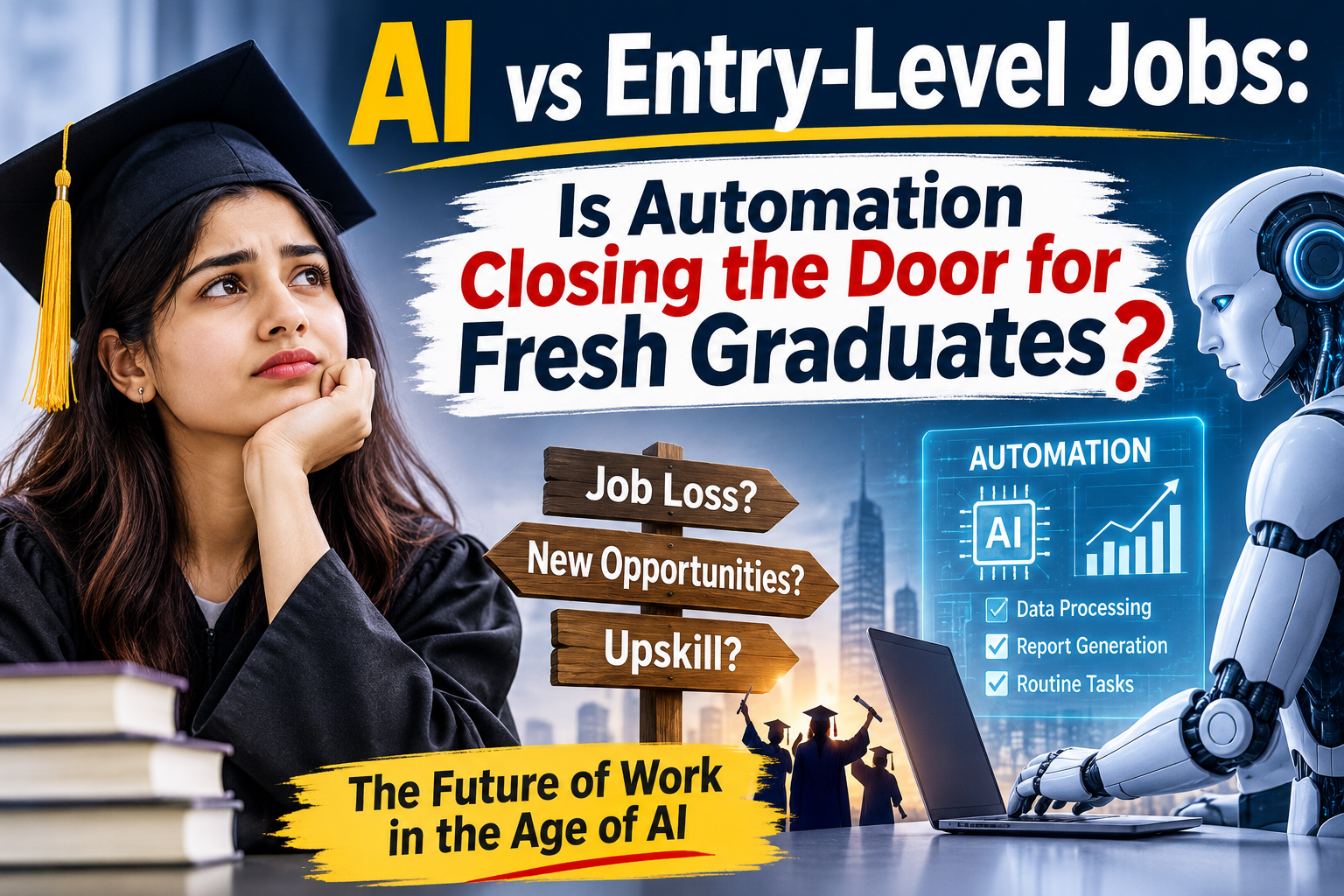
As artificial intelligence transforms workplaces, fresh graduates face a changing job market where companies increasingly value specialised skills, technological adaptability and productivity over traditional entry-level qualifications.
Introduction
For decades, entry-level jobs have served as the starting point of professional careers. Fresh graduates entered organisations as trainees, junior executives, assistants and analysts, gradually developing the skills required for higher responsibilities.
However, Artificial Intelligence (AI) is changing this traditional career pathway.
Tasks that once required teams of junior employees can now be completed faster with AI-powered tools. From preparing financial reports and analysing spreadsheets to processing invoices, screening applications and handling customer queries, automation is increasingly taking over routine responsibilities.
This raises an important question: If AI can perform the tasks traditionally assigned to fresh graduates, where will the next generation of professionals gain its first work experience?
The Changing Reality of Entry-Level Employment
The concern is no longer limited to technological industries. AI is influencing recruitment across finance, accounting, banking, administration, customer service and business operations.
In India, the impact is becoming increasingly visible in the IT and IT-enabled services sector.
A 2026 study by the Indian Council for Research on International Economic Relations (ICRIER), covering approximately 650 IT firms, found that businesses adopting generative AI were moderating hiring, particularly at the entry level. At the same time, 63% of surveyed firms reported increased demand for candidates combining domain expertise with AI or data skills.
The underlying shift is significant: companies increasingly expect fewer employees to accomplish more with technology.
Consequently, the traditional fresher recruitment model is evolving. Employers are becoming more selective, prioritising candidates who can contribute from the beginning rather than requiring extensive training.
Which Entry-Level Jobs Are Most Vulnerable?
AI is particularly effective at handling repetitive, rule-based and data-intensive activities.
Some functions facing considerable transformation include:
| Industry | Traditional entry-level tasks affected |
|---|---|
| Accounting & Finance | Invoice processing, bookkeeping, reconciliations and routine reporting |
| Banking | Data entry, transaction processing and basic customer support |
| Human Resources | Resume screening, interview scheduling and documentation |
| Administration | Record keeping, report preparation and routine correspondence |
| IT & Software | Basic coding, documentation and repetitive testing |
| Customer Service | Standard queries, complaint classification and automated responses |
This does not mean these professions will disappear. Rather, the number of employees required for certain routine activities may decline as automation improves.
The World Economic Forum’s Future of Jobs Report 2025 also identifies clerical and administrative occupations, including data-entry clerks and bank tellers, among roles expected to experience significant declines by 2030.
The Accounting and Finance Sector: A Clear Example
The accounting profession provides an interesting example of how AI is changing entry-level responsibilities.
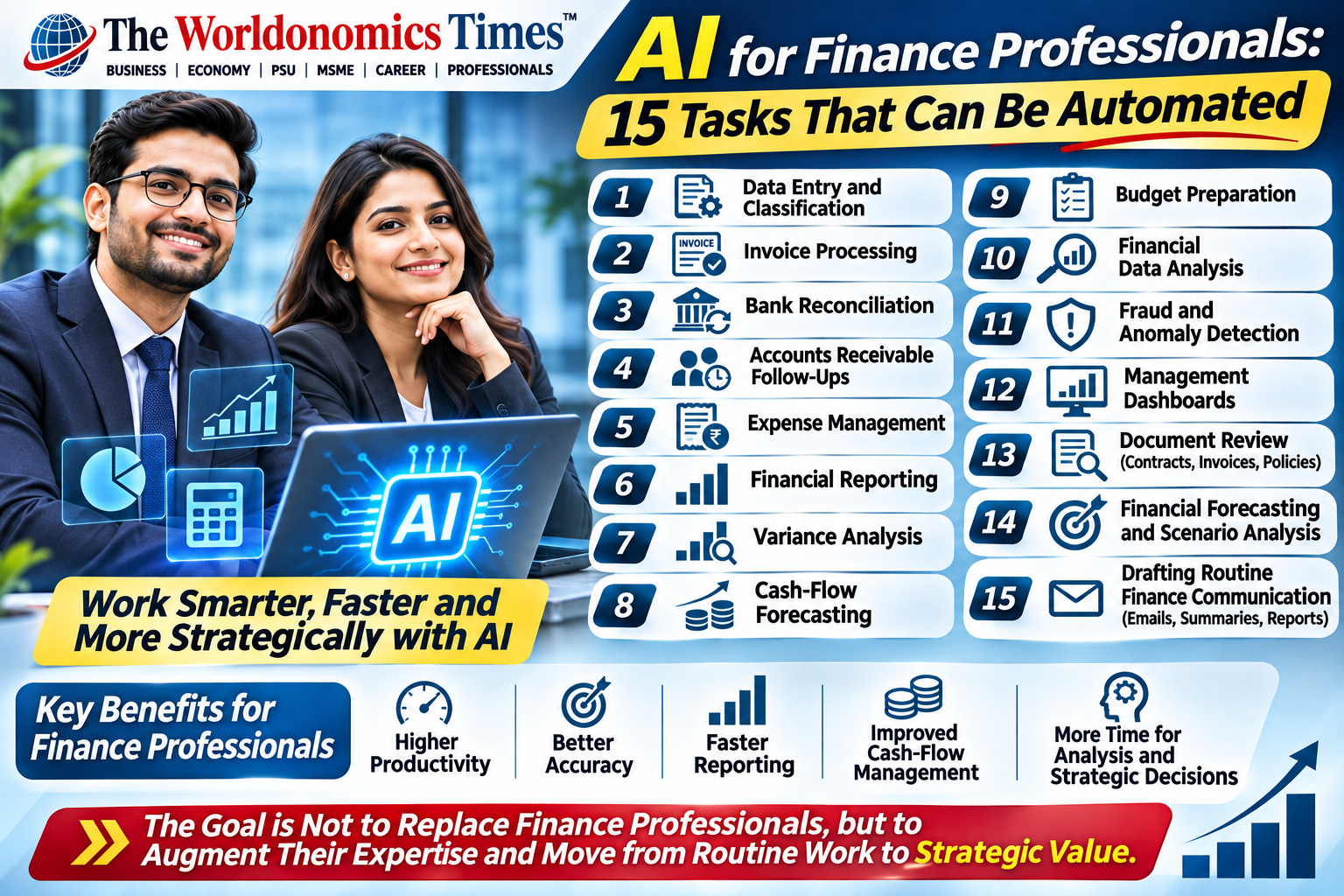
Traditionally, fresh graduates entered finance departments by performing tasks such as:
- Recording daily financial transactions.
- Preparing bank reconciliations.
- Processing invoices and payments.
- Maintaining accounts payable and receivable.
- Assisting with GST documentation.
- Preparing basic MIS reports.
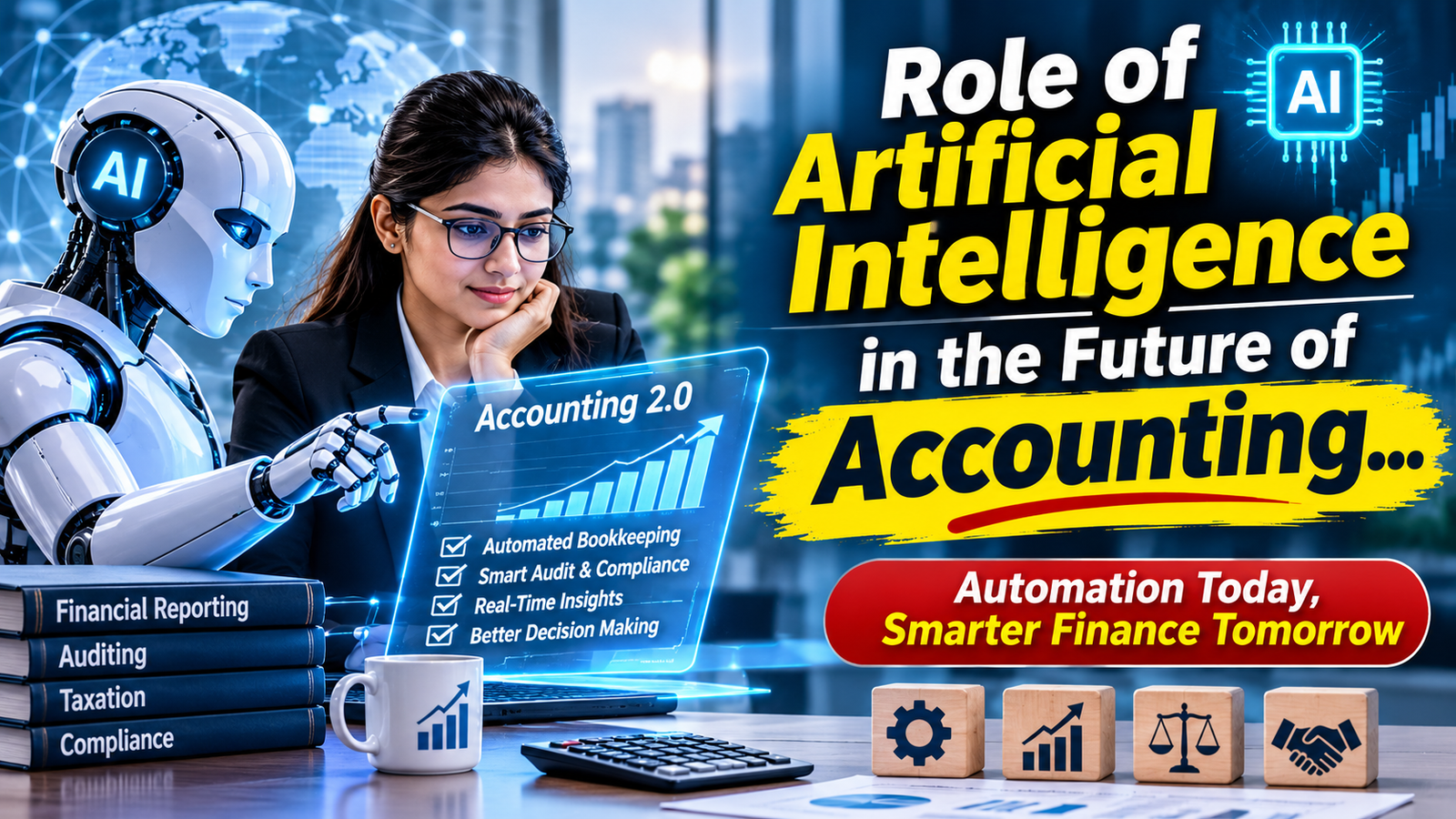
Today, accounting software, automation platforms and AI-powered applications can perform or assist with several of these activities.
However, finance is not simply about recording transactions. It also requires interpreting financial information, identifying discrepancies, understanding taxation, evaluating business performance and ensuring regulatory compliance.
AI can generate a financial report, but professional judgement is still required to assess whether the numbers are accurate, meaningful and compliant with applicable regulations.
This creates an opportunity for graduates who combine accounting knowledge with technological capabilities.
The future finance professional will increasingly need to understand both financial fundamentals and digital tools.
Is AI Eliminating Opportunities or Changing the Skills Required?
The broader employment evidence suggests that AI is transforming jobs rather than simply eliminating entire professions.
According to the International Labour Organization’s 2025 research update on generative AI, approximately one in four workers globally is employed in an occupation with some degree of exposure to generative AI. However, most occupations are expected to undergo transformation rather than complete replacement because human involvement remains necessary.
India’s campus recruitment landscape also reflects this changing reality.
Deloitte India’s Campus Workforce Trends 2026 reported that:
- 86% of surveyed organisations said AI or Agentic AI was transforming recruitment processes.
- 35% reported that AI adoption was creating new entry-level roles or skill requirements, compared with 21% in FY25.
- Campus recruitment budgets increased by 19%.
- AI and data skills attracted hiring premiums of approximately 20–25%.
These findings reveal an important distinction: opportunities are not necessarily disappearing everywhere, but the requirements for accessing them are changing.
The Growing Challenge for Fresh Graduates
One of the biggest concerns is the weakening of the traditional learning pathway.
Previously, companies hired fresh graduates, trained them in basic operational activities and gradually prepared them for more complex responsibilities.
AI is increasingly performing some of those foundational tasks.
This creates a potential experience paradox:
Companies want experienced candidates, but fresh graduates need entry-level opportunities to gain that experience.
If organisations reduce junior hiring without creating alternative training opportunities, graduates may find it increasingly difficult to enter the corporate workforce.
The challenge is particularly important in a country like India, where a large number of graduates enter the employment market every year.
A degree may demonstrate academic knowledge, but employers increasingly look for practical capabilities, industry exposure and the ability to work with modern technology.
What Should Fresh Graduates Do?
The solution is not to compete against AI but to learn how to work alongside it.
Graduates need to move beyond theoretical qualifications and develop a combination of technical knowledge and practical skills.
1. Develop AI literacy
Learn how to use AI tools for research, data analysis, documentation and productivity. Understanding their limitations is equally important.
2. Strengthen domain expertise
Accounting graduates should understand taxation, financial reporting, auditing and compliance. Management graduates should develop business analysis and decision-making capabilities.
3. Improve analytical thinking
Employers need professionals who can interpret information, identify problems and make informed decisions rather than simply generate reports.
4. Gain practical exposure
Internships, project-based assignments, industry training and practical case studies can help bridge the gap between academic learning and workplace expectations.
5. Develop communication and problem-solving skills
Professional communication, critical thinking, adaptability and judgement remain important capabilities in technology-driven workplaces.
The World Economic Forum identifies analytical thinking, resilience, flexibility, technological literacy and AI-related capabilities among the important skills shaping the future workforce.
What Should Employers and Educational Institutions Do?
The responsibility cannot rest entirely on graduates.
Organisations must recognise that entry-level recruitment is also an investment in their future workforce.
Reducing junior hiring may improve short-term operational efficiency, but companies also need a sustainable pipeline of trained professionals.
Employers should consider structured graduate training programmes, apprenticeships, internship-to-employment pathways and opportunities for graduates to work alongside experienced professionals.
Educational institutions must also strengthen industry-oriented learning by incorporating practical projects, digital tools, financial technologies and real-world business applications into their curricula.
The objective should be to produce graduates who are not only academically qualified but also professionally prepared.
Conclusion: The Door Is Changing, Not Necessarily Closing
Artificial Intelligence is undoubtedly changing the employment landscape, and fresh graduates are among those experiencing its early effects.
Routine work is becoming automated, traditional junior responsibilities are evolving, and employers are increasingly looking for candidates with a combination of professional knowledge and technological capabilities.
However, the rise of AI does not necessarily signal the end of opportunities for young professionals.
It signals a transition towards a different employment model—one where adaptability, analytical thinking, practical knowledge and the ability to use technology effectively will become increasingly important.
The real concern should not be whether AI can perform the work of a fresh graduate. It should be whether businesses are creating enough opportunities for graduates to learn, develop and become experienced professionals.
After all, today’s fresh graduates are tomorrow’s experienced workforce. If the entry-level career ladder disappears, who will be prepared to occupy the leadership positions of the future?