Introduction
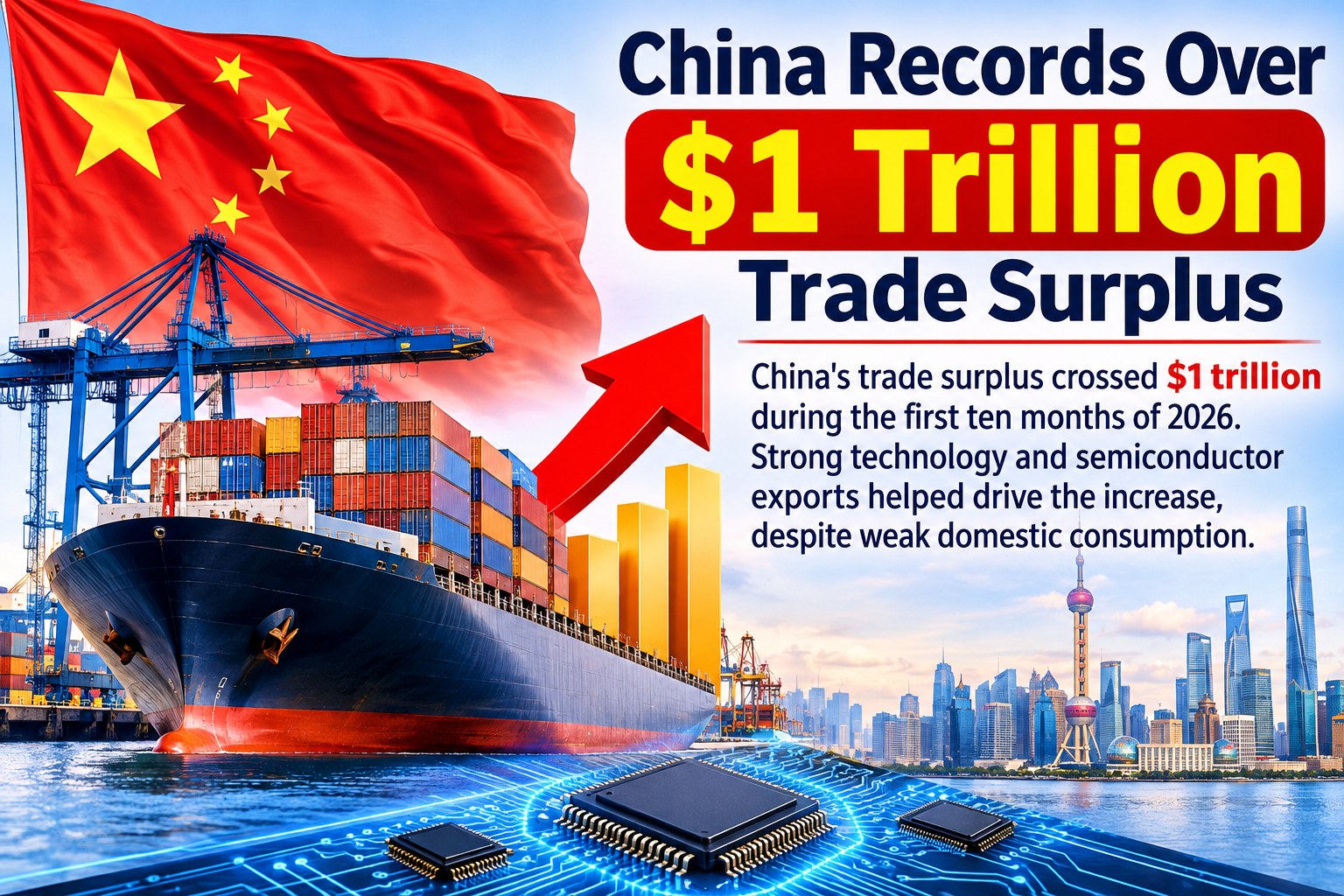
China has achieved a significant milestone in international trade, recording a trade surplus of approximately $1.04 trillion during the first ten months of 2026. The achievement reflects the country’s growing strength in global manufacturing, technology and semiconductor exports, supported by rising international demand for artificial intelligence (AI)-related products.
Despite continued weakness in domestic consumption and challenges in the property sector, China’s export performance has provided an important source of economic growth. The latest figures highlight the country’s increasing influence in global supply chains while raising questions about international trade imbalances, economic competition and the sustainability of export-driven growth.
Technology and Semiconductor Exports Drive Growth
One of the biggest contributors to China’s expanding trade surplus has been the rapid growth of technology exports. Increasing global investment in artificial intelligence infrastructure, data centres and advanced computing systems has created substantial demand for semiconductors, electronic components, computer equipment and networking products.
According to China’s customs data, semiconductor exports increased significantly during the first ten months of 2026. Exports of integrated circuits rose by 111.1% in US dollar value, while high-tech product shipments increased by 47.9% compared with the corresponding period last year.
The global expansion of AI technology has created new opportunities for Chinese manufacturers. Companies involved in electronics, chip production, industrial equipment and advanced manufacturing are benefiting from international demand.
Beyond semiconductors, China’s exports of electric vehicles, lithium batteries and solar-related products have also strengthened its position in international markets. These developments indicate that China’s manufacturing industry is gradually expanding beyond traditional low-cost goods towards higher-value technology products.
Weak Domestic Consumption Remains a Concern
Although China’s export performance has been impressive, its domestic economy continues to face significant challenges. Consumer spending remains relatively weak, while the prolonged property-sector downturn has affected household confidence and investment activity.
Many Chinese households remain cautious about spending because of uncertainty surrounding employment, property values and future economic conditions. This has created difficulties for businesses that depend heavily on domestic consumers.
As a result, manufacturers are increasingly looking towards international markets to maintain production levels, generate revenue and support business expansion.
The dependence on overseas demand, however, creates an economic imbalance. Strong exports can support employment and industrial production, but they cannot completely replace the importance of healthy domestic consumption.
For sustainable long-term growth, China will need to strengthen household purchasing power, improve consumer confidence and encourage greater domestic investment.
Growing Trade Surplus Raises International Concerns
China’s expanding trade surplus is also attracting attention from major trading partners, particularly the United States and European Union.
A large trade surplus indicates that a country exports significantly more goods than it imports. While this reflects international competitiveness, persistent trade imbalances can create concerns among trading partners about market access, industrial competition and manufacturing dependence.
European manufacturers have expressed concerns about the growing presence of Chinese products in sectors such as automobiles, batteries and renewable energy.
Similarly, trade relations between Washington and Beijing remain sensitive because of tariffs, technology restrictions and competition for strategic industries.
The possibility of additional trade barriers could become a major challenge for Chinese exporters in 2027. Increased tariffs or restrictions could affect international sales, disrupt supply chains and create uncertainty for manufacturers operating across borders.
Implications for the Global Economy
China’s trade performance has significant implications for the global economic landscape. As one of the world’s largest manufacturing and exporting economies, changes in Chinese production and export activity can influence international commodity prices, supply chains and industrial competition.
Countries importing Chinese machinery, electronic components, batteries and consumer products may benefit from competitive pricing and improved access to technology.
At the same time, domestic manufacturers in other countries could face stronger competition from Chinese companies, particularly in industries where production capacity is expanding rapidly.
Emerging economies may experience both opportunities and challenges. Greater access to affordable Chinese technology can support infrastructure development and industrial modernisation. However, increased competition could put pressure on local manufacturing industries.
What It Means for India
For India, China’s growing trade surplus presents both opportunities and strategic challenges.
Indian industries depend on imports of several Chinese products, including electronic components, machinery, chemicals and industrial equipment. Competitive pricing and greater availability of these products can support manufacturing activities and infrastructure development.
However, India’s domestic manufacturers must also prepare for stronger international competition, particularly in electronics, electric vehicles, solar equipment and battery manufacturing.
The situation creates an opportunity for India to strengthen its domestic production capabilities through manufacturing incentives, research and development, technological innovation and improved infrastructure.
Reducing excessive dependence on imported components while developing competitive export industries will be important for India’s long-term economic ambitions.
The Road Ahead: Can China Maintain Its Export Momentum?
China’s export performance is expected to remain influenced by global technology investment, international consumer demand and developments in trade relations.
The continuing expansion of AI infrastructure could support demand for semiconductors, computers and electronic components. However, any slowdown in global technology investment could affect export growth.
Another major concern is the possibility of increasing protectionism. Countries facing competitive pressure from Chinese manufacturers may introduce additional trade restrictions to protect domestic industries.
China will therefore need to balance its export ambitions with efforts to strengthen domestic consumption and establish more sustainable economic growth.
The Worldonomics Times Views
China’s achievement of a trade surplus exceeding $1 trillion demonstrates the strength and competitiveness of its manufacturing and technology industries. Its growing presence in semiconductor exports, electric vehicles and advanced electronics reflects a major transformation in global industrial competition.
However, a strong trade surplus should not be considered the only measure of economic success. Sustainable growth requires a healthy balance between exports, imports, domestic consumption and investment.
China must focus on strengthening household demand while maintaining its technological progress and international competitiveness. Meanwhile, other economies, including India, should view China’s growing export strength as both a competitive challenge and an opportunity to accelerate domestic industrial development.
Ultimately, the future of global trade will depend on cooperation, fair competition and balanced economic policies. China’s $1 trillion trade surplus is not merely a national economic achievement; it is a development that could reshape international trade relationships and influence the direction of the global economy in the years ahead.