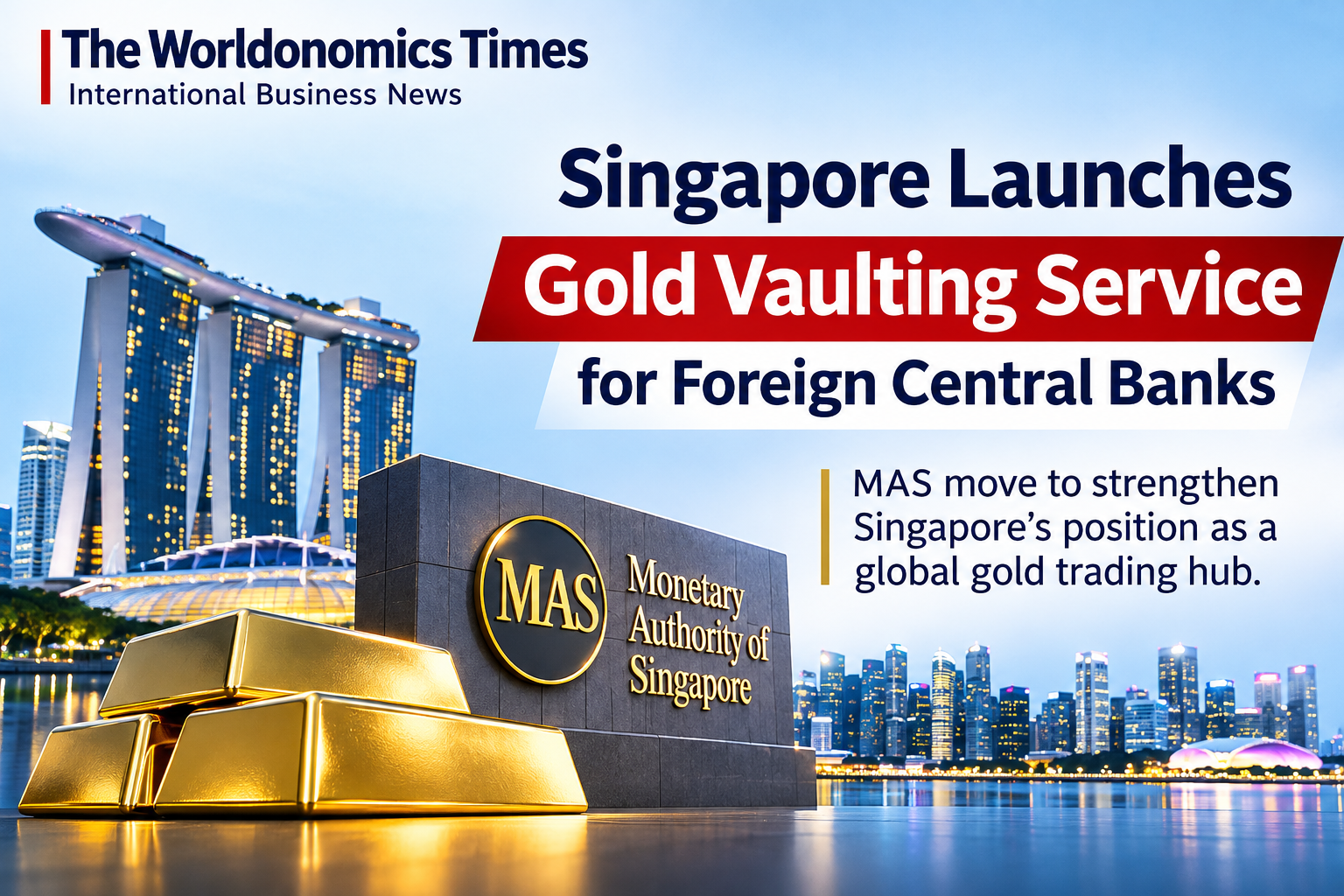
Singapore, 11 November 2026: Singapore has taken a significant step towards strengthening its position as an international precious-metals trading and financial centre with the launch of a dedicated gold vaulting service for foreign central banks and sovereign institutions by the Monetary Authority of Singapore (MAS).
The initiative, officially launched on 10 November 2026, will allow foreign central banks, international financial institutions and sovereign entities to securely store their gold reserves in Singapore. The service is designed to attract institutional gold holdings, strengthen confidence in Singapore’s financial infrastructure and improve access to gold-market liquidity during Asian trading hours.
The announcement also includes an enhanced Goods and Services Tax (GST) framework for wholesale investment precious metals activities, developed jointly by MAS and Singapore’s Ministry of Finance.
MAS National Vault to Offer Storage Capacity of 500 Tonnes
Under the new arrangement, gold deposited by eligible institutions will be stored in Singapore’s national currency vault, which has a current storage capacity of up to 500 tonnes of gold, with the possibility of expansion depending on future demand.
The facility will provide allocated gold custody, meaning that specific gold bars will be assigned to individual customers and recorded separately. The arrangement is intended to provide institutional customers with secure ownership records, reliable custody services and efficient access to their gold holdings.
MAS will also offer gold custody accounts to selected Singapore-based bullion banks with the expertise and experience required to provide gold-related services and trading liquidity to foreign central banks and other eligible institutions.
The service complements Singapore’s existing commercial gold storage infrastructure, which has a capacity exceeding 2,000 tonnes and serves bullion banks, institutional investors and high-net-worth individuals.
According to Singapore’s Deputy Prime Minister and MAS Chairman Gan Kim Yong, growing uncertainty in the international environment has increased demand for gold as a reserve asset. Central banks and investors are increasingly looking for diversification and resilience in their reserve management strategies.
He also clarified that Singapore aims to provide an additional option for central banks rather than replace established international gold trading centres.
Rising Demand for Gold Reserves Drives the Initiative
Gold continues to play an important role in the reserve management strategies of central banks worldwide. Its perceived value as a long-term store of wealth and diversification asset has encouraged monetary authorities to review their gold holdings and storage arrangements.
Geopolitical uncertainties, fluctuations in international currencies, concerns about financial stability and changing global economic conditions have further strengthened institutional interest in gold.
Singapore believes its established reputation as a stable, well-regulated international financial centre can help attract institutions seeking secure and efficient locations for their precious-metal reserves.
The new service will also help connect physical gold storage with trading, settlement and other financial services. This could encourage more institutional gold-related activities to take place within Singapore.
Enhanced GST Framework to Support Wholesale Gold Market
Alongside the gold vaulting initiative, MAS and the Ministry of Finance have announced an enhanced GST framework designed to support wholesale investment precious metals activities.
Under the proposed framework, specified wholesale services between eligible institutional participants will receive GST relief. These services include:
- Gold vaulting and custody services.
- Gold refining and recasting.
- Gold assaying and testing.
- Institutional gold broking services.
The initiative builds on Singapore’s existing GST measures for investment precious metals, which already provide exemptions for qualifying imports and local supplies.
The enhanced framework is intended to reduce tax-related costs and improve cash-flow efficiency for institutional participants involved in wholesale gold transactions.
The new framework is expected to take effect from April 2027, with further details scheduled to be announced during Singapore’s Budget 2027.
Singapore Exchange to Introduce Gold Clearing System in 2027
Another important component of Singapore’s gold market development strategy is the proposed over-the-counter (OTC) gold clearing system being developed by Singapore Exchange (SGX) Group in collaboration with six founding clearing banks.
The participating institutions are:
- DBS Bank
- Deutsche Bank
- ICBC Standard Bank
- JPMorgan
- OCBC
- United Overseas Bank (UOB)
Industry testing of the clearing system has been completed, and the participating institutions are working towards finalising the operational framework and rulebook.
Live trading and market operations are expected to commence in the first quarter of 2027.
The system is expected to support institutional transactions involving large gold bars and kilobars, improving the efficiency of clearing and settlement in the regional gold market.
Separately, SGX is targeting the launch of physically deliverable Gold Kilobar Futures in the second quarter of 2027. This product is expected to provide additional opportunities for price discovery, hedging and risk management.
Singapore Strengthens Competition with Established Gold Centres
The initiative positions Singapore more prominently in the international gold ecosystem alongside established centres such as London, Switzerland, Dubai, Hong Kong and Shanghai.
While London and New York remain important centres for global gold trading and price discovery, Singapore aims to strengthen the availability of institutional services during Asian trading hours.
The combination of secure storage facilities, bullion banking services, tax incentives, clearing infrastructure and gold-linked financial products could make Singapore a more attractive destination for international gold market participants.
Singapore is not seeking to replace existing gold centres. Instead, its strategy is to act as an additional trusted financial hub connecting Asian gold demand with international markets and liquidity providers.
Economic and Financial Sector Implications
The expansion of gold-related infrastructure could create new business opportunities across several segments of Singapore’s financial services industry.
Potential beneficiaries include bullion banks, precious-metal traders, financial institutions, logistics companies, vault operators, refining businesses and professional service providers.
The development could also generate demand for specialised skills in commodities trading, financial risk management, custody operations, regulatory compliance and international settlement services.
For Singapore, the initiative represents more than an expansion of physical gold storage capacity. It is part of a broader strategy to attract high-value financial activities and diversify the country’s international financial services ecosystem.
Conclusion
Singapore’s launch of a central bank gold vaulting service marks an important development in its ambition to become a leading international precious-metals trading centre.
With a 500-tonne national vault, enhanced GST arrangements from April 2027 and a new gold clearing system expected to begin operations in 2027, Singapore is building the infrastructure required to attract global institutional participation.
As central banks increasingly focus on reserve diversification and secure asset custody, Singapore’s combination of financial stability, regulatory credibility and market connectivity could strengthen its role in the evolving global gold market.
The Worldonomics Times | International Business & Finance