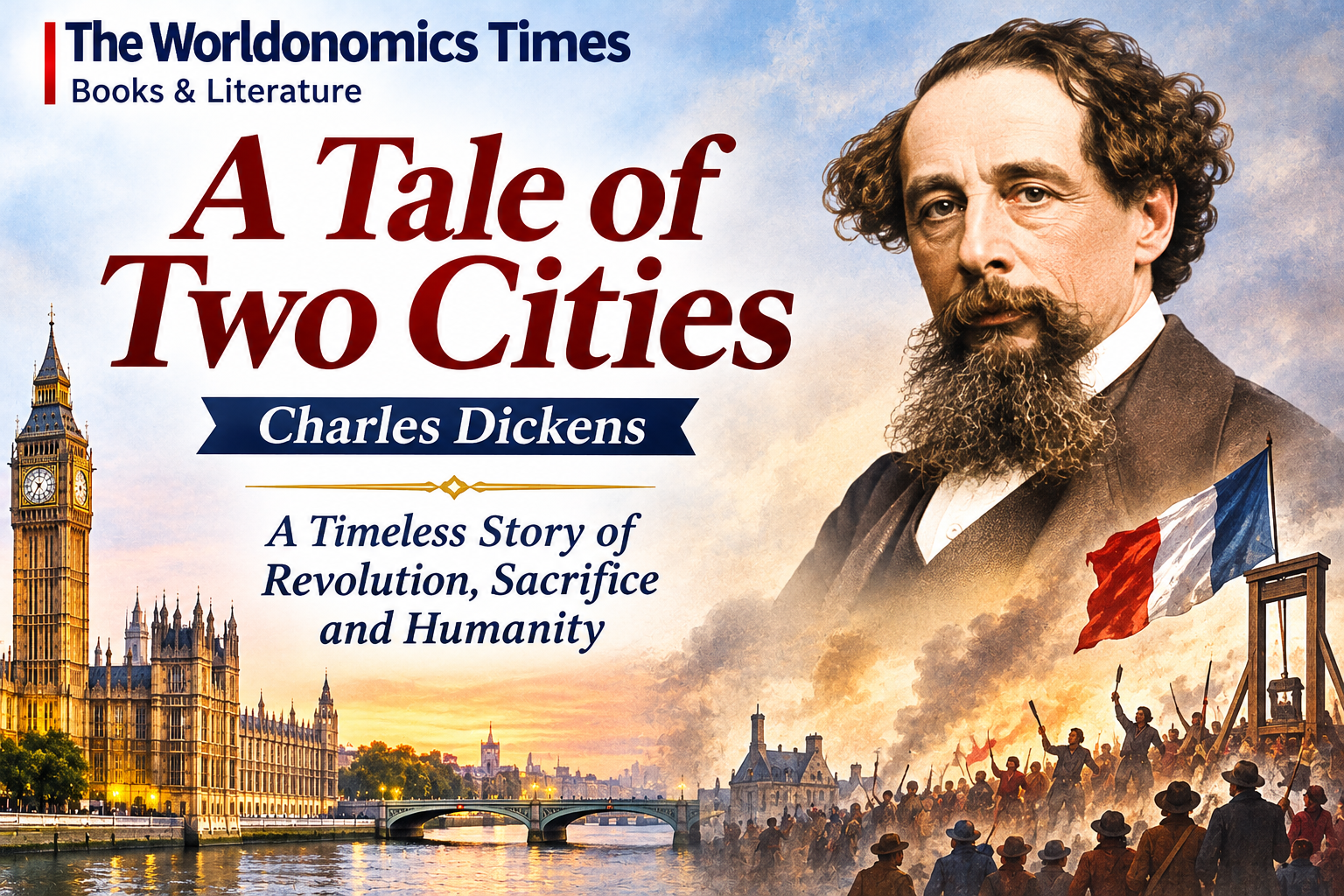
By The Worldonomics Times Editorial Desk
Few novels in the history of English literature have achieved the lasting popularity and cultural significance of A Tale of Two Cities by Charles Dickens. First published in 1859, the historical novel explores the French Revolution, social inequality, political oppression, personal sacrifice and the human desire for justice.
Beginning with its famous opening contrast between the best and worst of times, the novel takes readers into two major European cities—London and Paris—during one of the most turbulent periods in modern history.
With its powerful storytelling, memorable characters and emotional conclusion, A Tale of Two Cities has remained one of the most widely read and recognised works of English literature.
About the Book
A Tale of Two Cities – Dua Book Palace
A Tale of Two Cities
- Author: Charles Dickens
- First published: 1859
- Genre: Historical fiction
- Setting: London and Paris
- Historical background: French Revolution
- Language: English
The novel was originally published in weekly instalments in Dickens’s periodical All the Year Round. It subsequently became one of his most celebrated literary works.
The story is set against the background of the French Revolution, which began in 1789 and transformed France’s political and social structure.
Historical Background: The French Revolution
To understand the importance of A Tale of Two Cities, it is essential to understand the historical circumstances in which its story takes place.
Before the French Revolution, French society was deeply divided into social classes. The aristocracy and clergy enjoyed significant privileges, while ordinary people faced heavy taxation, poverty, food shortages and limited political representation.
Growing public anger against inequality and royal authority eventually contributed to the revolution.
The storming of the Bastille in July 1789 became a powerful symbol of resistance against the monarchy. However, the revolution also witnessed widespread violence, political executions and the Reign of Terror.
Dickens uses this historical period to explore how injustice and oppression can create conditions for revolutionary violence—and how the pursuit of justice can itself become destructive when driven by revenge.
Plot Summary: Two Cities, Two Different Worlds
The novel begins in 1775, introducing London and Paris as cities experiencing political and social uncertainty.
One of the central characters is Dr Alexandre Manette, a French physician who has spent eighteen years imprisoned in the Bastille. Following his release, he is reunited with his daughter, Lucie Manette, in London.
Lucie becomes an important emotional centre of the story. Her kindness, compassion and devotion influence the lives of several other characters.
The narrative introduces Charles Darnay, a French aristocrat who rejects the privileges and injustices associated with his family background. He falls in love with Lucie and eventually marries her.
Another major character is Sydney Carton, an English lawyer who struggles with disappointment, alcoholism and a sense of wasted potential. Although he initially appears cynical and emotionally detached, his character develops into one of the most memorable examples of personal sacrifice in literature.
As the French Revolution intensifies, Darnay returns to France to help someone in danger. However, his aristocratic family connections make him vulnerable to revolutionary justice.
He is arrested and faces execution.
His fate brings together the lives of Dr Manette, Lucie, Sydney Carton and several other characters in a dramatic conclusion.
Major Characters and Their Significance
1. Sydney Carton
Sydney Carton is arguably the most powerful character in the novel. Initially presented as a disappointed and self-destructive individual, he gradually discovers a deeper purpose in life.
His final decision to sacrifice himself for another person demonstrates the possibilities of redemption, courage and unconditional love.
2. Charles Darnay
Charles Darnay represents an individual who rejects inherited privilege and attempts to live according to his own moral principles.
His experiences highlight the dangers of collective punishment and the difficulty of escaping the consequences of historical injustice.
3. Lucie Manette
Lucie symbolises compassion, loyalty and emotional strength. Her influence brings stability and hope to people experiencing personal and political turmoil.
4. Dr Alexandre Manette
Dr Manette represents the human consequences of political oppression. His imprisonment leaves lasting psychological scars, showing that injustice can damage individuals long after their physical freedom is restored.
5. Madame Defarge
Madame Defarge represents revolutionary anger and the desire for revenge. Her character demonstrates how personal suffering and historical injustice can turn into an overwhelming pursuit of retaliation.
Major Themes of the Novel
1. Justice Versus Revenge
One of the central themes of the novel is the distinction between justice and revenge.
The French Revolution begins with demands for equality, freedom and justice. However, as violence increases, revolutionary authorities begin punishing individuals based on their social backgrounds and family associations.
Dickens highlights how the pursuit of revenge can reproduce the very injustice that originally inspired resistance.
2. Sacrifice and Redemption
Sydney Carton’s transformation provides the novel’s strongest message about personal sacrifice.
His final act suggests that a person’s worth is not determined entirely by past mistakes but also by the choices they make.
The theme of redemption gives the novel its emotional and philosophical depth.
3. Social Inequality
Dickens presents a society in which economic and political privileges are concentrated among a small section of the population.
The suffering of ordinary French citizens illustrates how extreme inequality can weaken social stability and generate political unrest.
4. Love and Human Compassion
Lucie Manette’s relationships with her family and friends demonstrate the importance of compassion during periods of conflict.
The novel suggests that love and human connection can provide hope even when society is experiencing violence and uncertainty.
5. The Destructive Power of Oppression
Through the experiences of Dr Manette and the French population, Dickens explores the long-term consequences of political oppression.
The novel suggests that societies ignoring injustice risk creating conditions for instability and revolution.
Why Is A Tale of Two Cities Still Relevant Today?
Although the novel is set during the eighteenth-century French Revolution, its themes remain relevant to contemporary society.
Economic inequality, political polarisation, institutional accountability, social justice and the misuse of political power continue to influence countries around the world.
The book also provides an important lesson for leaders and policymakers: institutions must protect fairness and public trust if they are to maintain long-term stability.
For students of economics, history, political science and literature, the novel offers an opportunity to understand the relationship between economic inequality, social dissatisfaction and political transformation.
It also reminds readers that justice should not be confused with revenge and that compassion remains important even during periods of social conflict.
Literary Significance and Global Popularity
Charles Dickens’s storytelling combines historical events with personal relationships, moral questions and emotional drama.
The novel’s memorable characters and exploration of universal human experiences have helped it remain popular across generations.
Its influence extends beyond literature into theatre, cinema, television and popular culture.
Its enduring popularity has also made it a regular part of discussions about the world’s most widely read and commercially successful novels.
Conclusion: A Novel That Transcends Time
A Tale of Two Cities is much more than a historical account of the French Revolution. It is a powerful exploration of human behaviour, social inequality, political justice, forgiveness and sacrifice.
Through the contrasting experiences of London and Paris, Charles Dickens demonstrates how societies can be transformed by injustice, anger and the pursuit of political change.
The novel’s greatest message lies in its exploration of human redemption and the importance of compassion.
More than a century and a half after its publication, the book continues to encourage readers to reflect on the responsibilities of individuals, institutions and governments in building a fairer society.
The Worldonomics Times | Books, Literature & Knowledge