By The Worldonomics Times Editorial Desk
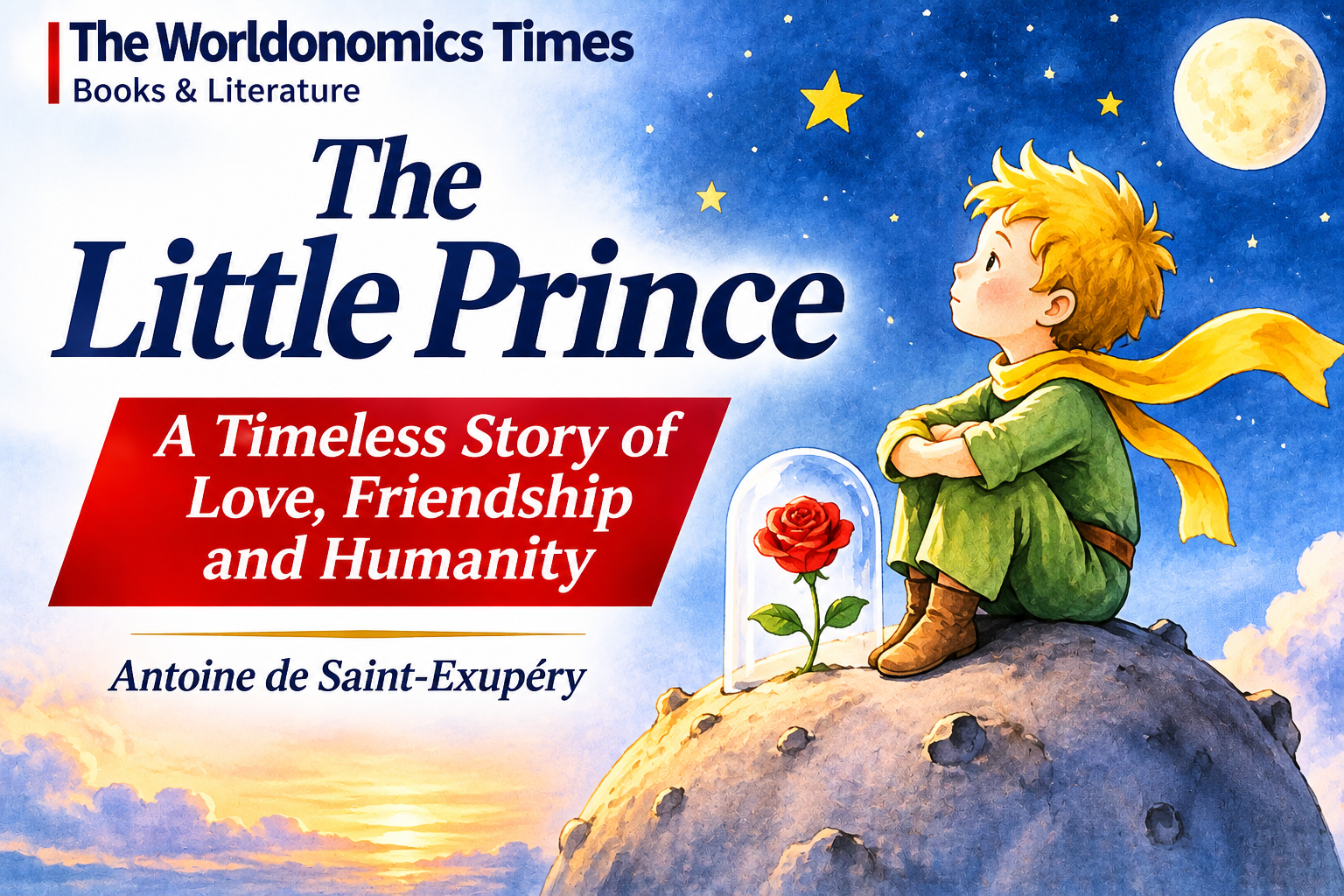
Some books entertain readers, some educate them, and a few transform the way people understand life. The Little Prince, written by French author and aviator Antoine de Saint-Exupéry, belongs to the third category. First published in 1943, this beautifully illustrated novella has become one of the most celebrated works of world literature.
At first glance, the book appears to be a simple children’s story about a young prince travelling between planets. However, beneath its charming illustrations and imaginative storytelling lies a profound exploration of love, friendship, loneliness, responsibility, human relationships and the meaning of life.
Through the journey of a little prince, the author encourages readers to look beyond material possessions, social status and superficial appearances and rediscover the values that make human life meaningful.
About the Book
The Little Prince (Le Petit Prince) was written and illustrated by Antoine de Saint-Exupéry and first published in 1943 in New York, during the Second World War.
The book was originally written in French and later translated into hundreds of languages and dialects, making it one of the most widely translated literary works in the world.
| Book details | Information |
|---|---|
| Title | The Little Prince |
| Original title | Le Petit Prince |
| Author | Antoine de Saint-Exupéry |
| First published | 1943 |
| Genre | Philosophical novella / Children’s literature |
| Original language | French |
| Main themes | Love, friendship, responsibility and humanity |
Although commonly classified as children’s literature, the book appeals equally to adults because of its philosophical observations about society and human behaviour.
The Story: A Journey Across Planets
The story begins with an aviator whose aircraft crashes in the Sahara Desert. While attempting to repair his aeroplane, he encounters a mysterious young boy who introduces himself as the Little Prince.
The boy asks the aviator to draw a sheep, beginning an unusual friendship between two individuals from very different worlds.
As their conversations develop, the aviator learns that the Little Prince comes from a tiny planet known as Asteroid B-612.
The prince lives alone on his small planet, where he takes care of three volcanoes and removes harmful baobab plants before they grow too large and damage his home.
His life changes when a beautiful rose appears on his planet. The prince becomes deeply attached to the flower but struggles to understand its behaviour. Confused by the rose’s pride and complicated expressions of affection, he eventually decides to leave his planet and explore the universe.
During his journey, he visits several planets, each inhabited by an adult whose behaviour represents a particular aspect of human society.
These encounters gradually teach him important lessons about relationships, responsibility and the limitations of adult thinking.
The Six Planets and Their Lessons
One of the most interesting features of the novel is the Little Prince’s journey across different planets.
Each planet introduces a character who symbolises a particular human weakness.
1. The King – The Desire for Power
The first planet is occupied by a king who believes that he has authority over everything.
His character represents the human desire for power and control, even when that authority has little practical meaning.
2. The Vain Man – The Desire for Recognition
The second planet contains a man who wants everyone to admire him.
He represents vanity and the human tendency to seek appreciation and approval from others.
3. The Drunkard – The Cycle of Escape
The third planet belongs to a drunkard who drinks to forget the shame of drinking.
This character illustrates the destructive cycle of denial and escapism.
4. The Businessman – Obsession with Possessions
The fourth planet is occupied by a businessman who spends his time counting stars and claiming ownership over them.
He represents materialism and the endless pursuit of wealth and possessions without understanding their real purpose.
5. The Lamplighter – Duty and Responsibility
The fifth planet contains a lamplighter whose responsibility is to light and extinguish a lamp.
Although his planet rotates rapidly, he continues performing his duty.
His character highlights commitment, discipline and responsibility.
6. The Geographer – Knowledge Without Experience
The sixth planet belongs to a geographer who records information about the world but does not explore it himself.
He represents the limitations of theoretical knowledge when it is disconnected from direct experience.
Through these encounters, the author encourages readers to question the priorities that dominate adult life.
The Rose: A Symbol of Love and Responsibility
The rose is one of the most important symbols in the novel.
Although the Little Prince initially believes that his flower is difficult to understand, his journey gradually teaches him the importance of emotional attachment.
He discovers that his rose is special not because it is the only flower in existence, but because of the time, care and affection he has invested in it.
The rose represents love, relationships and the responsibilities that accompany emotional connections.
The story suggests that genuine relationships require patience, understanding, commitment and care.
The Fox: The Meaning of Friendship
One of the most memorable sections of the book is the Little Prince’s meeting with a fox.
The fox introduces him to the idea of forming meaningful relationships through time, trust and emotional connection.
The prince learns that friendship cannot be created instantly. It develops through shared experiences, patience and mutual understanding.
The fox also teaches him that responsibility comes with emotional attachment.
This encounter helps the prince understand why his rose is so important to him.
The lesson remains relevant in modern society, where people often have numerous social connections but may struggle to develop meaningful relationships.
Major Themes of The Little Prince
1. Love and Emotional Responsibility
The book explains that love is not merely an emotion. It also involves responsibility, understanding and commitment.
2. Friendship and Human Connection
The relationship between the prince and the fox demonstrates that genuine friendship requires time and emotional investment.
3. Materialism Versus Meaningful Living
Through the businessman and other characters, the author questions society’s obsession with wealth, ownership, status and recognition.
4. Childhood and Imagination
The novel contrasts the imagination and curiosity of children with the rigid thinking often associated with adults.
It encourages readers to preserve their curiosity and ability to appreciate simple things.
5. Loneliness and the Search for Meaning
The prince’s journey reflects the human search for belonging, understanding and emotional fulfilment.
Why The Little Prince Remains Relevant Today
More than eight decades after its publication, The Little Prince continues to connect with readers across generations and cultures.
In today’s world, people often measure success through financial achievements, professional positions, social recognition and material possessions.
While these achievements may be important, the novel reminds readers that they do not necessarily guarantee happiness or meaningful relationships.
Its lessons are particularly relevant in an increasingly digital society where communication is easier than ever, but genuine human connection can sometimes become difficult.
For students, professionals, entrepreneurs and business leaders, the book offers an opportunity to reflect on priorities beyond career advancement and financial success.
It encourages individuals to value trust, empathy, responsibility and meaningful relationships.
Global Popularity and Literary Significance
The Little Prince has achieved extraordinary international recognition. It has been translated into hundreds of languages and dialects and has reached readers in countries across the world.
Its popularity has extended beyond books into theatre, cinema, animation, museums and educational programmes.
The book’s illustrations, philosophical ideas and accessible storytelling have helped it remain relevant to both young readers and adults.
Its continued popularity demonstrates that powerful literary ideas do not necessarily require complicated language. Sometimes, simple stories communicate the deepest truths.
Conclusion: A Small Book with a Big Message
The Little Prince is much more than a children’s story about a boy travelling between planets. It is a philosophical reflection on the values that give life meaning.
Through the prince’s encounters with different characters, Antoine de Saint-Exupéry questions the importance society gives to power, wealth, status and recognition.
The book ultimately celebrates love, friendship, responsibility, imagination and human connection.
Its enduring message is that the most valuable things in life are often invisible to the eyes but deeply meaningful to the heart.
For readers of every age, The Little Prince remains a reminder to slow down, appreciate relationships and rediscover the beauty of simple things.
The Worldonomics Times | Books, Literature & Knowledge